Showing posts with label Redditch. Show all posts

Friday, July 3, 2026

The legendary fire that destroyed the original Royal Enfield factory

Fire fighters battle warehouse fire at night.
Fire fighters couldn't save the blazing factory.

 Half a century before Royal Enfield motorcycles were made in India, they were produced in the English industrial midlands, in the town of Redditch, an ancient village that by the 1870s had become the center of the needle and fishing tackle industry. 

Incredibly, it's claimed that Redditch and surrounding districts made 90 percent of the world's needles by the 1870s. (I was amazed when my wife found a circa-1935 packet of Redditch needles in a sewing kit left by the elderly previous owners of our house!) 

From precision engineering of pins and needles grew new technologies, first of bicycles, and then of motorcars and motorcycles.

There's a plaque on the wall of a building on Hewell Road, in Redditch, marking the location of the immense factory that once stood around it, turning out Royal Enfield bicycles and motorcycles by the thousands.

You can see a photo of that building on Jorge Pullin's blog, My Royal Enfields. (Jorge has done a series of articles about Royal Enfield factories in Britain.)

But the Hewell Road factory wasn't the birth place of Royal Enfield. The bicycle and motorcycle company grew out of a building then just outside Redditch, in a building where sewing pins had been made.

Until last week, the site of that original Royal Enfield factory was unmarked. The location is at 196 Enfield Road, in the leafy Redditch district of Hunt End. (Of course the road wasn't originally called "Enfield Road" before the Enfield Cycle Co. located there; it had been called Hunt End Lane, a name since reapplied to a new road in a nearby subdivision.)

Royal Enfield historian Gordon May speaks.
Royal Enfield historian Gordon May relates history of the Hunt End Works before unveiling of the new plaque. Project Origin, a replica of the first Royal Enfield motorcycle, is at left.

World Origin Site placed in place on wall.
The plaque in place.

The new plaque was placed June 21 on the remains of a brick wall said to have surrounded the original factory. The wall is all that's left now. 

That's because the factory burned beyond saving in a dramatic fire on March 8, 1969.

The first factory was built, sometime after 1851, as a needle factory named "Givry Works." The Red Lion pub was on Enfield Road nearby, and may have been associated with the factory: workers likely got part of their pay in tokens for use in the pub. (The pub still stands on Enfield Road.)

Front of the Red Lion pub in Hunt End.
The Red Lion pub saw Royal Enfield come and go next door.

Expanded over time, the Givry Works at Hunt End was producing bicycles by 1888. Those bicycles eventually began being branded as Royal Enfields.

This is where the first Royal Enfield motorcycle would have been assembled, in 1901.

By the Spring of 1904 this factory in Hunt End had added a purpose built-facility, between the original Givry Works and the Red Lion pub, specifically for production of motorcycles and motor cars.

Historical photo of the Givry Works.
The Hunt End Works, circa 1904, with new addition in the foreground.

Despite economic ups and downs, the Enfield Cycle Co. then managed to approve construction of the different, much grander factory, on Hewell Road in Redditch proper.

Royal Enfield would move out of the Hunt End factory in 1907, repurchase it in 1912, and finally vacate it for good in 1920.

The Hunt End Works would go on to serve other businesses, eventually becoming a storage facility for Dunlop Tyres.

Aerial photo of Hunt End factory in 1935.
The Hunt End Works in 1935, when it housed Batteries Limited
Note Red Lion pub at extreme left. (Historic England Photo)

And this sets up the story of former Enfield employee Les "Kipper" Gibbs, who was, by 1969, a Dunlop employee.

In Anne Bradford's book "Royal Enfield, The Story of the Company and the People Who Made It Great," Gibbs told how he was the last worker out of the Dunlop warehouse the Saturday of the fire.

He found it ironic that a former Royal Enfield man was the last one out of the first Royal Enfield factory before it was gone forever.

Whoever told it, the tale gets more colorful yet. According to the RedditchVirtualMuseum:

"One of the caretakers liked a hot lunch so at midday he would take an old tyre up to the top floor, spread it out, put his little stove in the centre and heat his lunch. Unfortunately, one day he went to sleep. When the fire brigade arrived they discovered that all the water pipes in Redditch were (what they described as) Victorian and very narrow, and totally impossible to carry enough water to put out a fire. They had to get water from Redditch."

Newspaper page featuring coverage of fire.
The Redditch Indicator covered the fire.

The Redditch Indicator newspaper captured the blaze in a full-page story the next day, Sunday, March 9, 1969, with photographs. The Redditch Library reproduced the newspaper page in a Facebook post in 2021.

The type is too small to read the Redditch Indicator article in the Facebook post, but an account from the Sunday Birmingham Mercury is online at the British Newspaper Archive, and is readable. Some excerpts:

"At Redditch, in the biggest fire of the day nearly 20,000 car tyres went up in flames at the Dunlop Tyre Company's storage depot. Fifty firemen from all parts of Worcestershire and reinforcements from Warwickshire fought the huge blaze for hours before getting it under control.

"The depot is one of the biggest of Dunlop's 50 storage depots. A huge pall of smoke rose high over Redditch and flames leaping 60 feet into the air could be seen in Birmingham, 16 miles away.

"A Dunlop spokesman said: 'A large number of Mini car tyres are stored at this depot and it may result in temporary shortage of some sizes of tyres for perhaps a week or a fortnight...'

"The fire in the depot at Enfield Road, Hunt End, was discovered just after six o'clock last night. One half of the building was alight when firemen arrived.

Fire fighters silhouetted by flames at factory.
Fire fighters arrived to find the Hunt End Works ablaze.

"The man who gave the alarm, Mr. Samuel Brookes, is the owner of a timber yard next door to the store.

"He said: 'I saw black smoke coming from the roof. After I told the fire brigade I saw the roof rapidly disintegrate as flames shot 60 feet into the air. It was fantastic...'

"Last man to leave the store was the gateman Mr. Edgar Vale who locked up at 12:45 p.m. The night man was not due to report until 7 p.m...

"As fireman fought the blaze people crowded into the street, and traffic jammed the surrounding roads.

"Housewives took cups of tea to the firemen and police were called in to deal with the crowds.

"After a series of muffled explosions from the building, residents in houses near the depot were warned by the police that they might have to be evacuated. But firemen prevented flames threatening their homes."

People crowd sidewalk to get view of fire.
Homes line one side of Enfield Road, across from factory.

The factory site would be cleared, and the modern Hunt End Industrial Estate occupies the space today, behind a tree line, its entrance being not on Enfield Road but off Dunlop Road, to the north.

Yet, in an odd way, a related bit of the Givry Works remains on Enfield Road.

Author Anne Bradford lived at 66 Enfield Road, less than a mile away from the Givry site, and always said that her home was a "replica" of the original Givry Works. In fact, she said this was what inspired her to write about Royal Enfield history.

Illustration of Givry Works, 1869.
The Givry Works needle mill as it appeared in 1869.
66, 64 and 62 Enfield Road, Hunt End.
From left, 66, 64 and 62 Enfield Road as they appeared in 2020.

The resemblance is apparent, if you compare 66, 64 and 62 Enfield Road on Google Streetview to the 1869 illustration of the Givry Works. The side-by-side fronts of the main buildings appear very similar, although not identical.

An explanation for this is in RedditchVirtualMuseum:

"In the 1830s, all the land in the Crabbs Cross area was owned by Farmer Eades. Then he sold a small piece of ground to William Welch to build a needle mill. Welch had a relative who was so taken with the needle mill that he asked Farmer Eades for permission to build an identical mill a bit further along the road. Consequently two identical mills were built, the oldest was Ashberry House, near the top end of Enfield Road (number 66), and the second was Givry Works, halfway along."

Friday, October 7, 2022

Royal Enfield fed wartime works here

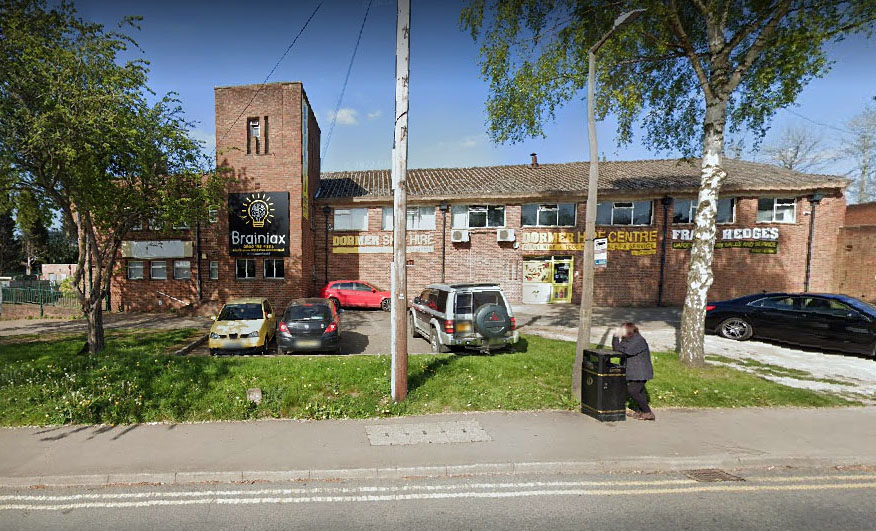
Royal Enfield canteen as it looks today.
Its distinctive tower made Royal Enfield's one-time canteen easy to spot.

 Royal Enfield built a canteen (a cafeteria that is) for its Redditch factory workers during World War II. The plant was working at its capacity and there probably were many more workers on more shifts than in peacetime. 

Obviously it was a necessity, but the fact that the canteen was backed by a sports field (now gone) for employees reveals that sustenance for the body wasn't its only goal. Royal Enfield meant to keep up morale as well. 

Contemporary pictures show an austere but distinctive building, horizontal with a prominent rectangular tower. It was not on the factory grounds. But knowing it must be in easy walking distance, I quickly came across it on Hewell Road, on Google Street View. 

Royal Enfield canteen as it looked when new.
Royal Enfield canteen as it looked when built.

I posted photos on the Royal Enfield Community Facebook page, which is devoted to the memories of those who remember Redditch in the days when it was the headquarters of Royal Enfield and the site of Royal Enfield Factory No. 1. 

Sure enough, some Facebook members recalled it. 

"They held good dances there," Dave Jackson wrote. 

"We had our Christmas Parties in this canteen when our Dad worked at Royal Enfield. Happy times!" said Teresa Twilton.

"Have many happy memories of Xmas parties, and watching and playing cricket and football on the field behind," wrote Tony Wiggett.

Women compete in track events on field.
Royal Enfield conducted an annual field day for its employees.

"If you go inside you can tell (original toilets, sinks, etc.) when it was built. Even the tiles. It's half is Dormer Hire, half is Valhalla gym and when you look around the signs of all the original bits are still there, it's not really been changed. It's definitely that same building," Helen Sanders wrote.

Blogger Jorge Pullin helpfully responded to my plea for information by featuring the Royal Enfield cafeteria building on his My Royal Enfields blog. He reprinted two period architectural descriptions of the building. You can read them in full on his blog.

They make dry but interesting reading and each article includes a floorplan.

An article by Martin Peel in The Architects Journal of Nov. 18, 1943, credits the building with being able to serve 700 people. In the military-industrial language of the day, the building is a "messroom."

Hopefully the food was better than that sounds!

Another article about the building was published in "The Builder" magazine on Sept. 22, 1944. This article credits Francis W.B. Yorke, F.R.I.B.A. as the architect.

According to Columbia University Library, which has his papers, Yorke had a branch office in Redditch and built or restored many inns, farms and country houses. He died in 1957.

The floorplan of his building for Royal Enfield shows a living room, two bedrooms, kitchen and bath on the second floor, reached by a staircase in the "tower" portion of the building. This apartment is for the "caretaker" the article explains. It has a "coal fire" (presumably a fireplace, as the entire building is heated by hot water radiators).

Above the staircase in the tower is the water tank for the building.

Interior of Royal Enfield canteen.
Royal Enfield Canteen interior in 1949.
(Photo from Royal Enfield REVS magazine.)

The original interior of the brick building is easy to picture, with ivory painted walls and blue painted doors and window fames. Floors were linoleum, with stone used in the kitchen and lavatories and wood floors in the caretaker's apartment.

Royal Enfield's female work force greatly expanded for the war, and the floorplans show big restrooms of about equal space for men and women.

The men, of course, have far more stations to use in the restroom but there are two tiny private rooms shown in the women's. One may be to allow a bit of privacy or a chance to lie down (there's room for a cot). The other has no toilet, only a sink and a shelf; it must be a dressing room for women wanting a bit more time with the mirror.

Long, wide, tall (two stories) and wide open, the "Works Mess Room" that occupies most of the building must have been very noisy when full.

Perhaps window treatments absorbed some noise; it's hard to see how the great many windows in that room could effectively be "blacked out" in wartime without them. Maybe they just turned off the lights?

No Executive Dining Room is shown on the plans. If executives ate there, they did it in the same room as everyone else, although they might have had reserved tables.

(In newspaper printing plants where I worked there were reserved tables for pressroom workers who might have ink on their clothes. I wonder if there was something similar here, for those exposed to grease.)

Presumably, the canteen remained in use until Road Enfield ceased operation in Redditch in 1970. Can anyone provide more information?


Friday, August 19, 2016

Redditch family's history tied to Royal Enfield

Royal Enfield sidecar outfit serves with the factory fire brigade.
Three intriguing photographs hit my email recently. One showed a dashing man in uniform riding a Royal Enfield sidecar rig. The sidecar was an enormous box structure.

Another showed the pre-war Royal Enfield factory fire brigade, and the last was the big "Royal Enfield" sign on the roof of the old factory in Redditch, Worcestershire, UK.

The source of the photos was Lynne Andrews, who labelled the email "My Grandad."

Her grandfather, H. Andrews, is second from right in the first row of the fire brigade group photo, which was taken in 1938. Judging by the row of medals on his chest (and the fact that he is seated in the front row) he must have been one of the more experienced brigade members by then.

H. Andrews is second from right, first row, in this 1938 photo of the factory fire brigade.
And that's him, too, on the Royal Enfield sidecar rig, Lynne wrote.

"Yes my grandad Harry Andrews senior is 'modeling' the bike and sidecar...

"Sadly my grandad died when my dad (also Harry Andrews) was 12...

The picture of the roof "was just to show you... the name on the roof (which my dad painted!!!). He was a painter,decorator and sign writer and also worked a short time at the Enfield (factory) like his dad before.

Lynne says her father painted the Royal Enfield sign on the factory roof.
(It's actually set in roof tiles but would have been brightened up with paint.)
"My grandad, grandma, dad and his sister lived in Hewell Road opposite the main entrance of the Royal Enfield factory. I remember staying with them and hearing the 'bull' go off at lunch time. It scared me as a child as I thought it similar to an air raid siren (of which I obviously had never experienced but heard it on films.)"

Lynne said she has lived her whole life in Redditch, and she provided a YouTube link to a lovely home movie of Redditch, shot in the 1960s.

But she wasn't able to provide much more information about her grandfather's connection to the UK home of Royal Enfield.

She did supply a clipping of the obituary for H. Andrews, which verifies he was with the Enfield company fire brigade.

Obituary identifies H. Andrews as a member
of the Enfield Fire Brigade for more than 12 years..
As for the Royal Enfield sidecar outfit, one can only assume it's full of fire fighting equipment.

There is a 1925 photo of a very similar Royal Enfield sidecar outfit on the Internet. Posing with it are women firefighters of the Achille Serre, Ltd. company. This was a large dry cleaning establishment. Like Royal Enfield, it was so large it had its own fire brigade, staffed by women.

Similar Royal Enfield fire fighting outfit
in photo of all-women fire brigade.
The fire-fighting Royal Enfield sidecar rigs appear very similar.

Friday, August 8, 2014

Royal Enfields made in Redditch now on Facebook

Two Royal Enfields unload in Belgium in 1959 for high-speed testing.
Royal Enfield Redditch,  a new Facebook page devoted to Royal Enfields made in England — especially the postwar twins — is already getting interesting.

Carl Best created it to address what he considered a lack of Facebook offerings for the original Royal Enfields, made in Redditch (and elsewhere) in England. Production ended there by 1970 but admiration for the motorcycles lives on.

The new site will make its mission "Celebrating the English made Royal Enfields, especially the twin-cylinder models."

By way of introduction, he writes that "the ads in Cycle World magazine in 1967 and '68 for the series 1A Interceptors were what inspired my interest in Royal Enfields as a 16-year-old." Apparently, the interest hasn't worn off.

Best was born in Long Beach, Calif. and now lives in Oregon, where he is an IT support specialist at a college. He began riding at 19 and his second bike was a 1966 Royal Enfield Interceptor, purchased in 1972 as a basket case. He still has it.

He also has a 1958 Indian Tomahawk (built by Royal Enfield in Redditch, of course) that he is restoring.

There are plenty of Facebook pages for the Royal Enfield Bullet, still produced today in India.

"We have nothing against the modern India-built bikes, in fact many of our members own current production models," Best explains. The fact that some parts interchange is a godsend to owners of the older bikes, he notes.

His Facebook page offers a different take on Royal Enfields, and it's interesting to me, a Bullet owner. (Best made me — unasked — an administrator on the Facebook page. We'll see how well I do.)

One recent entry in Royal Enfield Redditch by Best showed the 1959 Motorcycling magazine road test of the twin-cylinder Constellation, reporting a high-speed run between Brussels and Ostend to catch a ferry back to England.

The incident is well know. Writer Bernal Osborne and Royal Enfield's Jack Booker took a 692cc Constellation and a 500cc Meteor equipped with an Airflow fairing to Belgium, where they flogged the motorcycles back and forth on a long, straight and flat public road (not available in England at the time).

They kept it up until the Constellation managed the quarter mile in under 8 seconds.

After lingering over a meal in Brussels the two men decided to try to beat the hour it would take a train to run from Brussels to Ostend. Not only would they try to beat it, but they would, "without taking risks or dicing" try to beat it by "as handsome a margin as possible."

Booker, on the streamlined Meteor, managed the feat in 58 minutes, an average speed of 66 mph. For Osborne, on the Constellation, things were more exciting, as he really did push hard.

Too hard? Here's a quote from the end of the article:

"...A final burst and the needle swung well past '110,' as if clawing to reach the limit of travel around the dial, and it was probably at that moment that one of the rocker oil-feed pipes parted company with the union and disposed wastefully of a considerable amount of valuable lubricant."

Ah well, they were nearly there anyway by then.

Monday, May 7, 2012

A Royal Enfield motorcycle trip to Redditch, UK

A made-in-India Royal Enfield visits the birthplace of the brand in the UK.
Riding a Royal Enfield to Redditch may be nothing unusual for a resident of the UK, but it strikes many who live elsewhere as an interesting thing to do someday.

It seems like a worthy pilgrimage of sorts and that is what the Business Standard Motoring website entitled its story on the subject:

"Royal Enfield Pilgrimage."

Writer Sachin Rao borrowed a 2011 Royal Enfield G5 Bullet for a journey up the scenic route from Ripley, in Surrey, to the once industrial metropolis of Redditch, where Royal Enfield motorcycles and bicycles were formerly built by the thousands.

Today Royal Enfield motorcycles are built in Chennai, India, the last place Rao had ridden one, 10 years before. He found the 2011 Bullet reassuringly more modern but still a worthy choice for "modern nostalgics who want the memories of yesteryear without the troubles."

Ride along with Rao as he describes his trip. He did it much as I would have wanted to, stopping at the new Royal Enfield pub for refreshment.

For the most definitive possible (as far as I know) tour of Royal Enfield factory sites in Redditch, see blogger Jorge Pullin's excellent series of articles at this link in his My Royal Enfields blog.

Friday, May 21, 2010

Royal Enfield theme pub in Redditch
is a great idea, but I had it first!

The history of Royal Enfield motorcycles is the theme for a new pub opening May 28 in Redditch, England, birthplace of the brand. The Redditch Advertiser reports that it will be called The Royal Enfield.

"The new pub will specialise in real ales, serving a wide range of beers, including those from local and regional brewers, as well as an exclusive ale called The Bullet brewed by Stourbridge-based Sadler’s Ales," the Advertiser reports.

That's good enough for me. One more reason to put Redditch on the list of places I want to visit next time I can afford to cross the Atlantic.

I am a little distressed that "there will be music throughout the evening from 5 p.m. as well as a DJ on Thursday, Friday and Saturday nights." Hopefully there will be no karaoke.

My taste in drinking establishments runs to quieter nooks. In fact, when I started this blog, it was as a fictional account of an imaginary bar I called the Three Down. Located somewhere in the United States, the Three Down was noteworthy only because only one brand of beer was on tap and it was never revealed what kind it was.

The name Three Down was inspired by the way the gears worked in Royal Enfield's Albion transmission. My fictional account revolved around the tensions in the bar between old-timers and those who had just discovered Royal Enfield motorcycles. I meant to mirror the flame wars that used to happen (and still smoulder) on Yahoo groups devoted to the brand.

My chief Internet consultant (my wife, a professor of multi-media journalism) advised me that blog readers prefer facts, not fiction. I gave it up, no doubt for the good.

Still, if you're curious, you can read my Royal Enfield soap opera at these links:

Chapter 1: The Royal Enfield motorcycle
Chapter 2: One for All
Chapter 3: Up in Arms
Chapter 4: Bar etiquette
Chapter 5: A riddle
Chapter 6: Answer to the riddle
Chapter 7: A beer to match Royal Enfield

Last call, gentlemen!

Tuesday, July 28, 2009

Walking tour finds remains of Royal Enfield

In his blog My Royal Enfields, Jorge Pullin takes a walking tour of the surprisingly extensive remains of the Royal Enfield motorcycle factory in Redditch, England. In an exhaustive post, he compares historical photos of the birthplace of Royal Enfield with his own modern photographs.

Pullin, a university professor in the United States, has long conducted a sort of "aerial survey" of Royal Enfield sites in England, with the aid of Google Earth. Now, on foot, he was able to discover that some of the conclusions he came to while at the computer do indeed stand up on the ground.

He answered the question of how a Royal Enfield sign could still be visible on the rooftop of a factory out of the motorcycle business for 40 years.

But mysteries remain. Chief among those must be what is to happen to the somewhat derelict buildings he found. It's a fascinating post. Check it out.


Tuesday, July 14, 2009

He searches for remains of Royal Enfield


At MyRoyalEnfields blogger Jorge Pullin ferrets out the remains of Royal Enfield motorcycle factories in Redditch and elsewhere in England. Armed only with books about Royal Enfield history and Google satellite images, Pullin has discovered factory buildings still standing.

He found "Royal Enfield" still emblazoned on a roof 40 years after the factory closed (above). Incredibly, he even spotted the outlines of Royal Enfield's secret wartime underground factory!

All this seems especially remarkable, because here in America, it has been an article of faith that there was "nothing left" of Royal Enfield in England. Residents of the United Kingdom may have known better but, elsewhere, except for the existence of one marker on a building, the scale of the reminders of the glory that was Enfield's weren't known. Royal Enfields made today all come from the factory in Chennai, India.

Now this professor of physics in Baton Rouge, La. has traveled to Redditch personally. He's promising more information when he returns. There can't be that much more visible from the ground that Pullin has not spotted from space. Or can there? His delightful blog is always full of surprises. We'll see what he finds.

Monday, July 6, 2009

Royal Enfield factory hidden in plain sight

Royal Enfield's motorcycle factory in Redditch, England, seen above in a publicity shot from the 1960s, is long gone, I was told. Supposedly it had been replaced by a busy road intersection.

That's not quite true, and Jorge Pullin has devoted himself to revealing what is left of Royal Enfield factories in Redditch and elsewhere on his blog My Royal Enfields. His latest discovery is truly startling. It raises the roof.

Check out My Royal Enfields for a photo that will amaze you.

Friday, February 27, 2009

Where was the Redditch factory?

Where exactly was the Royal Enfield factory in Redditch, England, and what, if anything, is left of it? Jorge Pullin asks that question on his blog, My Royal Enfields, and he goes to the trouble to try to track the answer down using Google Earth.

According to the circa-1940s Royal Enfield ad copy shown above, the factory was a considerable place: covering 25 acres and employing 1,000 workers. I have read that the location was taken over for modern roadways but more than that I do not know.

Thousands in the UK probably know the answer to this off the top of their heads, and could even sketch the factory location on a map for us. So far, poking around on the Internet in my home here in the U.S., I haven't found the answer.

Anybody?