Showing posts with label India. Show all posts

Friday, September 9, 2016

Are Royal Enfield motorcycles Indian enough for India?

Royal Enfield introduced an updated brand logo at the end of 2015.
Some thought it looked more Indian, with inspiration from an elephant's tusks or trunk,
but the company hedged, taking the occasion to stress its "British motorcycling roots."
My apologies first for writing about India, a place I've never visited or studied. But I do own a Royal Enfield Bullet motorcycle and I am grateful to India every time I ride it for preserving my ability to experience it.

What is good for me is not necessarily good for India, of course. So, when a blog item in The Times of India suggests such artifacts of the past as my Royal Enfield may be unhelpful to India, I'm compelled to consider that possibility.

Blog author Francois Gautier describes himself as French, but he obviously knows more about India than I do. He is prepared to point fingers.

"It is probably the British colonization that blunted for good the Indian innovation spirit," he asserts.

"...Take the manufacturing sector, for instance, since Independence, India has often copied English models, such as the Ambassador car, the Royal Enfield Bullet, or the Raleigh cycle, selling them at huge profits for decades and never caring much to improve them."

Gautier's argument, I take it, is that India must innovate from its own strengths to prosper in the modern world.

Makes sense. Take what you have and build on it.

And so, he asks:

"What is that Indian-ness then? And what to do so that Indians become innovators again and not copiers anymore?"

Unfortunately, his solutions are not innovative. He suggests, in effect, that India celebrate its own national history, heroes, religion, sports stars and business spirit. His proof that this will spur innovation seems to be based on the argument that it worked for France.

"...Napoleon is known in India."

In all, I think he's a bit harsh. Napoleon is a special case. So is India.

Today, Royal Enfield is taking steps to insert itself into international markets. Surely a good thing.

In an effort to gain traction globally, the new Continental GT certainly trades on the motorcycle's British heritage. Maybe not innovative design, but smart marketing, I think.

And now the new Himalayan model seems to me to be a pure example of India building on its own strengths (and geography) to innovate.

Friday, January 30, 2015

Royal Enfield riders praised by President Obama

Royal Enfield motorcycles paraded, and President Obama was impressed.
Royal Enfield motorcycle riders received a verbal salute from U.S. President Barak Obama after he witnessed India's Republic Day Parade Jan. 26, 2015.

The president referred to the impressive performance of Border Police on Royal Enfield motorcycles in the parade. Obama noted their dare-devil stunts to set up a joke about how the Secret Service doesn't let him ride motorcycles.

Ritesh C. Soni, film editor for yash Raj Films, prepared this clip of the President's remarks for Facebook.


View this YouTube video of the parade to get some idea of how remarkable it is that the Royal Enfield segment was mentioned. The Republic Day parade is a combination of floats, military bands, drill teams, costumes and military gear with a touch of Bollywood thrown in.


Reader Charles Fernandes kindly found this additional link to a short YouTube clip of the Border Police performance itself.

Thursday, July 25, 2013

Royal Enfield's famous Thump: Can it be copied?

Can this strange device reproduce the sound of a Royal Enfield Bullet?
A young man in India created a strange looking modification to the exhaust of his Hero Honda motorcycle in an effort to mimic the famous "thump" sound of the Royal Enfield Bullet.

"My Hero Honda is like a Royal Enfield Bullet now," he boasted in a post on the India Study Channel forum.

The young man, who signs himself "Sun," attached a photo of his device, which appears to include a pie plate or reflector of some sort. It is attached to the silencer of his Hero Honda Splendor motorcycle, a 97cc single-cylinder that sells in India at the rate of a million a year.

Sun reported that his device modifies only the exterior of the silencer and will not cause increased back pressure on the engine.

Reactions from other members of the forum ranged from congratulations to suggestions that, should he want to ride with the sound of a Royal Enfield motorcycle, he should simply ride a Royal Enfield motorcycle.

Surprisingly, no one asked him to upload a sound file or video proving that he had achieved the results he claimed.

Wednesday, November 16, 2011

Royal Enfield links India with U.S. yachting center

Suki Finnerty directs Kenneth Maginnity as he describes his India on an Enfield project.
More than most motorcycles, Royal Enfields help shrink our world.

Royal Enfields don't just travel over the world's surface, reducing the time it takes to get from one place to the next. They bring people — sometimes very different sorts of people — together.

I couldn't help thinking this as I watched a videographer tape Kenneth Maginnity speaking on a dock Saturday in Fort Lauderdale, Fla. It was a beautiful sunlit day and over Maginnity's shoulder loomed an enormous private yacht. Under Maginnity was a far more modest private vehicle: my 1999 Royal Enfield Bullet.

Maginnity, a tall, lean Australian, doesn't own a yacht but he knows them well. He's a private chef on one and has cruised the east coast of the United States, the Caribbean and even the Mediterranean, stopping in famous ports of call. Sounds glamorous, but realize that an on-board chef works 50 hours a week while the vessel is in port, and many hours more when it's underway.

After a decade at it, Maginnity is taking a break. He intends to rough it, riding a restored 1965 Royal Enfield Bullet 3,500 miles through India, to the top of the world and into Kashmir. Quite a change in lifestyle.

He's paying for it himself, but is promoting the ride to help people in need in India through End Poverty, an organization that conducts micro-financing. Small loans enable people to use their own skills and ambitions to lift themselves out of poverty. The organization says that 95 percent of those who get the loans manage to repay them.

Working from a computer on his bunk aboard the yacht, Maginnity has done a terrific job of making the world aware of his plans. There is an India on an Enfield website, Facebook page and Twitter feed. Articles have appeared in The Triton,  2 Wheel Tuesday and Kick Stand Up  (scroll to page 24).

Now there will be a video, thanks to "Suki" Finnerty, creative director of Yachting Today TV.  Since Maginnity's Royal Enfield is waiting for him in India, he asked if I could bring mine over for use as a prop. Secretly happy that I had only just washed it — for the first time in two years — I was happy to oblige. In the closing shot Maginnity bravely chugs off on my Bullet.

To my relief, no parts fell off, at least none you could see.

He'll have to do far braver stunts in May, 2012, when he sets off to conquer the Himalayas.

I read somewhere that there is a dispute in that neck of the woods about which road is "the world's highest motorable road." Here's what surprised me about this: the dispute apparently centers not on which road is higher. Modern instruments determine that easily. The point in dispute is what you mean when you say "road."

In typical Australian fashion, Maginnity is undaunted. He is reassured by the friendly reception his Internet postings have received from riders in India, some of whom will escort him along the way.

"I can not tell you how much I am looking forward to miles of roads and miles of smiles in India," Maginnity wrote on Twitter.

Just another example of Royal Enfields shrinking the world by making the people in it seem bigger, and more important to us.

God speed, Kenneth.

Friday, September 2, 2011

Owner learns the truth about Royal Enfields

Want to know the truth about Royal Enfield motorcycles?
There's a 2002 Royal Enfield Military for sale on CraigsList in Oakland, Calif. that comes with an amusing story, at no extra charge.

In his ad, the seller apologizes that he has been too busy to get back to those who have emailed with questions about the motorcycle. He attempts to address that with a lengthy description of the bike, including this anecdote:

"I really like the bike; it took some getting used to — like there is no tach and finding what gears it likes at what speed, and everything is old fashioned, like drum brakes.

"Also people from India always want to sit on it. They're sort of a friendly culture and these bikes are big there I guess.

"One time the gas station attendant got on it and drove around the block without even asking. I turned around and he was gone. He came back smiling, like it's no big deal.

"At first I was mad, but the type of confused mad where your have a closed fist locked and loaded but need more info first — and the smile threw me off.

"I'm glad I didn't get mad because a lot of the things I thought were wrong with the bike were user error. The guy knew the bike inside and out and didn't have any problem kick starting it or finding gears.

"I'm getting off track here. If you're looking for a bike that's fun to ride that gets lots of attention and is different than most bikes, with old fashioned style and modern electric start, then you will be happy. This bike was originally made at a time when riders worked on their own bikes so everything is simple, with simple tools. It's not like a modern Harley, where you need a technician with a computer to adjust the valves."

So, why is he selling?

"It's an around-town bike or a three-exit commuter bike... That's my main complaint about this bike. It's more 'neat' than powerful."

The seller's description goes on. It's well worth reading for an honest assessment of a 2002 Royal Enfield Military.

The motorcycle has 2,850 miles. Asking price is $4,000.

Monday, August 29, 2011

Can you spot what's different about this Royal Enfield?

At first glance, this looks like any Royal Enfield Military model.
A photo of a very unusual Royal Enfield Military arrived by email recently from Adam, of Brooklyn, N.Y.

I know, it looks pretty standard in the photo. Familiar color, familiar features, left-shift — WHOA! That left-shift lever is coming out of the primary cover, instead of ducking below it, as four-speed Royal Enfield shifts do in the U.S.

This appears to be a very clever way to cut out some of the sloppy linkage that plagues left-shift four-speed Royal Enfields in the U.S.

Even more unusual: Adam wrote that he bought his Royal Enfield directly from India, through Nova Classics.

"They refurbished the bike in India and then shipped it over to me," he wrote. " I paid extra to Nova Classics to have the shifter moved to the left side. It was originally on the right but I didn't want to risk riding with an unfamiliar feel."

Adam said his motorcycle is a 1978. It looks very like one of the Royal Enfield Military models officially imported to the United States after 1995.

But it's the left-shift that captured my attention. Someone at Nova Classics appears to have come up with a neater solution than the factory did.

Adam is a legal aid attorney who spent a six-month sabbatical in Nepal.

"When I was in Nepal, I fell in love with the Enfield look and sound (but not the unreliability!). I bought a brand new 350cc bullet when I was there and sold it when I left. When I returned to the states, I found Nova Classic online, and purchased the 1978 rebuilt one in the pic for $3,600.  I ordered it in March, and just got it this week (August).

"Had no problem with customs/delivery/registration etc. I would say that I had to pay an additional $1,200 for customs, delivery, registration and taxes."

By coincidence, about the same time Adam wrote, an Anonymous commenter posted this message on my blog, about importing motorcycles from India:

"Getting the vehicle acceptable for registration in the U.S. is quite another matter. It's complicated and the best I can determine, the process will cost much more than the vehicle is worth. If you're considering it, do the homework. Visit www.NHTSA.gov and then call your motor vehicle department. And then decide if the price offered for the bike is really worth it."

I took a look at that National Highway Traffic Safety Administration website the writer cites and found this sentence interesting:

"As a general rule, a motor vehicle less than 25 years old must comply with all applicable Federal motor vehicle safety standards (FMVSS) to be imported on a permanent basis." There is much more to the NHTSA requirements, of course, much of it very daunting. But this suggests that, identified as a 1978 model, Adam's motorcycle at least leaped that first hurdle.

Monday, August 22, 2011

Royal Enfield Bullet became a member of the family

1982 Royal Enfield Bullet (back mudflap makes it sound even better).
The Royal Enfield Bullet his father bought in India in 1982 is now at home with Chirag Mahyavanshi and his young family in a small town in Florida. The Bullet has been a member of the family for almost 30 years.

Chirag, now 31, was a child when his father, a pilot, bought the Bullet. Like most Bullets of the era, it developed some issues, and was not reliable. About 1988 he found he needed to get to the airport but taxi drivers in Mumbai were on strike. Well, he said, "if she starts, she starts." If not, he would not make his flight.

The Bullet did start and became his "lucky charm."

The problems persisted, though, and the decision was made to replace the motorcycle with a new Bullet. The original was dropped off (literally dumped, Chirag says) at a mechanic's shop, to be offered for sale. It stayed there for months, so long in fact that the decision was made to sell the new Bullet (which naturally brought more money anyway) and bring the old one back home.

"She's like a family member now. Let's keep her," Chirag's father said. So this Bullet became the motorcycle that Chirag learned to ride, at 14, and rode day in and day out in India.

Chirag moved to the United States in 2005, and works in the hotel business in Chipley, Fla. He thought of bringing the Bullet to Florida, but didn't think it was possible. Then one day he learned it could be done.

"A guy by the name of John Holdson stopped by at our motel and rented a room and we got talking. He's moved to India (New Delhi) and has been nicknamed Ballu Bulletwala. Means Ballu the Bullet Guy. He told me it was possible to import a bike, but it had to be more than 25 years old — and mine is."

Chirag was proud that his Bullet had survived more than 25 years in India, a very rough life. On a visit to India he invested in having the motorcycle reconditioned. You can see how great it looks in the pictures here.

The Bullet, Chirag, and his son Aayush in Florida.
Exporting it was harder.

"Getting the bike out of India was very time consuming. It took almost five months to get the bike out of the shipping dock due to custom authorities asking for different documentation each time," Chirag says. Part of the problem was that he was now having to deal with all this from back in the United States.

Fortunately things were easier on this side of the ocean. The motorcycle arrived in the United States on June 28 and recovering it was only delayed by the Independence Day holiday.

Aayush looks ready to ride.
Now the Bullet is at home in Florida, where Chirag has been told that the state will register it because it is more than 25 years old. Florida registrations expire on your birthday, so he will wait until after his birthday in October to register for the first time.

For the moment the Bullet is a display piece. Most people who see it don't know what it is, and some take pictures.

Eventually the Bullet will join Chirag's Yamaha GTS1000 as regular transportation. (The GTS1000 itself is a rare bird, a highly advanced sports touring model that was considered too expensive in the U.S. and so was imported only in 1993 and 1994. It featured a single-sided front swingarm suspension and anti-lock brakes.)

Chirag imagines that one day his little boy, Aayush, will ride the Bullet.

...and he very well may.

Friday, August 5, 2011

As India rubs up against the world, some world rubs off

Call center employee's Royal Enfield carried him
around India; his job carried him away.
Somewhere in New Delhi is a young man who rides a Royal Enfield motorcycle and earns a living telling Americans his name is "Adam."

It's not.

"Adam" is one of the Indian call center employees profiled by writer Andrew Marantz in the July/August 2011 edition of Mother Jones.

Marantz, born in the United States, spent his summer training to work in New Delhi in what is called Business Process Outsourcing (BPO). That " includes customer service, sales, and anything else foreign corporations hire Indians to do."

"A BPO salary is contingent on the worker's ability to de-Indianize: to adopt a Western name and accent and, to some extent, attitude," Marantz explains. "Aping Western culture has long been fashionable; in the call-center classroom, it's company policy."

He quotes a 2003 article from the Guardian: "The most marketable skill in India today, is the ability to abandon your identity and slip into someone else's."

BPO employees earn as much $5,000 per year, a middle-class salary, but most live cheaply as possible in the big city so they can send money home.

"Adam" was different, Marantz writes. Adam wore his biker outfit: black bomber jacket, black boots, a bandanna around his neck.

He'd only intended to work in the call centers for a few months. At 34, he felt stuck.

"All this time 'perfecting my skills,'" he told Marantz, bitterly. "What skills? Accent and diction? How will that lead to a career?"

Adam's family had expected him to stay home and marry his high school sweetheart. He shocked them by moving to Delhi. BPO culture training encouraged him to eat American fast food and use American slang. And it taught him about societies where young people lived as they pleased.

His high school sweetheart met another guy, but Adam had not found a girlfriend in Delhi.

He told Marantz "he was still stuck in the same customer-support job, still verging on depression, and still single. He never could figure out how to date casually, as Americans do; nor could he bring himself to use the matrimonial websites popular in India."

Adam "is too westernized to be happy in India. He speaks with an American accent, listens to American rock music, and suffers from American-style malaise. In his more candid moments, he admits that life would have been easier if he had hewn to the traditional Indian path."

The conclusion Marantz comes to is this:

"Free-market cheerleaders, conflating rising wages with rising spirits, are quick to applaud India's 'maturing' markets. But the truth is more complicated: Studies show that once people move out of poverty, increasing wealth does not necessarily lead to happiness.

"Call-center employees gain their financial independence at the risk of an identity crisis."

There is much more to Marantz's article than I have quoted here. It's worth a look.

Tuesday, June 28, 2011

Royal Enfield motorcycles not all they make in India

Where it is: LA. Where it's from: India.
"You have to get a picture of this! You have to write about this!" my brother Phil said, waving his arms at the ground.

"What?!" I asked staring at the manhole cover beneath his feet.

"This!" he replied. "It's Made in India!" Just like my Royal Enfield motorcycle.

These days it is not very surprising that anything in the United States is made somewhere else, mostly China. But, somehow, no, I didn't expect the City of Los Angeles to have purchased its manhole covers in India.

And, besides, why would "Made in India" be thought so important that the words are every bit as prominent as the "City of LA" cast into the cover?

Turns out, manhole covers are no light matter to India.

According to IndUS Business Journal:

"Every year, American municipalities and utilities purchase thousands of Indian-made manhole covers at prices considerably less than those charged by American foundries. The list of public entities that have at one time or another purchased Indian-made manhole covers includes the cities of Los Angeles, New York, New Orleans and Phoenix..."

"Indian foundries typically sell their manhole covers for about one-third to one-half the cost of those produced in American foundries. The heavy iron lids, which weigh on average about 100 pounds, vary widely in price – basic manhole covers can cost as little as $75, while the more artistically designed lids can easily top $300 – but the majority of manhole covers fetch about $100."

Ah-ha, I'll bet that is why Los Angeles kept its manhole design Spartan, even going with the abbreviation "LA." It probably paid for the cover by the letter! The manufacturer had to fill out the design with "Made in India."

According to IndUS Business Journal, the lower cost of manhole covers from India is due entirely to lower wages paid to steelworkers there. In 2007, The New York Times detailed dangerous and miserable working conditions in a steel mill in India. That mill closed, but it's hardly a happy ending: the workers lost their jobs.

Based on the Royal Enfield Factory Tour video, I'd say that conditions look good for workers building Royal Enfields. I like to think so. I want to take pride that my motorcycle was Made in India.

Monday, March 14, 2011

Royal Enfield is 'hot' in the U.S., India readers told

Royal Enfield riders experience "The Loop" near Daytona Beach Florida.
The Hindustan Times recently informed readers that Americans think Royal Enfield motorcycles are "hot."

Times writer Anirudh Bhattacharyya seemed to think it surprising that the Bullet would make its mark outside India.

"You read that right, the Bullet. The stolid bike that appears to have all the oomph of the sturdy Ambassador. But not here. With its lineage, which goes all the way back to pre-World War II Brit bikes, Royal Enfield has gained cultural cachet in the U.S. and revved into the territory of cult chic," he writes.

The article goes on to explain that Royal Enfield sales in the U.S. are small, but expected to grow, as the dealer network expands and the U.S. comes out of recession.

Bhattacharyya notes that Royal Enfield already has a vibrant on-line community in the U.S., thanks to the extremely active Community Forum on the Royal Enfield USA website. It's Royal Enfield USA president Kevin Mahoney he quotes saying that the brand has become "hot" in the U.S.

The author was kind enough to mention me: "David Blasco, a retired photo editor with the Miami Herald, is its leading booster, with a regularly-updated blog and a Facebook page supplemented by Twitter feed."

I don't know if I am the "leading booster," but I admit I'm enthusiastic about Royal Enfield. Do I see flaws? Oh, sure. But, then, my has dad rooted for the Chicago Cubs all his life, so, genetically, I find it easy to overlook small problems.

To balance my optimism, I suggested Bhattacharyya interview Al Meinster of Philadelphia. He comments frequently on the Royal Enfield Yahoo message board about quality control problems. I'm sure Al spoke his mind, but his comments chosen for the article fit its overall tone of approval:

"The Enfield's engine is a charming reminder of the way things were— basic in design, easily diagnosed and repaired... In economic terms, the Enfield's selling price is good value for money, it uses gasoline sparingly, and there is a ready availability of replacement parts."

Hot? Maybe not. Cool? Maybe so. Interesting? That's for sure.

Tuesday, November 30, 2010

Royal Enfield motorcycle is at the center
of competition for most riders on a single bike


The Royal Enfield Bullet is at the center (literally) of one of India's most distinctive competitions: the effort to see which police agency can pack more riders onto a single motorcycle.

I am indebted to Royal Enfield's Praveen P. Sathaye for these pictures and word that the World Record for maximum number of people on a single motorcycle has again been surpassed.


The Army Service Corps motorcycle display team called the Tornadoes successfully mounted 54 people on a single Royal Enfield 500cc motorcycle and rode for a distance of 1,100 meters at the Yehlanka Air Force base in Bangalore Nov. 28.

Sathaye notes that there were no modifications carried out to the engine of the motorcycle — an obvious point of pride.

The record surpassed the 48-person mark reached earlier by the Corps of Military Police — also on a Royal Enfield.

The Times of India notes that the Tornadoes also set a second record "by carrying 55 persons on a single moving 500cc Enfield motorcycle for a distance of 925 meters." Oops, not quite a kilometer.

You wonder how this sort of thing ends: does someone just touch a foot down, or do you have a heap of bodies?

These daring police units are obviously up to the challenge, since they typically show off by balancing in pyramids atop Royal Enfields, crashing through barriers and jumping through flaming hoops.

The point is that Royal Enfield is the standard here. You might get more people on a Goldwing, but that would not be the same thing.


Monday, November 22, 2010

'One Life to Ride' a book about more than
a Royal Enfield trip to the Himalayas

Lots of people ride Royal Enfield motorcycles into the tall mountains of India. Many are moved to write about the experience.

Their accounts on the Internet are exciting and, often, philosophical. The altitude seems to inspire thoughts of Heaven, while the roads invariably provide a brush with the afterlife. The adventurers post beautiful pictures that leave me gasping for breath even here in my home, at sea level.

At least two reactions are possible:

1. These guys are nuts, and

2. I'm jealous.

Not jealous enough to do it myself, mind you. Too far, I tell myself. Too expensive, I assume. The truth is I don't want to do it bad enough to be that uncomfortable. But, if you want to tell me about it, with beautiful pictures, I will read.

And then came Ajit Harisinghani's book, One Life to Ride. He graciously offered to send me a copy to review. I accepted, although I was skeptical that there would be anything substantial I could add to the lavish praise it has received. The book itself includes several pages of glowing excerpts from reviews.

But, I was surprised. Here is the story of one man's journey by Royal Enfield to the High Himalayas, but it is not just a ride out story and it is not a picture gallery. It is (why does this seem so exceptional these days?) a book.

Instead of scanning a computer screen on the edge of my stiff office chair, I was able to join my wife in the library, where an armchair awaited. I felt no pressure to mentally download the story and rush off to another web site. Well, this is cozy, I thought.

My feet may have been propped on an ottoman, but my mind was still geared for Google. I encountered this passage:

"With a pooja-thali in his hands and shlokas on his lips, he leads and I follow him all the way into the temple where resides the deity in full splendour. Ensconced on the left in a large niche sits the Elephant God Ganesha, adorned with ornaments and surrounded by his favorite modak ladoos which are heaped on plates and may become the prasad after the pooja."

What the hell? I am sitting here in an armchair, I can't Google all these Hindi words, if that's what they are. This book, I decided, needs a Glossary.

I sped through the book in several sittings, enjoying some passages, but always waiting for "the good part" to start. It never seemed to come. And, then, on Page 225, I found the Glossary that was there all the time.

That should have told me right then that I had approached the book with the wrong attitude. But it was not until several weeks later that I found myself drawn to it again.

I had been thinking about how every time Harisinghani reaches a high point in his story he seems to pause and think. In part this practice is responsible for him having to travel alone instead of with the group he'd intended to join.

Kind of neat, I thought; he is traveling at Royal Enfield speed. The author is accumulating something besides miles and altitude. Enlightenment? Well, yes, I think so. And I could use some of that.

I read more slowly, the second time, and made use of the excellent glossary. I'm glad I did.

One last note. With full respect for all those who conquer the high mountains on Royal Enfields, I would like to point out that Ajit Harisinghani's trip was somewhat exceptional in two important regards:

1. He did it alone: no companions, no travel agents (in fact, no reservations), and no support team of mechanics following in a truck full of spare parts.

2. He rode his own motorcycle, not a rental. That alone makes me want to go out to the garage and give my Royal Enfield a hug.

For more information on buying One Life to Ride, click here.

Saturday, September 11, 2010

Royal Enfield a thing of the past?
Read about the man who saved it

Royal Enfield president Siddhartha Lal is the subject of an especially detailed profile by Priya Ramani on livemint.com

Lal is the 37-year-old credited not only with saving Royal Enfield but with making it so popular in India and around the world that the factory can't keep up with demand.

Royal Enfield motorcycles have become faster, more reliable (and more expensive). And, yet, Lal hasn't sacrificed the vintage elements. The thump of its motor remains the heartbeat of India. In the rest of the world, the Royal Enfield Bullet is appreciated as the last affordable "Brit bike" in production.

So, Siddhartha Lal saves our beloved Bullet, makes the company tons of money and still has all his hair. He even rides the motorcycles. "What's not to like?" Ramani asks — and he can't find an answer.

Lal is easy to lionize. But Ramani's article takes a good look at this remarkable man. Check it out.

Wednesday, August 25, 2010

A Royal Enfield named Monster
becomes a member of the family

The two adorable children perched atop a time worn Royal Enfield Bullet motorcycle are Hrishi and Meenakshi, nephew and niece of Ranjith Anand.

Ranjith is the reader who brought our attention to the sentimental story of an old Royal Enfield Bullet motorcycle imported from India to Canada by S. Balakrishnan of Winnipeg. Balakrishnan had helped his father restore the bike, in India, and now his son wanted him to bring "grandpa's motorcycle" to their home in Canada.

After the I recounted the story, from The Hindu, Ranjith mentioned that he, too, has an attachment to a vintage Royal Enfield left behind in India. He is a Ph.D. student at Tufts University in the United Sates.

"Wish I could do the same as what Balakrishnan did!"

Ranjith sent the picture of Hrishi and Meenakshi, who look as though they are impersonating one of the big Indian Army stunt shows. These feature mounted troopers balancing on Bullets and riding through rings of fire. The children look brave enough to try it.

Ranjith also sent a picture of the motorcycle by itself.

"We call it Rakshasan, meaning Demon/Monster," he wrote.

It certainly looks formidable.

"My dad had gifted a Bullet to my brother (as he had promised) when he secured admission into the prestigious Indian Institute of Science. Later, my brother promised that he will pass the bike on to me, if I get into a good program, which was what motivated me to get into a Masters Program!"

Ranjith sent one last photo, of himself and his wife riding the Monster.

"My wife's name is Mala," Ranjith writes.

"I am from Kerala and she is from Hyderabad. We met here in Boston; actually at Tufts."

Monday, August 23, 2010

Old Royal Enfield carries load of memories
from Chennai, India to Winnipeg, Canada

Winnipeg man and his Royal EnfieldRoyal Enfield Bullet motorcycles are for sale now in Canada, but at least one made its way from India to Winnipeg thanks strictly to its owner.

The Daily Hindu of Chennai, India, tells how S. Balakrishnan and his father "Mani" put together an old Royal Enfield, bought at an Army auction in 1970. Balakrishnan rode it all over Chennai, before moving to Canada. In later years, his father kept the old Bullet running.

“My father and the bike were inseparable," he told The Hindu. "By the sound of the approaching Bullet, friends and relatives knew Mani had come to visit them!”

Mani died in 1996. Eventually, Balakrishnan's own son began to encourage him to bring "grandpa's bike to Canada."

And he did, after first having it restored in India.

"As my son and I spent a considerable time together in the garage to watch the bike being put together, I was flooded with memories of the bike's first restoration carried out by my dad and I,” he said.

From there it was just a simple matter of having the motorcycle imported into Canada as a pre-1975 "antique."

Of course, it wasn't simple at all, and the story details the difficulties Balakrishnan had just getting the motorcycle OUT of India.

You can read the full saga in The Hindu. I am grateful to reader Ranjith Anand for pointing out the story to me.

Friday, February 19, 2010

Royal Enfields teach lessons to travelers

Encounters with Royal Enfield motorcycles are something many visitors seem to experience in India. Their stories often emphasize how these peculiar motorcycles end up teaching them something about themselves, about India and about its people.

A Royal Adventure by traveler Tucker Bradford is typical of these, but his gentle story telling ability makes it special as well. He tells it on his blog, Forge over. The blog name, he explains, is a nautical term for pressing on, regardless.

In that spirit he and his father visited India in 2009 and rented Royal Enfield motorcycles.

Bradford is an American who lives in the San Francisco Bay area. He went to India to attend the TEDIndia conference. TED (Technology, Entertainment, Design) is a U.S private nonprofit foundation devoted to "ideas worth spreading." Speakers deemed to have good ideas are allotted no more than 18 minutes to make their points, and the lectures hit the Internet on social media.

Bradford provides links to those, but the story of his experience with Royal Enfield Bullets is on his blog. Here's a brief excerpt:

Just past the top of the first hill, I had discovered that my bike had no hand brakes. I didn’t fully appreciate the gravity of this until I stalled out on a hill and was forced to brace the bike’s peg against my shin in order to keep it from rolling away from me while I kickstarted it. I wasn’t going to let a little thing like brakes stop me, so I waved my dad on, and we headed off in a thoroughly futile search for fuel.

We were retracing a stretch of road for what felt like the third time when my dad’s bike stalled out on him. Try as he might he could not get the engine to start. After 10 or so minutes someone from the crowd (who had been watching with unmasked glee) stepped forward to reteach us how to kickstart the bikes. This was the first indication I had that everyone in Karala seems to know how to fix and ride a Royal Enfield.

Disappointed, we decided to head back to the hotel and demand a Hero Honda. We almost made it too when (wait for it) … dad ran out of gas. We talked for a moment or two and decided to ditch his bike and head back to the hotel on my bike. At that moment an onlooker (Bali Ali) came bounding over to our rescue.

“What’s wrong,” he asked.

“No gas,” we said

“Why not just take some from one tank and put it in the other,” he rejoined.

Dad and I looked blankly.

“Here, park it on my side and I’ll help you.”

Bali headed into his work-in-progress shop (he and his buddies were building it when we arrived) and came out with some Chai.

“Want some tea?” he offered. I accepted only to find out that he had just offered me the tea that he was about to drink. “I’ll share with my friend, you share with your dad.”

The tea was awesome, and it was sweetened with the wholehearted generosity that Bali exuded. He grabbed an empty water bottle, and while I drank tea, proceeded to pop off the fuel line and drain about a half liter of gas into it. We poured that into our tank, finished the tea, chatted for a few more minutes and then as we were preparing to say goodbye, the guys who rented us the bikes showed up.

Was this cosmic synchronicity or did they get tipped off? We’ll never know. After we went down our laundry list of problems and they tightened the brakes up, we headed off to the petrol station in their wake.


The story continues on Bradford's blog.

Saturday, August 15, 2009

Royal Enfield celebrates Independence Day

Royal Enfield motorcycles owe their continued production to India's military, which purchased such big numbers that a factory in Chennai began building the 1955 British motorcycle. It never stopped.

Until the last few years, the design changed very little and the motorcycles continue to serve India's police and military.

These units can be counted on to show off their skill with the motorcycles, as seen here, during a rehearsal for the Indian Independence Day parade in Srinagar, India. The police officers are members of the Jammu Kashmir police.

India celebrates its 1947 independence from British colonial rule today, Aug. 15. This photo is by Mukhtar Khan and was distributed through the Associated Press. It was considered remarkable enough to show up on the front of The South Florida Sun-Sentinel web site.

Friday, July 31, 2009

Royal Enfield's India dealers shine

Few motorcycle dealerships in the world can compare to a typical Harley-Davidson dealership in the United States. Some of these are nicer than art galleries, and the two-wheeled works of art on display may be more expensive than the art on a gallery's walls.

But a Royal Enfield motorcycle dealership in India so impressed American Shana Weinberg that she took a series of pictures of it. Americans familiar with Royal Enfield dealers know that most also carry other brands and there usually aren't many Royal Enfields on the floor. Obviously, that is not the case in India. Shana writes:

"Here are some photos from the Royal Enfield dealership in Lucknow (the capital city of Uttar Pradesh one of the most rural and populous states in India. It's located in the north/northeast of India). I'm far from an expert on the topic, but I think the whole place is dedicated to Royal Enfields—there was a great time line, which I tried to take some photos of. Also, please note the shop's location below the test tube baby center. Ha!"

The dealership Shana saw is probably the Royal Enfield showroom on Faizbad Road. It opened in 2006 and was the first company showroom in Utta Pradesh. The timeline she photographed was mentioned at the time in a story on India Standard. This showroom was part of an expansion of company owned showrooms from four to 16 in India.

Royal Enfield is riding a wave. Jorge Pullin notes in his blog My Royal Enfields that profits at the parent company, Eicher motors, are up 600 per cent! Eicher acquired Enfield India in 1994.


What brought Weinberg to India? She explains:

"I'm volunteering at this non-governmental organization in Lucknow that works on gender equity and human rights. I helped them to write a grant and find potential funders for their project, which focuses on maternal rights for marginalized women who are often denied services at government hospitals. The organization helps coordinate a network of rural women, teaching them about their government promised right to health services and helps them to monitor local systems."

Tuesday, June 23, 2009

Royal Enfield: Indian vs. English made

Australian William J. Rice is one of those Royal Enfield owners who has motorcycles that were made in England as well as Royal Enfields from the factory in India. That makes him unusually qualified to answer questions about differences between them. He recently undertook to answer such a question on the Royal Enfield Yahoo message board.

"Paul" in the United Kingdom already owns a Royal Enfield Electra, but would like to acquire a Royal Enfield Bullet from the 1950s. He asked: "how do they compare to the 2000-2009 Bullets being produced from India in terms of finish and reliability?"

Rice's reply:

"You must compare like with like. My Royal Enfields are kick start only, unlike your Electra. I own a 350 made in England and a 350 made in India. Even though there is 50 years between them, I find there is little difference providing I treat them both the same. I also own a 500 made in England and a 500 made in India, with 50 years between them. Again, providing that I treat them both the same I find that there is little difference.

"None of my bikes leak oil because they have been assembled using modern sealants and seals. I have friends in my local club who ride Royal Enfields made in England and in India. They find little difference between them providing they are treated the same. I find that owners who have 50-year-old Royal Enfields made in England, and then buy a new Royal Enfield made in India are satisfied with what they bought. They know what to expect.

"The problem owners are the ones who buy a new Royal Enfield without having owned or ridden an older one. They expect the new Royal Enfield to perform like a Honda. When it doesn't they are unhappy. They should have bought a Honda in the first place.

"In your case if you buy a 50-year-old Royal Enfield made in England you will find that it will not be up to what you have become used to with your Electra. You will have to learn to kick start it. You will have to remain below 90 kmh, and allow greater stopping distances than for your Electra. In other words you will not be able to substitute a 50-year-old bike for your modern Electra.

"In my case I use my old bikes to ride in club events and rallies, and my new bikes for road work. If you change the brakes, the primary drive and whatever else, then you will wind up changing the character of the bike, so what is the point? If you are prepared to live with a 50-year-old bike, and treat it with the respect you would give to your elders, then you will have a lot of fun; but you must also hold on to your Electra."


I wrote to Rice asking about his experience with English and Indian-made Royal Enfields. It turns out, that's not how he divides the brand. Rather it is a question of the design.

"This is where I disagree slightly with you when you seem to say...that it is possible to buy a new Royal Enfield that is the same as one made in England 50 years ago," he wrote. "It is not. When Royal Enfield India withdrew the kick-start, cast iron barrell models that comparison ceased."

He ought to know: "I own a number of bikes in Indonesia including three Royal Enfields and I go there a few times per year. I have an interest in a small motorcycle business over there called Bali Classic Bikes. We sell restored bikes, spare parts and conduct tours of Indonesia. We are Royal Enfield agents for Indonesia. I am going there again at the end of June for one month and can't get enough of the place.

"In answer to your questions I live near the Greater City of Taree, New South Wales, and turn 66, Thursday, 25 June. I started my career as an engineering apprentice at age 16, and I retired as a Head Teacher of Engineering at the local Institute of Technical and Further Education at age 60. I became interested in motorcycles at 16 out of necessity as I had to find a cheap way of getting to work, and that interest has lasted 50 years to date. I hope to be involved in motorcycles for many years to come."

Two photos of him here were taken in Amed, on the northeast coast of Bali; the group photo was taken in Ubud. He rode a 1954 AJS 350 on this trip. From his ride report:

"The tour started in Denpasar... with a stop planned for lunch at Candi Dasa on the northeast coast. After lunch at Candi Dasa the group rode on to Amed for an overnight stay at a hotel overlooking the sea...

"Day two began with a short tour of the beautiful seaside village of Amed, photos were taken, then it was on through Sinjaraja to Lovina for night number two, and early to bed for all after dinner. The group was up before dawn the next day to go dolphin watching... The dolphins put on a stunning performance right on cue.

"After breakfast the group rode through a National Park towards Gillimanuk where accommodation for the night was booked. A stop along the way for lunch at a fishing village saw the riders treated to fresh snapper... Early next morning the group headed along the west coast, planning to reach Tabanan for a late lunch... After lunch at Tabanan it was on to Ubud, and the accommodation for that night.

"Following breakfast the next day an hour or two was spent seeing the sights of Ubud and taking the necessary photos, then it was on to Kintimani to see a volcano close up. Fortunately the volcano has not been active for a number of years. Accommodation for the night was booked at a lakeside hotel at the foot of the volcano. There were hot springs in the hotel grounds so a dip in the hot pool was welcomed by all. The following day it was back to Denpasar at a leisurely pace with stops along the way for photos."

Monday, May 4, 2009

Royal Enfield stands tall in India

Taking a different route one morning, on my Royal Enfield Bullet, I became conscious that a car in the next lane was going no faster than I was.

Finally, I thought to myself, someone taking it slow to conserve gas. But then we came to a stoplight and the driver rolled down a window, pointed and shouted:
"I have THAT motorcycle. I have THAT motorcycle. In India!"

You could tell he wasn't a tourist; the car was too old to be a rental. He was clearly on his way to work and it was a thrill for him to see a bit of his homeland here on the street, being ridden by an American.

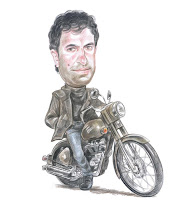
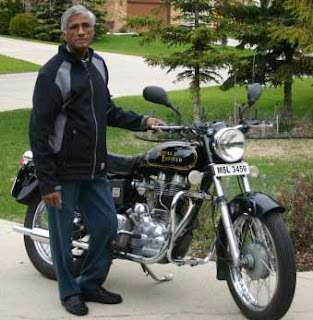
The importance of the Royal Enfield motorcycle in India can best be explained by an Indian. I came across how one man, apparently now a doctor in Canada, put it in his blog in 2006. (Interestingly, although this fellow maintains several blogs, he signs them all as "Enfield." His self-caricature from his blog is shown here.)

What follows is "Enfield" writing about about Royal Enfield:

"The Bullet 500 that I owned (in India) was first introduced in 1993, and went on to become the most desired, a green in the eye.

"In context of its role in the culture of Punjab, the Bullet can best be regarded an icon. The 'dugg, dugg' of its engine is just as much part of Punjab and the lives of its people as lassi, makki di roti, saron da saag, gidha and bhangra.

"Ever since the urbanisation of Punjab, a 'dodhi' (the milk vendor on a motorcycle) has been integral to the very existence of life in Punjab which had earlier been a predominantly farming state, and 90% of its urban population can trace their backgrounds to some 'pind.' People might have moved on to live in towns and cities but there is still a vital link that keeps them connected to their roots, and that is the dodhi, and the unmistakable 'dugg dugg' of his Bullet.

"Punjabis belong to a strong, robust, machismo race which is crumbling to the unhealthy eating, working, and living conditions of urbanisation. A Bullet, for these urban Punjabis, is the best reflection of their lost personalities.

"For some others, it is a stamp of authority. For some, it is sign of being macho amongst peers.

"For a few others, it's a magic wand when it comes to winning over girls! Above all, whatever their respective reasons, every Bullet owner prides in owning a piece of history, and the respect it commands!"