Showing posts with label Royal Enfield accessories. Show all posts

Friday, February 24, 2023

Royal Enfield accessories for 650 twins

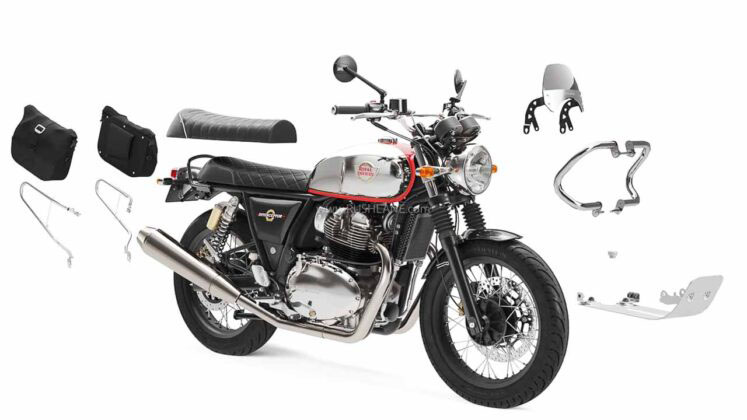
Royal Enfield Interceptor 650 Lightning edition.
The Royal Enfield Interceptor Lightning edition has it all. 

 A friend recently pointed out that Royal Enfield announced "Thunder and Lightning" editions of the Royal Enfield 650 twins for the UK. These are Royal Enfield Continental GT and Interceptor 650 motorcycles dressed up with soft paniers, engine guards and high end mirrors, seats, and even oil caps. 

"Royal Enfield has really gussied up the Interceptor and Continental GT 650 for the UK market," John Donlon wrote me in an email. 

"The Interceptor is as close to a 1970 Mk 2 redux as you are ever going to see; IMHO  just beautiful." 

Basically, Royal Enfield emptied an accessories catalog on its 650 twins, and they do look nice. 

But... 

Well, the engine guard is attractive and potentially useful without hiding that polished 650-twin motor. Nicely done. A machined oil filler cap adds to pride of ownership, I suppose. 

But, unless I needed to travel I think I would skip the paniers, as nice as they are. I was surprised that the friend who liked the Thunder and Lightning packages so much agreed with me.

"I'm not a 'bag' person because when I have them they magically fill up with all sorts of shit I eventually forgot I put in them -- so, I avoid them altogether. Still, I love the package for that bike. It is very handsome," John wrote.

He hit that nail on the head.

My 1999 Royal Enfield Bullet came with two very handy extra-cost accessory leather saddle bags. Since the Bullet already had two surprisingly capacious lockable metal toolboxes standard, the saddle bags never carried anything more than an occasional library book.

At first.

Then, over time, I found that it was handy to toss a screwdriver and adjustable wrench into the bags, even though I had a full set of tools locked in a toolbox.

Then another screwdriver. Then an extra spark plug, even though there was one in a toolbox. An extra rag. A second rain coat. A redundant tire pressure gauge. Etc.

Soon there was a near duplicate set of stuff rattling around in one or other of the bags and my carefully selected tools, riding gear, spare parts and owners manual rode forgotten inside the toolboxes.

Then, one Spring Cleaning day, I removed the saddle bags and put the accumulated debris back in the garage.

Maybe just an illusion, but I swear that the Bullet was noticeably faster without the bags dragging through the air.

What's in your toolbox? If yours is an old Bullet you already know how full you can pack the standard toolboxes. Here's what I carry in mine.

Tool box contents laid out on driveway.
Here's what I carry in my Royal Enfield toolboxes. List here.


Friday, June 25, 2021

How did Royal Enfield riders of old keep track of time?

Small clock attached to motorcycle dashboard.
Stem nut clock for Royal Enfields from Hitchcocks Motorcycles.

Riding an old Royal Enfield Bullet is and ought to be a minimalist experience. One cylinder. One spark plug. Vibrations in your butt instead of a tachometer. You get the idea.

But I could use a clock.

Sometimes you want to be on time to an appointment and simply want to know how many minutes you have left to get there. While riding you don't want to have to pull up your sleeve to see a wrist watch.

And you definitely don't want to mount a modern phone on your vintage motorcycle!

The obvious solution would be to buy one of the cute little clocks sold for Royal Enfields. They are surprisingly attractive. Clever, too. They attach with a small set screw to the steering stem nut. Another design attaches to the handlebars themselves.

But are they really retro enough for Royal Enfield?

I wondered: is there some more vintage way to equip my Bullet with a timepiece?

Richard Miller blogs about vintage motorcycles and bicycles at RedDevilMotors. In reply to my question he said he hadn't noticed clocks in the old photographs he often reproduces on the blog. But he suspects clocks were around.

"In earlier days (from the late nineteenth century up to the mid-twenties) an available accessory for both motorcycles and bicycles was the handlebar pocket watch holder," he wrote in an email.

Smiths offered accessory clocks for motorcycles and cars, and clocks appeared in the tank-mounted instrument panels that became popular in the 1930s, he added.

So wind-up clocks for motorcycles did exist. I was surprised to find this one for sale on eBay in Germany.

Old clock meant to attach to handlebars.
This looks awfully big to ride on the handlebars.

And for only $1,590! Plus shipping, of course.

The "Globus" clock was being offered by the Alexwoa online "museum." Photos with the ad showed it to be fairly large, meant to be mounted on a handlebar, and set and wound from the back. Details otherwise were few, the museum only adding "Working!" and "Wow!"

The numbers and hands on the clock looked as though they might be luminous. Radioactive, I wondered? Otherwise there was no provision for lighting.

Old clock meant to attach to handlebars.
The Kienzle clock reads in 12-hour and 24-hour modes.

Further searching on the Internet found another antique German handlebar clock, the "8 tag" (meaning 8-day) Kienzle clock.  It appeared very well made, with a substantial mounting, and meant to cleverly swing out of its casing to allow it to be wound and set. It didn't look as though it was meant to glow in the dark, however.

Old clock swings out of its case to be wound.
The Kienzle swings out of its case to be set and wound.

To be honest, these seem too big and clunky for my handlebars. Even back then they would have been inconvenient, expensive and therefore rare.

"As to what people did without clocks on bikes back in the day? Perhaps they weren't as obsessed by time as we are nowadays!" Richard wrote.

I have a little different theory. I think that in cities and even villages, the time of day used to be publicly posted more than it is today. Anyone my age will remember when most banks, many churches and every jewelry store in town thought they ought to have a big clock above the entrance.

Still, riders of the past surely found ways to neatly wrap a wrist watch around their handlebars. 

I found one technique for doing this recommended on RoadbikeReview, a bicycling site. The author meant the watch case to end up above the handlebar, but I couldn't make that work. The vibration of the Bullet motor and weight of the watch case would have allowed the watch to rotate around the bar.

It might work, I thought, with the watch hanging under the handlebars, pendulum like. Then the weight of the watch case would keep it in place.

Wrist watch hanging from handlebar.
Dangling watch would be OK here, except...

Here's how I would do it:

1. Hold both ends of the bands together, above the clock face, with the plain band running behind the watch case.

2. Slide the plain band all the way through the little loop on the buckle band designed to retain the excess when the band is buckled. This will leave both bands pinched together.

3. Wrap the loose end of the bands around the bar (the "pinched" area will be below the bar).

4. Tightly buckle the strap as usual.

"This always worked easy for me and didn't result in a 'bulky' foam knot on my bar. It's sleek and simple," the author wrote.

Watch has slide down bars to bang on tank.
...if watch slides down bars like this it would scratch tank.

A leather strap has a vintage appeal.  But while it might work on a bicycle, it's a nonstarter for my Royal Enfield Bullet, as the case of the watch would impact the tank when the strap inevitably slipped to a lower point on the handlebars.

Any suggestions readers?

Royal Enfield Bullet with clock in nacelle.
Here's an idea: clock replaces amp meter on custom Bullet.


Friday, October 16, 2020

Ways to remember when to fill up your Royal Enfield

Five-digit counter with knurled wheels to set mileage.
If you owned an old Volkswagen, then you may know what this is.
Most people won't recall, but there was a time when automobiles came without gas gauges.

You could put a stick down the filler opening to see if it came out wet. Ford dealers offered purpose-made measuring sticks for their customers, with the dealership's name on them.

Or, if the car had a "Reserve" setting, you just waited until the engine coughed and switched the lever to access just a bit more gas.

This is still the way my 1999 Royal Enfield motorcycle operates. There's no gas gauge and no trip odometer to tell how far you've gone since your last fill-up.

If you wait until the motor coughs you might find yourself groping blindly under the seat for the Reserve lever while in the middle of a busy intersection.

My blog item on an easy way to remember when gas is needed brought plenty of response. Some who wrote thought I ought to hang up my helmet if I couldn't remember when gas is needed. Ouch.

Others seemed to think I'm a lout because I don't always check the gas level before riding.

"If you don't check your fuel level then don't ride any farther than you intend on pushing it," Oldjohn1951 wrote.

Or I am a careless lout because I don't automatically fill up after every ride (prevents getting stranded and corrosion in the tank as well).

Just buy a grease pencil and write the desired mileage on the face of the speedometer, ran another suggestion.

More sympathetic was the friend who suggested I use a stitch-counter from a knitting needle to remember at what mileage to get gas. I'm a lout to think that this seems a bit — well — feminine for my masculine motorcycle.

"I used suitcase combination locks to keep track of my next fill-up mileage," wrote Darrel Bedwell.

That I liked. Maybe the lock would be made of metal, in keeping with the rest of my motorcycle.

Then, to my surprise, there came a comment that really made sense.

Remember that cars used to come without gas gauges, or trip odometers, even if they had odometers?

So the problem of keeping track of when to buy gas was, at one point in history, a very common problem? What solution did those drivers of old find?

Well, they had one. "Bilgemaster" pointed to an accessory odometer counter still made in Germany.

One reviewer wrote of it:

"Years ago, some Volkswagens and other small cars had no fuel gauge. These counters were popular to remind the driver when to buy fuel. Now, they are almost impossible to find. I am using the two I bought in cars that have fuel gauges, but do not have trip odometers to remind me of when to change the oil. You could just use a sticky note, but this thing is more fun."

Another wrote:

"Just what I was looking for. Put it on my scooter. I use it as a trip odometer on the right three digits and as a gas minder on the left two digits. In the '70s I had this in my VW Beetle. Great product."

And another:

"Excellent product, good quality. My gas gauge in my '73 Thing is not working at this time. I had one of these in all my old VWs before they came with a gas gauge. Easy fix for now. Authentic, made in Germany."

So there you have it. A certified piece of vintage kit, still made the old way.

Now, I realize that there are much higher tech ways to accomplish this. Just set a reminder on your Apple Watch, for instance.

But I maintain that, if you ride an old Royal Enfield, "higher tech" is not the goal.

Tuesday, April 12, 2016

Passenger seat for Royal Enfield the cat's meow?

"Kitten Cushion" passenger pillion for Royal Enfield looks sporty.
Butt I foresee a problem.
"Keep the lady in your life happy with one and only Kitten Cushion Pillion Pad."

That's the advertising pitch from Classic Motorworks for its accessory passenger seat. I'm a big fan of Classic Motorworks and I try them first for everything I need for my 1999 Royal Enfield Bullet.

So, naturally, like any loyal friend, and being concerned about my relationship with my significant other, Classic Motorworks sent me an email today suggesting this pad might be just the thing for my lady.

The Kitten Cushion pillion pad is indeed a sleek little number, measuring a svelte 5.25 inches wide and 11 inches long. It's 3 inches deep at its deepest and it has no springs.

So, while I ride on my wide, tractor-style sprung solo seat, the missus is supposed to balance herself on a leather pad little larger than a business envelope.

Girlfriends may be different, but any guy suggesting a real wife ride on something like this will be hanging out a "Motorcycle for Sale by Wife" sign.

I feel the marketing here is all wrong.

Classic Motorworks should advertise the Kitten Cushion pillion pad as "The Wildcat Performance Seat."

I think the real use for this thing would be mounted forward on the rear fender so the rider can sit back on it to lean forward. Examples of this sort of mounting are seen on vintage racing motorcycles.

1930s Royal Enfield 250 hardtail racer with pillion canted forward.
Spotted for sale on Car and Classic.
Guaranteed 5 mph top speed increase! Maybe more! If you survive.

As kids, we used to slide back onto the rear racks of our 10-speeds to go tearing down the mountains outside Los Angeles. We survived, through no fault of our own.

Of course you would never really do this on a motorcycle. At my age, I'd be taking Ibuproven for a week afterwards if I tried. But consider the look.

Instead of saying "I Can't Get a Date So I Don't Need a Real Passenger Seat," the Wildcat Performance Seat says "I'm Too Speedy for My Own Good."

I want one!

Friday, March 18, 2016

Royal Enfield's 1958 wind tunnel test a publicity stunt?

Heroic looking rider on Royal Enfield in wind tunnel.
It is one of the most dashing photographs ever of a man on a Royal Enfield motorcycle. The picture appeared to document a turning point in motorcycle design — but it could have been just a publicity stunt.

The photo caption describes a wind tunnel test of a 500cc RoyalEnfield fitted with the company's new Airflow fairing. The test was at a Bristol Aircraft facility in England. The caption is dated Oct. 31, 1958, although it's unclear whether that was the date of the test or the date of the press release.

A similar photograph of the motorcycle being readied for testing in the tunnel appears in the Nov. 6, 1958 edition of Motor Cycling magazine.  Blogger Jorge Pullin includes that clipping in his item, "Cheating the Wind."

The Motor Cycling caption reads:

"Extensive testing in laboratory, workshop and wind tunnel lies behind the Bristol-made Royal Enfield fairing. Our photograph shows an example being prepared for 90 mph tests in one of the tunnels at Filton, Bristol."

Royal Enfield shown being readied for test in Motor Cycling article.
The photo of the test is full of drama. Our leather suited and helmeted hero sits astride his shining, streamlined Royal Enfield just ahead of the vanes of the wind tunnel. His head is cocked forward, his eyes focused straight ahead through goggles. His lips are set in determination.

The lighting is, to say the least, dramatic.

Somewhat less dramatic, Royal Enfield enthusiast Chris Overton points out, is the fact that the passenger peg is partly down and the motorcycle is fitted with very non-aerodynamic looking saddle bags.

Chris recently alerted me that another enthusiast, Robert Murdoch, has done some research into Royal Enfield's long ago visit to the BAC wind tunnel at Filton.

He contacted the Britol Aero Collection Trust, which is trying to create a major aviation heritage museum at Filton. (Centerpiece of the museum will be a British Airways Concorde, the last of the breed to fly.)

Bob's account is that a volunteer at the heritage organization tracked down a former wind-tunnel worker who remembered the motorcycle test.

This man's memory reportedly boils down to this: the test results were dreadful. Tufts of wool taped to the motorcycle fairing didn't show that the fairing worked. Wind tunnel workers vetoed a suggestion that the tufts be further taped down in a convincing way to make a better photo.

"A slightly different version than what was fed to the motorcycle press about their new Airflow fairing!" Bob wrote.

The Daily Mail called it the "Royal Enfield Overflow."
Royal Enfield did in fact make substantial claims for the Airflow. In one Daily Mail article reproduced by Jorge Pullin, the firm reported an 8 percent top-speed improvement for what the article called the "248cc Royal Enfield Crusader Overflow."

Gasoline consumption fell 20 percent, the article claimed.

Yet another article went so far as to claim the Airflow provided helmet-like protection to the rider's body in a crash. Highly unlikely.

Keep your cap on: Airflow's real advantage.
The Airflow's one real advantage would be weather protection. For instance, the deeply valanced front fender fitted to Airflow models was surely unaerodynamic, but it would have collected lots of road mire.

Most convincing to me is the fact that the Airflow fairing allows the rider to sit upright. It's not designed as primarily a performance accessory.

Oh, there was one more advantage claimed at the time: the Airflow fairing incorporated a glove box, like a car. Well, a place to keep the goggles, I suppose. Or even gloves!

The Airflow might have seemed an appealing offering to combat the growing popularity of scooters in the late 1950s and early 1960s.

The Daily Mail quotes Royal Enfield's Major F. W. Smith this way:

"The best features of the safe, honest-to-goodness motor-cycle and the stylish-looking scooter converge in this new design of ours."

That at least seems true. Author Roy Bacon summed up the Airflow this way in his book "Royal Enfield, the Postwar Models:"

"For a while it looked as if the public would follow this trend to combine motorcycle handling with scooter protection, but in a short space of time it was to reverse. Scooters were to fade from the scene and motorcycles went down the cafe-racer route to clip-ons and rear-sets."

Tuesday, June 9, 2015

Accessories and gizmos for my Royal Enfield

Obsolete handlebar AM radio is just the thing for a Royal Enfield.
Of all the accessories available for Royal Enfield motorcycles, it's the odd ones I like best. Let me explain:

Every Christmas, my Mom would send a check instead of a present.

"Get what you want," she'd write. This wouldn't do for my Dad.

My father would send a box containing a variety of wacky presents, each "Christmas wrapped" in old newspaper.

My wife and I would open these, marveling at the year's take of what can only be described as "gizmos." Strange as they were, they were wonderful in their way.

One I've always treasured is a square plastic AM radio meant to be attached to the handlebars of a bicycle. It's a Radio Shack Archer Road Patrol, powered by four "C" batteries and incorporating an electric horn.

Obviously impractical, its made-in-Hong-Kong guts would be shaken apart on the handlebars of any bicycle. But I would attach it to my Royal Enfield Bullet in a minute, if only it fit (the plate holding the Bullet's bars obstructs it).

You could never hear it "play" over the roar of the wind, and the horn would sound silly. But I love the whole cockeyed notion of it.

Another handlebar accessory I would love is one of the shiny "bullet" headlamps like the one I really did have on my bicycle as a kid. Mine was powered by two "D" cell batteries and even on a bicycle didn't cast enough light to be useful. But I loved the look.

You can buy new ones on eBay in plastic, but for my Bullet I'd have to have it in metal. Not many of those will still be around, as their shiny "chrome" soon rusted off.

Tinny metal headlight would look grand; note the wire providing power.
One appeared recently on a vintage bike for sale on eBay; it had a terminal for electrical wiring so it might even have cast some light!

Another accessory I've always wanted is a long, tube-styled air pump. Yes, the modern compact versions are wonderful, but those don't interest me.

Nfield Gear sells a vintage looking pump with screw-on clips. When I was a kid, English bicycles always had the hooks to secure the long pumps, but the pumps themselves were usually missing. I assume they were stolen, but they may have fallen off, which might make you think twice about putting one of these things anywhere near your spokes.

Air pump was obviously original equipment on this 1950s Royal Enfield.
But Royal Enfields did really have these pumps back in the day. A photo of a pump installation I like recently showed up in an eBay ad for a circa-1956 Royal Enfield. It shows the pump apparently well secured by metal tabs as well as the end hooks.

My parents have passed, so it's no longer a matter of "get what you want" or finding an odd accessory wrapped in newspaper. I miss those days.

Friday, November 21, 2014

Accessories improve look of Royal Enfield Bullet

Standard Royal Enfield Bullet is improved by subtle upgrades.
A 2001 Royal Enfield Bullet 500 for sale on eBay in Washington state is just about perfect.

Literally. It has only 50 miles on the odometer. The seller says he bought it only for display, kept it in his climate controlled home museum, and rode it only three times.

But that's not why I consider it "perfect." To my eye, this Bullet has been tastefully modified in ways I might have done myself, if I'd wanted to spend the money. The seller listed the changes made:

  • K&N air filter
  • Duck bill breather
  • Relocated horn
  • Chrome brake rod w/nut.
  • Chrome chain adjusters
  • Chrome rear wheel spacers
  • Chrome rear wheel hub cover
  • Bar-end mirrors
  • 350 front fender and fender stays
  • Re-jetted carb
  • Big tri-bar headlight and mounting ring
  • Removed turn indicators
  • Solo riding seat
  • Re-mounted electronics out of sight
  • More open muffler
  • Removed rear pegs

He doesn't even mention the tomb stone tail light fitted. While my own Bullet has the solo seat, I never got around to removing the passenger pegs. This man did, and it's a nice touch.

Clean look, but visible air filter looks too modern to my eyes.
I would have left the turn signals and the air filter box; the visible K&N filter looks too "modern" to me.

Note that although the electrics were relocated, the battery box remains, so there is no "see-through frame" effect anyway — so nothing would be lost by putting that K&N in the original air filter box.

Fuller 350 model front fender looks better than version on 500.
On the other hand, the switch to the better looking 350 front fender is subtle but effective. However, I wouldn't pay to replace a fender until I'm done denting the old one. That's the difference between cheap me and particular him.

Big headlight looks great.
Relocated horn is neat but why does it face down?
I think he got this one right.

Tuesday, June 26, 2012

Engine guards for Royal Enfields snag some comments

Are crash bars one way to hook trouble?
My explanation of why I decided not to fit crash bars to my Royal Enfield Bullet drew hearty congratulations from one reader: Maj. Bunty Golightly.

"Greetings Blasco, I awfully glad that you have decided not to fit the ruddy things, a chap with your ability could do a lot of ruddy damage to small animals and passers-by, don't yer know. Not to mention snapping himself orf at the knees in a high speed frontal crash."

I was delighted to have the good Major's approval, but not everyone else agreed.

One anonymous reader wrote:

"I have used Enfields with crash bars for years and they are never a problem. Not even in very heavy traffic in India. Most of these are not much wider than the handlebars, if at all. They are of no use in an accident as you fall off the bike anyway, but may save the paint job in a parking lot tip over."

Unadulterated version of photo is available from Royal Enfield
as wallpaper for your computer screen.
Agreed. However, most important, I think, was the real-life experience offered by reader Anant Singh:

"Hello David, I live in Toronto, Ontario, Canada and follow your blog pretty religiously. I'm from India originally, hence the fascination to all things Royal Enfield. My father was in the Indian Army and I grew up ogling the RE Bullets of the 'Dispatch Riders' and dreaming of riding them. I currently own a '54 G2 Bullet (project), '58 Constellation and a '69 Series II Interceptor.

"I found your article on 'crash bars' interesting. In India they were called 'leg guards' because they would protect your leg in a spill.

"Didn't make much sense to me as one such leg guard was the reason I had a pretty serious leg injury as it got entangled with a light truck front bumper in New Delhi's crazy traffic and set me airborne from the inertia. I agree with you completely and would not recommend it; besides it also takes away from the looks of the motorcycle."

On Facebook, Tom Shanti reported two incidents:

1. "My front wheel skidded... had to put the bull down to the side — the 'crash bar' bent beyond repair (simple tilt, hardly any velocity).

2. "During late hours I had an accident with a pedestrian in low speeds. I hit the back of his leg with my 'crash guard.' The crash guard bent inwards and the top end pierced my leg, blood gushing out. The pedestrian had no visible injury (luckily)."


Friday, June 22, 2012

Royal Enfield t-shirt recalls glory days of the brand

Royal Enfield t-shirt from the glory days of the Interceptor.
It's a plain white t-shirt, emblazoned "Royal Enfield" on the back in a fading rose color. It's thin from washings and stained by use.

The tag says it's a Russell product, 100 per cent combed cotton. It claims to be a Large, 42-44, but it wouldn't fit a large child. That tells you it has shrunk some but it also tells you that it was made before clothing sizes inflated to fit inflated modern people.

Another clue it's old: it's not marked "Made in China." And there is no "clothing care label," required on clothing sold in the United States since 1972.

So it's old, much older than my 1999 Royal Enfield motorcycle. I think it probably dates from the 1960s. You'd have wanted a Royal Enfield t-shirt then, because Royal Enfield was back trading under its own name in the United States, after half a decade of supplying motorcycles to be branded as Indians.

But you probably would have lost interest after 1971, when Royal Enfield stopped making motorcycles in England, leaving you no brand to support. (The made-in-India Royal Enfields weren't officially imported to the U.S. until 1995.)

Advertisement for Royal Enfield Interceptor used similar logo design.
Do you see the similarity between the Royal Enfield logo on the shirt and this vintage advertisement for the Royal Enfield Interceptor? I'd say they're from the same college of design. The Interceptor shown is the Series II of 1969-'71. My guess is that if you bought an Interceptor in 1970 the dealer would have thrown in this t-shirt.

I spotted the t-shirt for sale in a CraigsList ad out of Columbus, Ohio, in July, 2011. The seller didn't seem to know much about the shirt except that it was old. I pointed the ad out to Chris Bartlett of Her Majesty's Thunder, designer and seller of t-shirts with Royal Enfield and vintage motorcycling themes. I thought it might make a reference point for him.

In September a soft manila envelope arrived in my mail. It was from Chris and contained a t-shirt of his design and the t-shirt from the CraigsList ad.

"That old white shirt is the vintage one you pointed me to a while ago. It belongs in a shadow box or something. I figured my favorite Enfield friend would give it a good home," he wrote.

I haven't worked out a shadow box for it, but the shirt is certainly the star of my collection of memorabilia. This public "thank you" note to Chris is almost a year overdue.

Even so, I don't think he'd mind if I shared his doodle of a Royal Enfield from the outside of the manila envelope. It's in my collection, too.

Note I received from Her Majesty's Thunder.


Wednesday, June 20, 2012

Crash bars look good on Royal Enfields, but not mine

Diamond Engine Bar, available at Nfield Gear.
You see a lot of these on Royal Enfield motorcycles. Motorcyclists around here call them "crash bars," but probably not too many think of them as something that would really protect the rider in an accident.

Royal Enfield USA sells them as "engine guards" on its Nfield Gear site. They "protect your engine from damage in the event of a fall over..."

For motorcycles that are too heavy to pick up once they go all the way down, anything to prevent that probably makes sense. I vividly recall standing completely still astride my brother's big Kawasaki and feeling it gently but inexorably slipping sideways from my grip. Mercifully I was standing next to a large boulder that provided  a resting place part of the way down.

Engine guards make sense for motorcycles that must park on city streets, where the odds of being bumped over are substantial.

Still, for most motorcyclists, engine guards are probably just one more shiny thing they can put on the motorcycle. The bars may not add much practical value but they do offer this advantage: they give you a place to attach even more shiny things.

They're not for my Bullet, though. Yes, I've heard the warnings that in an actual crash they can bend, pinning the rider's leg to the motorcycle. I've never seen that happen, but it is not a happy thought.

Here is an experience I did have. Years ago I had a storage room on the back of the house. It fell into disarray and was so crowded I could no longer get in to find anything. Disgusted, I reached in, picked up the female end of a heavy duty extension cord, and began walking into the yard.

The extension cord unwound, roping a lawn chair, the arm of which caught a table, the edge of which collected a shovel, the blade of which pushed a whatnot into a whatchamacallit, the lip of which hooked a thingamajig that brought with it a shelf full of everything else.

I kept walking. By the time I reached the fence, the storage room was mostly empty. Its contents, wound in electrical cords, ropes and garden hose, were spread across the back yard, ready to be reorganized.

That's my fear: that the engine bars will snag a bumper in traffic or a towing ball in a parking lot, and down I will go.

If it could happen it would happen, and I would feel very silly.

Thursday, November 3, 2011

Royal Enfield belt makes the perfect gift for her

Royal Enfield Belt acts as aid in holding up pants.
The Royal Enfield Belt is the perfect gift for one's grown daughter or girlfriend and, at $398 — well — she surely deserves it.

The Royal Enfield Belt, available on the Free People website, is described as an "Incredible vintage-inspired leather belt adorned with distressed metal crests. Adjustable buckle closure."

So! The belt even comes with a buckle!

The metal crests unfortunately seem to have nothing to do with Royal Enfield.

Nor do the words "Royal Enfield" seem to appear on the belt.

Nor does this item have anything to do with a blog about Royal Enfield motorcycles. Sorry.

Free People is the original name of the fashion powerhouse Urban Outfitters. According to its website, Free People caters to the "26-year-old girl, smart, creative, confident and comfortable in all aspects of her being, free and adventurous, sweet to tough to tomboy to romantic. A girl who likes to keep busy and push life to its limits, with traveling and hanging out and everything in between."

You must know one of these. According to Free People, they look like this:

But does she have a Royal Enfield Belt?

Wednesday, October 19, 2011

Royal Enfield parts, too good to toss, too dippy to keep

Tossed in a box and offered for sale on CraigsList.
Royal Enfield motorcycles are mass produced in specific models. No sooner do these reach the masses, however, than certain specific parts are unbolted and chucked aside, to be replaced by after-market accessories (many of them available from Royal Enfield itself).

The result is boxes in attics and garages, probably around the world, containing the identical perfectly good and nearly brand new parts.

The items shown here are for sale on CraigsList in Appleton, Wis.  From a 2008 Bullet we have the full exhaust, $100; four blinkers, $30; headlight, $40; and airbox , $20.

I mused recently that hearths throughout America someday could be hung with a shiny chrome "bazooka" muffler from a Royal Enfield motorcycle. These are often the first item replaced (for something louder and, theoretically at least, more power inducing).

But what is to become of the unloved and unwanted plastic turn signals and the dim standard headlight in its dippy looking DOT-required adjustable rim? Flashier (pun intended) turn signals and full-size unaimed headlamps are the rage.

They are the rage right now, that is. Will there come a day when restorers place ads, begging elderly motorcyclists with fading memories (and their widows) to wipe the cobwebs off old boxes in the shed? The search will be on for genuine "factory" bits to perfect those museum-piece Royal Enfields from the 1990s.

Or am I crazy?

Wednesday, August 24, 2011

Built like gun, hardly used, Royal Enfield muffler will last

Someday, I imagine, on the hooks above the mantle once reserved for a musket, hearths across America will instead display a shiny chrome tube.

"What is that?" little children will ask, in awe.

"Oh, that. That's Grandpa David's original muffler for his Royal Enfield Bullet," parents will explain, with reverence. "No one wanted it, and it was too nice to throw away, so there it is above the fireplace."

Removing the stock "bazooka" muffler and replacing it with something less restrictive and sportier in appearance is probably the single most common modification owners make to Royal Enfields or any other motorcycles in the U.S.

Royal Enfield guru Pete Snidal once went so far as to write me to suggest that replacing the stock muffler and rejetting the motor appropriately to compensate for its loss were the most important things owners could do to increase their satisfaction with Royal Enfields.

As evidence, he pointed out that most older, low-mileage, "hardly used" Royal Enfields offered for sale on this blog can be seen to still have the unsatisfactory, over restrictive factory mufflers. Owners don't like the performance loss they inflict, so they sell the motorcycles.

Modern Royal Enfield mufflers contain expensive catalytic converters. They are designed to work with the sophisticated fuel injection system and are perfectly satisfactory.

But that won't stop owners from pulling them off and replacing them, in the theory that any change is a gain. You can buy after-market exhaust systems at Nfield Gear.

When you do, you'll have to breeze past the warning in the catalog: "The part may alter emission systems to be out of compliance with state and/or federal laws. The part should only be installed on machines intended for closed-course racing."

I recently viewed the outstanding Civil War weapons collection at the Atlanta History Center. I was interested to see the museum's explanation for why so many fine Civil War-era swords are on display in museums.

The reason is that soldiers didn't use them in battle. Civil War rifles had such long range that even the muzzle loaders could be fired repeatedly before anyone armed with a sword got close enough to be a threat.

Swords were just for parades. Union cavalry left them in camp when they went into battle. Southern cavalry never wore them at all.

Someday my Royal Enfield Bullet may be long gone thanks to hard use and rust. But the shiny original muffler will still be around, above the mantle.

Tuesday, December 7, 2010

Some nearly new Royal Enfield parts end up on the shelf

The rear tail light assembly from a Royal Enfield Bullet is for sale in Mt. Rainier, Md.

The optimistic seller writes that "I believe it is from a new Royal Enfield (the ones currently being imported from India) as it came out of a trash pile in a house where an Enfield was garaged. First cash gets the assembly for your bike!"

He wants $100 for it and perhaps he will get a taker, but I doubt it. There is a reason the tail light assembly was in the trash: lots of Royal Enfield owners replace the standard fitment with nicer looking after market items.

The seller doesn't realize how many of these things are on shelves in garages, or stuffed in attic crawl spaces across America.

There they share space with the bazooka mufflers and dual seats that are often pulled off and replaced with aftermarket silencers and sprung single seats.

This creates a treasure trove of nearly new (but largely unwanted) Royal Enfield parts.

So, when yet another plastic turn signal stalk snapped on my 1999 Bullet, another Royal Enfield owner that very day offered me two cherry turn signals that had been cluttering his garage. He wouldn't accept my offer of payment.

I guess there is an advantage to keeping your Royal Enfield stock.


Wednesday, May 12, 2010

Highway pegs made from passenger pegs
is clever modification to Royal Enfield

Royal Enfield motorcycles aren't the first thing you think of when you think of highway pegs (an extra set of foot pegs positioned to let you stretch your legs while riding).

The upright riding posture imposed by the Royal Enfield Bullet is not tiring for me But one case for foot pegs might be the one presented by Paul, a motorcycle mechanic in St. Cloud, Fla., who fabricated highway pegs for his Bullet, citing "Florida's flat roads."

What's neat is that he used the passenger pegs to do it.

Paul told me he welded up tubular steel to make the mounting. As you see, the highway pegs still fold up out of the way. There are no clearance issues with the front wheel, Paul said.

He tried using the entire rear peg mounting, but it "looked like a bit too much metal." So only the rubber covered and folding part of the pegs was used, and they are threaded on, not welded. The beauty of this is that the rear peg mounts are left untouched, so the whole thing can be unbolted and put back as original in 20 minutes.

Paul is a Royal Enfield mechanic, and his accent betrays him as a Brit, from London. He likes his comfort, maybe especially because he has a delicate hip and knees, and doesn't like to be "crunched up." He said he devoted a lot of effort to getting his solo seat positioned slightly rearward, for the same reason.

How does it work? "Great, very comfortable," Paul said. For reference, he is 6 feet 1 inch tall.

You can own it. The motorcycle is currently for sale on CraigsList.

What I like about this modification is that it instantly answers the question of what you do with the passenger pegs after you fit the solo seat. The sprung solo seat is certainly one of the most popular modifications for Royal Enfield motorcycles. But most of us who have them leave the dual seat's passenger pegs in place.

Maybe, we think, we'll add a passenger pillion pad someday. In the meantime, the passenger pegs are curiosities. I actually had a guy ask me what they're for.

Well, what are they for? Decoration? Carrying a standing passenger?

Paul seems to have the answer. He graciously offered to provide advice for any of you who want to create your own set of highway pegs this way. If you're serious (and you can handle the welding) write to me at david@royalenfields.com and I will forward your email to him.

Monday, March 22, 2010

Period correct accessories for Royal Enfield

Years ago I came across a picture of a couple in Quebec posing with the most amazing Royal Enfield Bullet. The motorcycle was shiny and clean, and looked to be in excellent condition. But never mind that.

What was amazing about the picture (I wish I had saved it) was that the couple had outfitted it for touring in a very tasteful and unusual fashion.

Many serious long-distance motorcyclists fit square, stainless steel boxes that don't look appropriate for a 1955-vintage motorcycle. Rounded plastic boxes hijacked from a Gold Wing don't please me either.

Instead, the couple in Quebec had modified their bike to accept the sort of gear a traveler might have used in the era when the Bullet was designed.

Most striking was a secondary set of pannier bars that slung small gas cans very low on the sides behind the rear wheel. You had to see it to appreciate how natural this looked.

Another photo I wish I had saved was of a different, younger couple from England who had ridden their Triumph motorcycle immense distances in the 1960s. They had fit plastic gas cans, one on each side, to the front crash bars. Now that looked dangerous. But very cool.

This same couple had fit a very small suitcase to the tank rack. It wasn't water proof, probably, but it was aesthetically so much nicer than some black nylon bag obviously made in the 21st Century.

I apologize for not having better pictures to go with this blog post. But here's something for you. Recently an ad ran on this blog for Heindl Engineering, in Eaton, Ohio, a Royal Enfield and Ural dealer.

They offer a Ural model called the "Gear Up." The intent of this model is obvious: they're thrown every possible period-correct accessory they have at it, including a rack on top of the spare wheel atop the sidecar.

Do you really need a big gas can on the front of the sidecar? Is it really safe to have one there? Who cares? You don't have to fill it with gas. It just looks awesome.

The Ural Gear Up captures the sort of "age appropriate" accessories I like on a Royal Enfield.