Showing posts with label Royal Enfield Military. Show all posts

Friday, July 29, 2022

Royal Enfield's own unit of "Dad's Army"

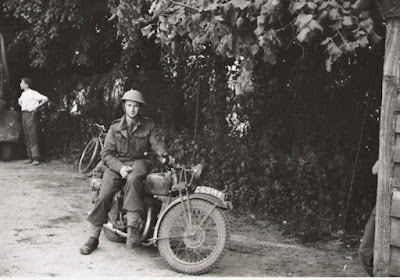
Home Guard motorcyclists pose in uniform.
Royal Enfield had its own company of the Home Guard.

 Royal Enfield motorcycles really do appear in a World War II photograph said to show "the Redditch Home Guard." 

What's more, there's evidence that the motorcycle-mounted soldiers in the photo are from Royal Enfield's own Redditch factory. 

We know that such a unit existed because Royal Enfield boasted of it in its post-war publication "A Proud War Record." 

"The Head Works at Redditch had its own Company of the 9th Bn. (Worcester) Home Guard," the book asserts. 

The Home Guard formed in 1940, with Britain exposed to invasion. Men too young, too old or too valuable on the production line to send overseas were enlisted in the Home Guard to defend their hometowns against enemy parachutists. 

At first there were no uniforms and few guns (and maybe five bullets apiece). 

But the Home Guard became well drilled and better equipped. Redditch itself was designated a "tank island," with members of the Home Guard assigned to block German invaders with trenches, fire bombs and, apparently, motorcycles. 

The website Birmingham Live posted the photo April 8, describing it as "Royal Enfield despatch rider motorbike and the Redditch Home Guard on Royal Enfield bikes."

Then Royal Enfield Owners Club UK archivist Robert Murdoch posted a version of the same photo May 31 on the REOC's Facebook page, Royal Enfield Owners Club - Est. 1877.

This time the photo was labelled "Enfield Home Guard."

"Here is the Royal Enfield factory Home Guard comprising factory workers in reserved occupations. Unsurprisingly, most seem to be mounted on Royal Enfield motorcycles," Bob wrote with the photo.

I asked him about it. He told me in an email that it came mounted in a page of an album donated to the club by Barry Smith.

Now that's something. Smith was secretary of the Royal Enfield Company from 1959 to 1962, the son of Major Frank Walker Smith, who led the company as managing director, and the grandson of Royal Enfield designer and managing director Bob Walker Smith. He died in 2009.

Barry Smith would have known how to label the photograph correctly.

"I'm sure this photo would be (the part of) the same 9th Battalion provided by the Royal Enfield employees after working hours, which would have been a very long day," Bob wrote.

It makes sense. Where else but the factory would an entire Home Guard unit get Royal Enfield motorcycles?

I shared the higher-resolution version of the photo Bob sent me with Jan Vandevelde, a student of Royal Enfield military motorcycles. What did he see in it?

"I can only see Royal Enfields here. Lots of WD/COs, a KX, a side-valve with a civilian petrol tank. None of the WD/COs has a census number on the petrol tank... " he replied in an email.

The absence of numbers stenciled on the gas tanks of any of the motorcycles in the photo is significant.

"Every vehicle that was purchased by the Army had its own unique census number, which in 1942 was applied in the factory. So these bikes most probably don’t come from one of the Army contracts. At least this is what I think," Jan wrote.

And he saw a lot more that suggested the motorcycles in the photo came directly to the Home Guard from the Royal Enfield factory, rather than government depots.

Three of the motorcycles pictured have civilian style fender license plates, all three of which seem to begin with the letters "DUY."

"DUY was a Worcestershire registration block that was issued during the first years of the war (1940-1941). I have copied the old registration ledgers in Worcester, and this DUY block contains quite a few Works Registrations (numbers that were issued to the 'Enfield Cycle Company' in Redditch)," Jan wrote me.

Specifically, Jan sees DUY905, DUY906 and DUY90-something on three motorcycles in the picture. He sent me his copies of the registration ledgers that show that all of those numbers went to Royal Enfield motorcycles registered to the Royal Enfield Cycle Co.

This includes the DUY90-something, which must have been DUY903 or DUY904, as the ledger book shows that the other final single digits were assigned to lorries or tractors.

In other words, we know these three motorcycles, at least, actually belonged to Royal Enfield.

Jan noted one other reason it's likely the motorcycles were provided by the factory: there seem to be prototypes among them.

The registration ledger shows that the DUY90-somethings were registered in June, 1941. That's too early for the Royal Enfield WD (War Department) CO models Jan sees in the photo. Production CO's didn't come along until Spring, 1942. (The factory could have switched the earlier plates to later vehicles, an alternative explanation.)

Another example: "DUY905 has a WD/CO engine, but the forks are WD/C (with speedometer at the left hand side of the forks). This could be a (flathead) WD/C in which they have put an OHV engine."

It's a detective game, figuring out this photo. What we still don't know is intriguing.

Why was the photo made? 

Illustration of military motorcyclists.
An idealized version of Home Guard riders on patrol.

I personally wonder if it wasn't made to serve as the basis of an illustration, something Royal Enfield did often for advertising. Something like this Home Guard photo appears in "A Proud War Record."

The motorcyclists in the illustration are proud, poised and praise worthy. Hopefully that is the feeling the men of the 9th Battalion got from their photo shoot.


Friday, January 21, 2022

Found: Royal Enfield motorcycle in wartime photo

Photographer poses with military Royal Enfield.
Lt. Geoffrey Keating posed with Royal Enfield motorcycle in 1940.
(Imperial War Museums Collections F 4776)

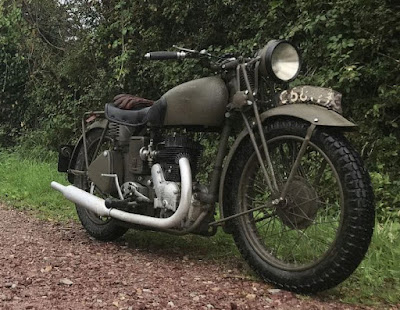
 A Royal Enfield military motorcycle, lost in the British Army's evacuation of France in 1940, and probably hidden under false documents and civilian paint after that, is found, rescued and restored.

 Incredibly it's the very motorcycle in a wartime photo of it in khaki paint, posed with the combat photographer who may have used it to document the BEF's final days in France.

 In the photo from 1940 the Royal Enfield's front wheel is turned, as if to show off its registration number. It's almost as if the photo is a message across 80 years: "Find me!"

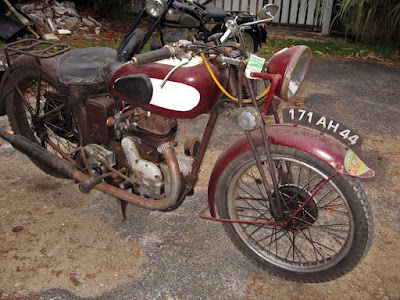
 The Royal Enfield is a WD/C, a side-valve, single-cylinder motorcycle probably sent to France with the British Expeditionary Force as a utility vehicle. Jan Vandevelde, a student of Royal Enfield military motorcycles, discovered it in France, where it was being incorrectly restored as a pre-war Royal Enfield.

Before that it had been used by a priest, somehow picking up a variety of incorrect parts from other makes and being described as an older motorcycle, perhaps to create a false history for it.

Royal Enfield motorcycle in civilian colors.
As originally found, the Royal Enfield had many non-original parts

Jan has found other Royal Enfield WD motorcycles, and owns one similar to this one. He recognized the Royal Enfield as likely having served with the BEF, although its crankcase lacks an important identifying number.

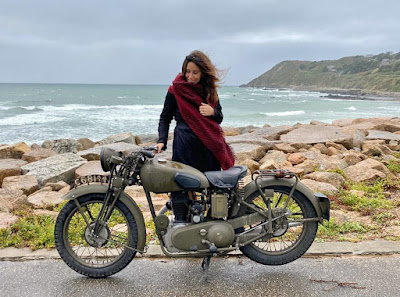
Alex Schmidt of Holland, a collector of military vehicles, acquired the motorcycle in 2018 and began an exacting restoration to return the Royal Enfield to its military appearance.

If he was aware of the 1940 photograph of a Royal Enfield WD/C with Lt. Keating, he "had not given it much thought really...," he told me in an email.

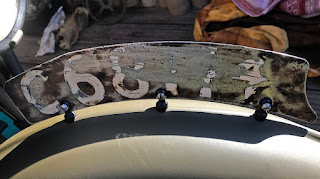
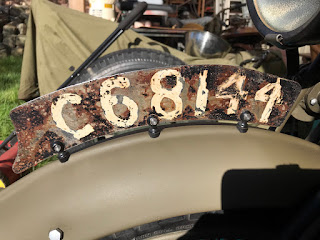
"My mate Ron Pier in the UK, whom I had commissioned to do the restoration, as he had already done 10 Enfields or so, and he knew how everything had to be... I asked him not to sandblast the front number plate, as there was a thick layer of black paint on it, and could reveal something; so he said that I best take the plate home with me and sand it off myself.

"So I did!

"It took me a couple of afternoons to carefully wet and dry sand, and the number came from under the layers; the Frenchman had put the French registration on with sticky self-adhesive numbers, so that was easy to remove."

Alex even wrote on the Historic Military Vehicles Forum (HMVF) in March, 2020 "Hopefully I can retrieve the C number on the front number plate; there's something under the layer of high build primer."

He was correct. In April, 2020, he told the forum:

"OK, sorry, long time, no updates, but since I have the bike at home, I've done 91 miles, and it's a very nice bike to ride!! Have found out about the history as well, and did various technical jobs, I knew that needed to be done. But the icing on the cake was that the front number plate revealed that this is the bike that Lieutenant Keating was sitting on in June 1940!!!"

Woman with restored Royal Enfield motorcycle.
A friend poses with Alex Schmidt's restored Royal Enfield WD/C.
(Photo courtesy Alex Schmidt)

While the motorcycle's war record isn't known for sure, Lt. Keating's history is known, and it's a proud one.

When the Second World War broke out in September, 1939, just one Army photographer, Geoffrey J. Keating, accompanied the British Expeditionary Force to France.

Born and educated in London, of Irish parents, Lt. Keating was a 25-year-old former Fleet Street journalist now serving as an (unarmed) War Department photographer. By the time of the photo with the Royal Enfield he already had covered the British expedition in Norway in April, 1940.

Later, as a Captain, he would photograph the Long Range Desert Group crashing over a sand dune in a truck on March 27, 1941; Churchill in a pith helmet viewing positions at El Alamein on July 8, 1942;  and cheery generals Eisenhower and Montgomery together in North Africa on March 31, 1943.

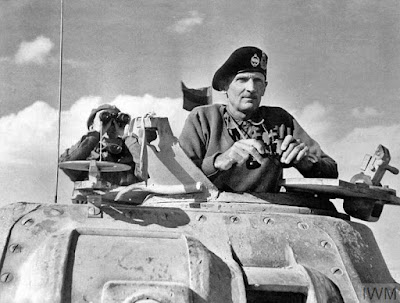
His is a photo of Monty in his beret, binoculars in hand, watching the beginning of the German retreat from El Alamein from the turret of his Grant tank, Nov. 5, 1942.

Gen. Montgomery with beret on tank.
Gen. Bernard Montgomery views enemy retreat at El Alamein.
(Geoffrey Keating photo, Imperial War Museums Collections E 18980)

Wounded several times, Keating eventually was with the army in Sicily, Italy and Normandy and was present at the German surrender to Montgomery in Luneburg.

He rose in rank to Lieutenant Colonel, head of the Army Film and Photography Unit, 8th Army, adding the initials "MC" to his name with the award of the Military Cross for gallantry in Tobruk in 1940

"Former Catholic Press photographer 'captures' Sicily town singlehanded," reads one wartime press clipping about him.

But on June 7, 1940, Keating was a lieutenant leaning on a Royal Enfield motorcycle near the Bresle River, and looking pretty composed, given the circumstances, which were alarming.

The evacuation of Dunkirk had ended on June 4, but thousands of British troops and British vehicles and weapons still remained in France. On June 5, German divisions had pushed back the depleted French and British divisions to the Bresle. This was the final German offensive, which defeated France.

From here on out, Keating would be covering a catastrophe.

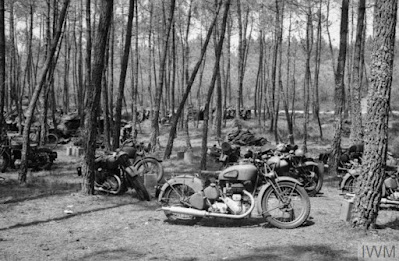
He shot a photo captioned "Abandoned British Army motorcycles at Monce-en-Belin near Le Mans," dated June 13, 1940.

Motorcycles abandoned by British Army.
British Army motorcycles abandoned in the fall of France.
(Geoffrey Keating Photo, Imperial War Museums Collections F 4841)

Keating's photographs typically show things in good military order, soldiers calmly getting on with business despite crisis. Perhaps that's just the way it was in the British Army, or perhaps it was his job as a War Department photographer to make sure everyone had his cap on.

But he also has photos of abandoned and burned lorries, and trucks being used to block roads on the outskirts of Cherbourg, dated June 13.

Dated that same day, he has a photo of British vehicles neatly lined up on a quay at Cherbourg for evacuation. The British would leave thousands of vehicles in the flight from France, but some equipment did get away from this port.

Then there is a photo from shipboard entitled "British and French troops on board ships leaving Cherbourg en route for Southampton," also marked June 13, 1940. This suggests how Keating escaped. He must have been on that ship to make the photo.

In the photo with the Royal Enfield, Keating is thought to be holding a light meter. Was the Royal Enfield his machine, or just a place to perch for a self-portrait using the camera's timer?

Perhaps he wanted to mark the roll of film (which would be processed by others) with his picture so it would be recognized as his work. Maybe he just wanted to use up the last shot on the roll so he could get the camera reloaded.

Restored Royal Enfield WD/C motorcycle.
Alex Schmidt's restored Royal Enfield C68144.
(Photo courtesy Alex Schmidt)

Close-up of number on license plate.
Close-up clearly shows C68144.
(Photo courtesy Alex Schmidt)

Other side of license plate show C68144.
"C68144" is even more clear on other side of plate.
(Photo courtesy Alex Schmidt)

Keating's wartime photos are in the Imperial War Museums collections and can be viewed at the website GJK Images.

In the years after the war he became head of public relations for British Petroleum, which meant travel to exotic locations and contact with international leaders, politicians, diplomats "and the like," according to one obituary.

"He made an unparalleled contribution to Anglo-Middle East relations at that time in history," the obituary states. His job included "special duties," and he "spoke fluent Arabic."

"Apparently he liked to be called an Irish adventurer; I would also call him an international man of mystery!" daughter Rima said of him. He died in 1981, at only age 66, at home in London.

Looking at the 1940 photo I think Keating had a connection to that Royal Enfield, even an affection for it. Maybe it had just been issued to him and he was proud of his new ride. Or perhaps he was moving on as the enemy approached, and the photo was made to remember the one he left behind.

Alex is in contact with Keating's daughter Rima, and hopes to fill in more details. Perhaps she will remember hearing her father tell a story about a little motorcycle in the great war.

Photos in the Imperial War Museum Collections show that Keating shot pictures in France as early as September, 1939, the start of the war. But he left to cover the Norwegian campaign in April, 1940. He was in Norway as late as April 30, 1940, when he shot a photo of HMS Bittern ablaze after an attack by Stuka dive bombers.

He is definitely back in France by June 6-8, 1940, as he has a photo captioned "men of the 7th Argyll and Sutherland Highlanders, 51st Highland Division, holding a position in the River Bresle area, 6-8 June, 1940."

The Highlander's Stag Head insignia is seen on the fender of the truck in the background of the photo of Lt. Keating and the Royal Enfield motorcycle.

A photo of an exhausted soldier sleeping on board the MV Royal Sovereign en route to Southampton, in the evacuation from Cherbourg, is dated June 13, again suggesting that is the date Keating himself escaped France.

The fact that so many of his photos are dated June 13 might suggest that the date was arbitrarily applied when all his film was processed and printed on his return to England. Or, perhaps, he simply shot every interesting subject he could find on that, his last day in France, since there was no longer any need to hoard his supply.

I first learned of Lt. Keating and the recovery of his motorcycle from Andreas Papadakis on the Royal Enfield Owners Club-International-Greek Branch Facebook page. Always something interesting there!

Friday, June 4, 2021

One woman's story of riding for Britain in World War II

Women soldiers pose with motorcycles.
ATS women dispatch riders on Royal Enfield motorcycles in 1943.

It's a classic wartime photograph, and now we know a bit more about it.

The time is 1943, and the five young women in uniform are dispatch riders for the British Army's Auxiliary Territorial Service, assigned to the great military base and naval dockyards at Chatham in Kent. Their three motorcycles are Royal Enfield WD/C models.

The women are identified on the back of the photograph as, from left, Bobbie, Vera, Eileen, Joan and Joyce. We know only Joyce's full name, as the photograph was kept by Joyce Preece.

Joyce's daughter Lorna Sargeant recently emailed me a scan of it.

We know a good deal about Joyce's service in World War II because in 2005, under her married name Joyce Sargeant, her memories were added to the BBC's WW2 People's War archive.

A 1945 photo of her in uniform on a Royal Enfield WD/CO motorcycle appears with the BBC memoir.

You can still read online most of what Joyce wrote at this link.

It's a light-hearted story of a very brave girl, 20 years old in 1941 when she joined up. She'd never driven even a car before but was accepted for training as a driver, starting on three-ton lorries. Later she'd volunteer for training as a motorcycle dispatch rider and was "thrilled to pieces" to be accepted.

Unfortunately a few key paragraphs Joyce wrote are omitted from the online archive. Joyce died in 1999, but Lorna was able to find and email the missing bit, which completes a fascinating story. I'll get to that in a moment.

First, it's helpful to know two things:

One, the Auxiliary Territorial Service was the women's branch of the British Army during the Second World War and since members were originally volunteers they were at first required to salute only their own officers. That changed in July 1941, when they were given full military status.

Two, the popular phrase "What is this, Scotch Mist?" became current after 1940. "Scotch mist" is an ironic term for rain in Scotland. But the phrase "What is this, Scotch Mist?" is roughly equivalent to saying sarcastically "Oh, yeah? Well what do you suppose this is, then?"

The "missing part" of Joyce's story goes like this:

The Despatch Rider course like all the others, passed too quickly and before long we were on our way back to Chatham, all of us proudly having passed the course. Four of us bike-riders shared a bedroom in the Victorian house, way up in the attic. Eileen came from Tottenham, Ver's home was Hull, Joan came from Cornwall and I was the Essex girl from Woodford Green. Our friend Bobbie made up the fifth member of the team.

There was often much amusement in being a Despatch Rider. We rode around Chatham wearing leather jackets, riding breeches, knee-length leather boots and, of course, crash helmets. We were all slim in those days (not so now!) and must have looked like men in the crash helmets with our hair all tucked out of sight; but we still wore our make-up as usual.

One day I was taking the post down to Chatham Post Office and when I came out four sailors were lined up alongside my bike each nudging each other and saying 'go on you ask,' 'no you ask,' 'no you,' but none of them had the courage to ask what they wanted to know: was I male or female?

So I got on my bike and said to them "So what do you think I am? Scotch Mist?" and rode off on my trusty bike.

One day I rode into a near-by barracks and on entering the office almost bumped into a rather gorgeous blond officer, but he scowled at me and walked past. I went to see the Regimental Sergeant Major I had to deliver the package to and was amazed when he bawled at me, at the top of his very lungs: 

'What’s the matter with you soldier, don’t you salute an Officer when you see one?'

I was so shocked, I couldn’t answer him. I just blushed scarlet, dropped the package on his desk and fled. I reached my bike and kicked the engine over to start it up. I was furious to hear roars of laughter coming from the office. Then a sergeant came out and said he had been sent to apologize. All the others in the office had realized the Regimental Sergeant Major had made a mistake.

I was still very angry and told him to go back and tell his R.S.M, 'Yes! I did salute officers, but only A.T.S. officers!' and with that, I roared away on my bike.

I was, though, to see again, my lovely blond officer. He was to attend one of our dances a week later. He came up to me and said. 'I have to speak to you. When I bumped into you at our barracks, I had just been into the office to ask if there was a motor bike available for me to ride and was refused. I went out sulking, and of course when I saw your bike parked there I thought: typical. There's no bike for me to ride but this slip of a girl is riding around barracks on one. I was livid.'

I told him what I thought of his R.S.M and we both finished up having a good laugh. I was to see Blondie often, for we became very good friends. He told me quietly one evening that all the barracks were moving on. By morning, they would be gone. We said our goodbyes.

Many months later, several of his men arrived back at our barracks. Sadly, they told me that Blondie had been killed over in France. He had been on his beloved motorcycle and had ridden straight over a land mine. He was killed instantly. My pillow was wet with tears that night. I will always remember him fondly as an Officer and a Gentleman.

It's well worth taking the time to read Joyce's full story on the BBC website.

And there is more. Daughter Lorna noted there were stories her mother told her that did not appear in the version that went to the BBC.

"For example," Lorna wrote, "if the girls were going out for the night they wore their hair in curling 'pins' under their helmets. One day she arrived on a parade ground with a full troop of soldiers being drilled; the bike skidded, mum fell off and her helmet (which wasn't done up) also came off and the soldiers ran to pick her up curlers and all. She was very embarrassed."

Jan Vandevelde, a student of Royal Enfield military motorcycles, identified the three motorcycles in the 1943 photo as Royal Enfield WD/C models. The model C used a 350cc single-cylinder side-valve motor. The Royal Enfield Joyce rides in the 1945 photo is the WD/CO, the "O" standing for the overhead valve version of the motor in a substantially similar motorcycle.

Woman soldier seated on motorcycle.
Joyce Sargeant on her Royal Enfield WD/CO motorcycle in 1945.


Friday, May 25, 2018

Royal Enfield Pegasus displays military heritage

A wartime Royal Enfield Flying Flea in the background as Royal Enfield
introduces its new Pegasus commemorative model. Only 1,000 will be built.
Royal Enfield confirms that some of the new limited edition Pegasus models will be available to customers in the United States.

The military-look model of the Classic 500 comes in Service Brown or Olive Drab, has World War II style canvas saddle bags and a unique serial number stenciled on the tank, just as British military motorcycles did in the 1940s.

The Pegasus logo, insignia of British airborne forces, also appears on the motorcycle's gas tank.

Only 1,000 examples of the commemorative model are to be built for the entire world.

"I can confirm we are getting some. Although I’m not at privy to say how many and when just yet!" Bree Poland, senior marketing manager for North America, wrote me in an email.

The new model is meant as a tribute to the veterans and Royal Enfield motorcycles that served in the great wars of the 20th Century.

The company points in particular to the diminutive Royal Enfield Flying Flea, which could be dropped by parachute in aerial assaults, including the "Bridge Too Far" battle at Arnhem in 1944.

The Pegasus was introduced May 21 at the Imperial War Museum in Duxford, England, complete with Royal Army parachutists, Parachute Regiment veteran and a C-47 Dakota airplane in D-Day colors.

Perhaps the most impressive part of the introduction is the elaborate website for the Pegasus, with a video on the history of the Flying Flea, the meaning of the Pegasus insignia and description of the new model's features.

All this for only 1,000 motorcycles? Clearly the Pegasus has a greater mission than selling a few more Classic 500s. It looks to be one more effort to strengthen Royal Enfield's emotional connection to its English roots, even as the motorcycles themselves inevitably become more modern mechanically.

Similar in appearance, today's Classic 500 is far advanced beyond the Royal Enfield Bullet design that began production in India in the 1950s. Yet its looks still tug at the heartstrings.

In Pegasus colors the Classic 500 looks a bit like the Royal Enfields that did dispatch duty for Commonwealth armies in World War II.

But it looks nothing at all like a Flying Flea, which was much smaller and far more crude — the Flea was a 125cc two-stroke popper with rubber band front suspension!

And while peculiar — it could be dropped from airplanes, or tucked into an assault glider — the Flying Flea was far from Royal Enfield's greatest contribution to the war effort.

Just after World War II, Royal Enfield distributed a richly illustrated hard-cover book to its employees in Britain. Entitled "A Proud War Record," it detailed the wide range of the company's wartime production of shells, gun aiming devices, lowly generators and, of course, motorcycles for the dispatch riders of the British military.

Among these last was the tiny (one man could lift it) motorcycle nicknamed the "Flying Flea." Never meant for war, it had an odd history. Originally dubbed the "Royal Baby," it was virtually a copy of a German DKW design. Its production for civilian use was an outright slap at the Nazis, who denied DKWs to Jewish Dutch importers.

Drafted for wartime service, the Flying Flea design and virtually every other British motorcycle (Royal Enfield, Triumph, BSA, Norton, Aeriel among them) served in the Empire's armies in World War II. They were used the same ways that made the Jeep ubiquitous in the American military.

Royal Enfields are now made in India, but there's a military connection there, too. When India needed motorcycles for service with the forces, it chose the 350cc Royal Enfield Bullet. A factory was established in Madras (now Chennai) in 1955.

Today, the Royal Enfield military models, including the Desert Storm and Battle Green Classic 500s, are good sellers in the United States. There's obviously an appeal to riding a military looking motorcycle. And, while its appearance may be just paint, the Pegasus has a legitimate claim to military ancestry.

Historian and rider Gordon May's article on Royal Enfield's military heritage gives the full story.

Royal Enfield prepared a video about the inspiration behind the Pegasus.

But you ought to first watch the video on the history of the Flying Flea.

Friday, May 26, 2017

Royal Enfield WD/CO is a messenger from WWII era

Royal Enfield Model WD/CO was built for World War II.
There's a very pretty wartime Royal Enfield WD/CO motorcycle for sale on CraigsList near Santa Cruz, Calif.

The ad includes a link to a fun and informative video of a ride along the California coast that illustrates what it's like to pilot this veteran.

Is this Royal Enfield an actual war veteran? Hard to say, since the post-war Royal Enfield company and others bought back military motorcycles (some probably never used) and "civilianized" them for sale to customers.

Clever policy: it not only helped meet pent-up demand for transportation, it eliminated war surplus motorcycles as competition.

The seller, Michael, checked the numbers on his machine with Graham Scarth, chairman of the Royal Enfield Owners Club UK. The REOC owns the Redditch factory dispatch ledgers.

Now civilianized, old soldier makes a tidy appearance.
They show that this motorcycle was sent to a War Office depot at Sheffield, West Yorkshire, in October, 1943, as part of a contract for the Royal Air Force.

The motorcycle is not listed among those bought back by Royal Enfield after the war, Graham wrote. So someone else civilianized it.

Michael calls the motorcycle just "mechanically restored," since it differs in intriguing ways from period photos of Royal Enfield WD/CO motorcycles. ("CO" stood for the 350cc single-cylinder overhead valve Royal Enfield bought in large numbers by the War Department.)

The frame and motor numbers match.

"Some have noted the front wheel hub is not original and a few have argued about the transmission, though I don't have any definitive info on that," Michael wrote me in an email. "I do have a spare transmission that looks more like most photos of the war bikes..."

"The color origin is unknown.  Original, if it was delivered for war use, was likely chalky blue, for RAF (not olive green for the more common Army bikes)."

Gearbox is linked to hand-shift mechanism.
Whatever the transmission is — it's not the Burman gearbox fitted to some WD/CO motorcycles in place of the more usual Royal Enfield unit — it has an unusual hand-shift mechanism.

"Riding with the hand shift is much easier and safer for me since 45 years of muscle memory in left-foot shifting and right-foot braking could be disastrous in a fast-reaction situation," Michael wrote.

"The hand shifting presents enough of environment-shift to scramble the muscle memory and cause me, the rider, to think before each action.

"The jump from first to second gear is very tall.

"The bike is very fun to ride and surprisingly comfortable and well-behaved in the corners.

"Here is a video of the bike in its process of restoration to its inaugural ride to Alice's Restaurant."


Friday, November 7, 2014

Swearing at your Royal Enfield? Watch your language

What language do you use when you curse at your Royal Enfield?

A part from a Royal Enfield military motorcycle of World War II led to this discussion on the Historic Military Vehicle Forum recently.

Rusted Royal Enfield forks.
Member Einbeck Bowl discovered his Triumph motorcycle project came with a mysterious front girder fork that other members helped him identify as coming from a Royal Enfield WD/CO, circa 1943.

He determined "to put some work in it, in order to preserve it," but soon found he couldn't fully loosen one of the spindles at the top of the forks.

"Are the threads running in opposite direction? The other spindle is completely stuck; I tried heat, oil and yelling at it in German. Unless I find a (cheap) WD/CO without a fork this will be stored here for years or it will become someone else's problem," he wrote.

A member named Ron replied, explaining that the spindle threads are left-hand on the right hand side and right-hand on the left side of the forks.

"I think if you get both links very hot at the spindles, then let them cool for a minute or two, then screw the spindle inwards with the square end, they should move," Ron wrote. "If the spindles are seized in their bushes, then the whole area will need heat.

"Or try swearing in English as I doubt they will understand or even want to respond to German."

Tuesday, September 9, 2014

Royal Enfield salutes dispatch riders at Goodwood Revival

Tickets are long sold out, so I will just have to imagine how perfect it would be to see Royal Enfield motorcycles among the swells at the Goodwood Revival 2014 this weekend in Chichester, West Sussex.

The event, Sept. 12-14, pays tribute to the past, with rare and bespoke automobiles, famous racers piloting the cars they once drove to glory, and patrons dressed in fashions to match the cars and motorcycles of yore.

But Goodwood has a wartime history, too. As RAF Westhampnett, it was a Battle of Britain airbase. In 1948 the perimeter road around the aerodrome became a motor racing circuit. Motor racing ended in 1966, but motorcycles and cars — and even wartime aircraft — returned for the first Revival Festival in 1998.

So it's appropriate that Royal Enfield chose Goodwood to honor World War II motorcycle dispatch riders. The famous "Don Rs," as they were called in the British Army, are invited to be Royal Enfield's guests of honor at this year’s Goodwood Revival.

At Goodwood Royal Enfield will preview a line of apparel inspired by the dispatch riders, with the real life Don Rs helping "bring the history that inspired the garments to life."

“Our new apparel range, inspired by the Don Rs goes beyond just biking gear. It also includes everyday fashion items; the collection brings to life core elements from the Despatch Riding era and is a tribute to these inspirational war heroes,” said Samrat Som, heal of apparel and accessories at Royal Enfield.

If you know a dispatch rider you'd like to nominate, email royalenfield@tangerinepr.com

Friday, June 14, 2013

Royal Enfield wants you to rescue its comic book hero

Royal Enfield rider is in danger; can you save him?
Royal Enfield's website recently sent the Bullet to war in a comic-page style graphic novel featuring a brave young lieutenant in the Indian Army. In the latest installment he rides his Royal Enfield into danger. Bullets fly.

Now Royal Enfield has to get its hero and his motorcycle out of trouble. And they want you to do it.

The website announces an "Exciting Contest" in which you are challenged to write the final chapter of the lieutenant's ride. Will he go down fighting?

Of course not: he'll get away, thanks to the Bullet, and warn his comrades of the enemy's approach. Or, at least, that is the ending I suggested when I entered the contest.

Years ago, as an editor of a tiny newspaper in Illinois, I let a staff member write a fictional adventure story, which appeared in installments. Finally, he admitted to me that he had gotten the characters into a situation from which he could not extract them alive. The only solution I could come up with was to run a contest, asking readers what should happen next.

Royal Enfield has done a far better job than we did of setting up an adventure. Here's your chance to be creative.

Friday, May 24, 2013

Royal Enfield Bullet rides off to war in comic book

A Royal Enfield military motorcycle stars in an online comic book adventure.
There's a second installment of Royal Enfield's "graphic novel" (a virtual comic book) on the company's website.

The exciting story line highlights the Bullet's military origins with a patriotic story featuring a courageous young lieutenant in the Indian army. Of course, the company's motorcycle is the real star. It's a clever marketing device, aimed at young customers.

It also delights old comic fans such as myself. No one likes war, but this adventure story is a guilty pleasure for me.

The graphic novel is well done, earning praise from the Powering Brands blog. They write:

"The concept and excellent action-comic artwork have enough drama to keep the reader interested though the story is still work-in-progress. It would be interesting to see how it culminates. This is a cool idea to keep users hooked."

Each installment ends with "Watch this space for more..." So, hopefully we will see future installments.

Monday, May 6, 2013

This Royal Enfield Military looks ready to salute

Battle Green Royal Enfield C5 looks ready to serve.
Here's a tough looking Battle Green Royal Enfield Military. What makes it look so GI? Owner Derek Kunzman explained:

"I have been working on a 2011 Military for a couple years now in between military deployments (I'm a Navy pilot in Washington state).

"I've turned the pilot lights into turn signals, and added turn signals on the back plate, for a low profile look.

Button turn signals at the rear clean up the look.
"I replaced the tail light with an LED and the pilot lights as well. I tried and tried to find amber lights that size in halogen, as I'm not a huge fan of LEDs on the older rigs. However that was pretty much my only option for the look I desired.

"I got them on there and I must say I love them; I don't think they take away from the old school appeal of the bike at all. Just waiting on my amber pilot light lenses from India to complete the front blinker set up.

Signaling for a turn with the pilot lights.
"Then just normal stuff: D&D exhaust, 7-inch headlight, pillion seat, and some trials tires to round out the look!

"The handling is fine with the tires. No marked difference. I do want to put a bigger tire up front now as that rear tire dwarfs the front (4.0 vs 3.0)! In time, I will put a 3.5 of the same tire up there.

Tires are aggressive looking.
"I am flying EA-18 Growlers (Super Hornet variant) out of Whidbey Island right now. Up until last year was on the EA-6B — a very old school jet from the Vietnam era; flew that on and off the USS Enterprise for two deployments. I love the classics!"

Monday, April 29, 2013

Royal Enfield Bullet goes to war in graphic novel

A Bullet takes enemy fire in a scene from Royal Enfield's graphic novel.
Royal Enfield's history as a military motorcycle is a proud one. It is also true that the only reason Royal Enfields are built today (in India) is that the military there wanted them. We civilian fans of the brand all over the world can thank them for that.

The Royal Enfield is a war horse.

So it is appropriate — but a bit unsettling — that Royal Enfield's official website is featuring a "graphic novel" (a comic book) glorifying military courage under fire.

Unsettling is that we see a young boy's head turned by a grandfather's war story. The boy yearns to become a soldier himself and.... well, we will have to wait until the next installment to find out what happens.

I'm a huge fan of comic books and, as a boy, devoured the stories of Sgt. Rock and Easy Company ("nothing's ever easy, in Easy"). So this Royal Enfield war comic is a guilty pleasure for me.

I don't wish combat on anybody, but I can't wait to see the next chapter. That assumes there really will be a next chapter. Despite the "Watch This Space For More" teaser this could be a one-off.

Wednesday, August 29, 2012

Royal Enfield Military with sidecar looks like Army issue

Grab handle and open design make this sidecar look like Army issue.
Royal Enfield Military model motorcycles look great with sidecars attached, I wrote, in 2009. There was only one problem: sidecars available today tend to look like civilian models, whereas the British Army of 1940 seems to have used a side car I called "a slab sided open box with grab handles and spare wheel on the back."

Northumberland Fusiliers, 1941.
So I was surprised to see a distinctly military looking sidecar attached to a 2012 Royal Enfield Desert Storm model, for sale on CraigsList in Crystal Lake, Ill.

It's made by Inder in India but as far as I know, only Scoots4U in Crystal Lake has it for sale in the United States.

Desert Storm model recalls the battle of El Alamein.
Bob Pilz of Scoots4U imported them himself.

"The car is an Inder product... It's a model that was just introduced. Nice change from the Cozy Rocket and Euro (sidecars available from Royal Enfield USA)," he explained.

"I imported the cars myself. It was an experience but I got four of them in and three have been mounted up."

Belgian girls give flowers to British troops riding a Norton motorcycle combination in Herseaux, as the BEF crosses the border into Belgium, May 10, 1940. © IWM (F 4344)
The Desert Storm with sidecar is advertised at $9,515, with a two-year warranty. According to the ad, Scoots4U also has the Royal Enfield Battle Green military model in stock, both with and without the sidecar.

Just add a tin helmet and tan shorts.
To me, this sidecar looks like just the thing to have if you want to look like the Northumberland Fusiliers.

Front plate was armor!
BUT NOT QUITE: From reader Mark Mumford: "The sidecars you illustrated are specific to the Norton Big 4 motorcycles they are attached to. The bikes had a driven sidecar wheel engaged by a crude dog clutch off the rear wheel. When they were sold off after the war the drive was usually "gas axed" (acetylene cut) off.

"I've seen a few of these at jumbles (swapmeets) and very few complete examples survive. The reason for chopping off the chair (as we call it) is that it was designed as a light Bren Gun carrier (a light machine gun) and that upright front is actually an armoured steel plate! Just losing that must have liberated a few horses! Enfield themselves don't seem to have supplied outfits to the Forces except for evaluation, which wasn't taken further."

Britain went to war on motorcycle combinations.

Friday, May 25, 2012

Royal Enfield Military does battle in New York City

A Royal Enfield Bullet on the street in New York City.
Many a treasured Royal Enfield Bullet spends its days cuddled in a garage, only coming out on weekends to be warmed up, washed and shined. Not so this Battle Green C5 Military, spotted in Manhattan by Mandy Kalajian, daughter of my pal, screenwriter and wit Douglas Kalajian.

Mandy is all grown up now and working in the Big Apple as one of those smart, dynamic marketing executives who make things happen for the brands that employ them. If you feel like a celebrity every time you twist the top off a Perrier, thank her for making you believe it's not just any bottle of H2O.

Mandy is thriving at her exciting job, but the motorcycle she noticed parked next to a ConEd hole in the ground is living a tough life on the street.

It's already missing its right-side rear-view mirror. A padlock secures the contents of its saddlebags.

It's a relatively new motorcycle but a few more summers of street fighting in New York City will add battle scars like badges of honor to its military paint job. Kiss those plastic turn signals goodbye.

I find myself hoping that Mandy finds this motorcycle parked on her street someday a few summers from now, and sends me an updated picture. My guess is that it will look even more heroic as a veteran.

Monday, March 1, 2010

Royal Enfield unveils C5 Military model


Its campaign hat set at a jaunty angle, the Royal Enfield Bullet C5 Military model is reporting for duty for 2010.

Royal Enfield dealers have been told they will get the C5 in "Battle Green" (olive drab) colors, replacing the G5 Military that served with honor in 2009. The C5 Military is the motorcycle that caused so much excitement when it appeared in pictures from the New Delhi motorcycle show.

It was called the "Battle Green" in India, but that appears to be the name of the color, not the model name, if you go by the preliminary spec sheet I saw. The frame and body are olive drab and the single sprung saddle seat is standard equipment. Bring your own sidearm.

Now it's coming to the U.S. Remarkably, according to U.S. importer Classic Motorworks, the prices dealers will pay are not going up for 2010, and the Military will not cost them more than other C5 models. That's good news for everybody.

Royal Enfield will debut the 2010 models at Daytona Bike Week this week, but the Military C5 is the big news. Looks ready for action, doesn't it?

Wednesday, June 10, 2009

Royal Enfield blog, with motorcycle photos

This blog has many photographs of Royal Enfield motorcycles for sale in the United States. Some sellers provide wonderful, high quality pictures that make you wonder why they would ever sell such a magnificent machine. Others just post a snapshot, often poorly lit. Some don't even bother to roll the motorcycle out of the garage for the photo.

Shooting pictures in the confines of a motorcycle dealership can produce bad results, too, since the clutter of other motorcycles can be distracting. Sometimes the juxtaposition of another style bike with the old-fashioned Royal Enfield is startling.

That is the case with this picture, from a dealership advertising a Royal Enfield Military on eBay. A flashy, red, stylized fantasy chopper is in the background. The olive drab Royal Enfield, the ad emphasizes, even has painted crash bars (and rims and brake wheel centers) that, along with the olive drab panniers, seek to camouflage it.

But which motorcycle would attract more attention on a city street? Here in glitzy South Florida, fantasy bikes like the red chopper are as common as Chinese scooters. They strike me as rather desperate attempts to draw attention to the rider. In contrast (actually, in low-contrast olive drab), a Royal Enfield Military would almost stop traffic.

If not stop traffic, it at the very least, would slow it down, especially if it was in front.

Tuesday, June 9, 2009

Machinegun motorcycles a fanciful idea

The Royal Enfield Military model inspires many owners to add wartime accessories to their motorcycles. Not many will be adding a Thompson submachine gun, but you have to admit, it would make an awesome accessory.

My brother Phil recently shared some World War II era photos of the real gun mounted to U.S. and British army motorcycles. He found them on MachineGunBoards, a site devoted to the Thompson.

The Thompson submachine gun was widely used by British forces, including motorcyclists, making it appropriate on a British-style bike like the Royal Enfield. The mount shown in use here was tested, but, according to Gavin Birch's book Motorcycles at War, was never used in combat.

It is difficult to imagine it actually being used. Riding the motorcycle while aiming the gun and pulling the trigger would be akin to scratching your head while rubbing your stomach.

A wartime newsreel I once viewed showed British Army motorcyclists riding to a point, then parking their bikes out of sight and moving on foot into ambush position. A moving motorcycle would have made a tricky and unstable mount for any weapon.

The cartoon like image of the British Army motorcyclist aiming his Thompson is one of my favorites. My brother points out that it was obviously directly inspired by the (nearly identical) magazine cover photograph.

The picture below is from Motorcycles at War. Note that, unlike the cartoon, the actual rider does not have the gun sights at eye level.

Saturday, May 30, 2009

New Royal Enfield gets Military model

The Royal Enfield Military model is very popular in the United States—some dealers tell me it is the most popular model they sell. They were disappointed when, at first, it appeared that the Military would be dropped from production as new bikes began to come off the line at the factory in Chennai, India.

Not so. There will be a Military edition of the new G5 model, with the new motor.

"We initially had a hard time getting the G5 in a Military configuration but we worked with REM and followed through aggressively knowing how many customers were eager for this model. I'm pleased to say that we will have some in stock shortly. The new G5 Military models do not have the engine guard bar or panniers, which gives them a simplified WWII-like look," U.S. importer Kevin Mahoney wrote in his recent newsletter.

"We've been selling new Bullet G5 models since the first of the year. The G5 is the first model to use Royal Enfield's new UCE engine with electronic fuel injection. The new engine is rock solid and offers incredible fuel economy (even better than the impressive mileage of the AVL Lean-Burn) and higher cruising speeds... The G5 models all have a front disk brake.

"Much like the AVL Bullets and the 1955 model Iron Barrel engine bikes before them, the G5 comes in the Classic, Deluxe and Military configurations. They are more expensive than the Lean-Burn, but they're the Bullet to have for those of you who want the latest and greatest," Mahoney writes.

The Royal Enfield G5 motorcycles are priced to start at $5,995 in the U.S. Military models have always been a bit more expensive than the Classic and Deluxe.

Thursday, April 30, 2009

Before Bunty, Blimp was Britain's battleax

One of my favorite films is The Life and Death of Colonel Blimp, not least because it opens with a terrific scene of British Army dispatch riders in action on their motorcycles. The rider who delivers the message is referred to as a "Don-R" — military speak for Dispatch Rider.

The original Colonel Blimp was a cartoon character that first appeared in British newspapers of the 1930s. Fat and bald, with a walrus mustache, the colonel was often found holding forth in the Turkish bath at his club.

"Egad, Sir!" he would announce. "England must keep her colonies, even if that means we have to buy a geography book and figure out where they are!"

Or: "War is not inevitable and never will be unless we do something about it!"

The similarities to Royal Enfield's own Major Bertram "Bunty" Golightly are obvious, although Bunty makes his outrageous statements on the Internet. Col. Blimp got quite a promotion in 1943, when he became the subject of Life and Death, by movie makers Michael Powell and Emerc Pressburger.

Actor Roger Livesey brought Blimp to life as British officer (eventually general) Clive Wynne-Candy.

Making a Technicolor comedy about an overweight British general during World War II was controversial. Winston Churchill personally tried to block distribution of the film, for fear it would hurt army morale.

Powell was denied military help making the picture, a real problem since nearly all the male actors of military age were in the military in 1942. Plastic manikins in uniform were used to fill out crowd scenes.

When the Ministry of Information asked Powell where he DID get the guns and other materials shown in the movie, he said he responded "we stole them, sir; you just don't understand how studio prop men work. They'll get you anything."

The authorities might not have liked it, but audiences adored the patriotic old officer. Besides, if Clive wasn't worth fighting for, the then 21-year-old Deborah Kerr, lips Technicolor red, certainly was.

IMDB photo

Ultimately, The Life and Death of Colonel Blimp was a terrifically effective propaganda film. Today the lengthy speeches about the need to fight Nazism would be left unsaid. But they were accurate enough. Pressburger wrote them; born in Hungary, he had fled that evil.

If you haven't seen the film, here's a bit of a spoiler: Clive Wynne-Candy doesn't die in the end. For the man who invented Colonel Blimp, however, the end of the war did eventually bring an end to his creation. Cartoonist David Low wrote in his autobiography:

"When World War II ended there was just as much mental muddle in the world, perhaps even more than before; but Blimp as a character had become too identified with the pre-war and war years to fit easily into the post-war chapter."

Luckily, in our Bunty, fans of Royal Enfield motorcycles can still enjoy the outrageous pronouncements of just such a patriotic blowhard. The Royal Enfield Military model is a decent substitute for the dispatch rider's motorcycle of World War II.

I know of no substitute for Deborah Kerr.

Tuesday, April 28, 2009

Enfield Military looks great with sidecar

Royal Enfield motorcycles look great with a sidecar attached. But one combination not often seen is a sidecar with the Military model. An anonymous comment from a reader raised the question: why not?

It's certainly appropriate on a Brit-style motorcycle like the Royal Enfield. The British Army used many motorcycle sidecars, often fitting them for combat with light machine guns.


Home Guard exercise with Lewis guns, 1941. Sidecar looks almost homemade.

Getting the machine gun might be touchy, but there is no problem obtaining the sidecar. Classic Motorworks, the U.S. importer of Royal Enfield motorcycles, offers sidecars for sale.

Travis Andersen at Classic told me there is no special problem fitting one of them to a Military model. The attachment points are the same and the pannier boxes do not interfere.

There are photos of a Military with a Cozy Rocket sidecar on the firm's Cycle Sidecar web site. Andersen said he has seen this motorcycle, and it has a clear coat over its paint, producing a glossy finish. Classic offers sidecars only in black, so getting the paint to match your Military is your problem. It would be easier if your bike has a flat, olive drab paint job and you're willing to sacrifice shine for authenticity.

RAF courier is handed target films for delivery in 1944. His sidecar may be a civilian model pressed into service.

Photos from the Imperial War Museum show several types of sidecars in use with the British Military in World War II. Everything that would roll was pressed into duty, so it shouldn't matter that Classic's Cozy sidecars look distinctly comfortable and civilian in comparison to the 1940 War Office variety.

This Cozy Euro model, with its canoe shaped prow, looks much like the RAF sidecar pictured above.

Northumberland Fusiliers exercise, summer of 1941.

A slab sided open box with grab handles and spare wheel on the back would look more war like. But do you really want to enlist to ride in that thing?