Showing posts with label World War II. Show all posts

Friday, April 10, 2026

Who was she? A Wren on a motorcycle

Wren dispatch rider Susan Barrington-Ward.
Susan Barrington-Ward, WRNS dispatch rider, 1941.*

 And now we know her name. 

A fascinating comment from "Anonymous" appeared on a blog item here that had included a photo of motorcycle dispatch riders for the Royal Navy during World War II. 

"Second from right is my mum; have a few photos of her dispatch riding days." 

"Anonymous" turned out to be William Newby-Robson, of North Yorkshire, UK and he did indeed have that photo of his mother as a young woman, in the uniform of the Women's Royal Naval Service (WRNS). The "Wrens." 

Naturally William would recognize his mother, second from right in a line-up of sharp looking Wrens on motorcycles. 

WRNS Wren Susan Barrington-Ward
Susan Barrington-Ward in uniform.

Better yet, his copy of the line-up photo in the family album was hand labelled with the names of some of the women.

Under the woman second from right, on motorcycle SHX123, are the initials "SBW" and the words "Now Newby-Robson" — her married name.

The initials, written in the album in her own handwriting, stood for Susan Barrington-Ward, just 21 years old when the photo was taken outside at the Wrens' quarters in London.

She was born Oct. 6, 1919 in London, one of three daughters of Lancelot Edward Barrington-Ward, who would become surgeon to the Royal family of George VI.

Photos in William's collection show she served in the Wrens throughout the war, ultimately becoming a "Second Officer."

The photo in the family album that shows Susan second from right in a line-up of Wrens is labelled in the album as "1940," but the Internet gives the date as March 11, 1941, and credits it to Fred Morley/Fox Photos. 

(See below for names of other Wrens identified in Susan's album.)

Line of Wrens (WRNS) on motorcycles.
Susan is second from right on motorcycle SHX123. Muriel Wright is fourth from right, on SHX122.

There's a whole series of photos on the Internet of Susan and these other Wrens riding around London, for the photographers, showing off the service to country performed by the intrepid young women.

There was danger as well as service. Wrens died during the war. One source says almost a third of Wrens to die on active duty were dispatch riders.

One of the women photographed with Susan in the line of riders was Ian Flemings' girlfriend Muriel Wright, killed when her London flat was bombed. With her beauty and daring, she could have inspired any James Bond.

Motorcycling alone had its risks, as Susan remembered.

"Sadly she died in 1995, but she did tell us a few stories about her World War II motorcycle days," William told me.

"It certainly was challenging. Some of London's streets were still paved with wooden blocks, which were treacherous when wet, and it was not always easy to see the road surface with limited lighting due to the blackouts."

At least Susan had ridden a motorcycle before her service. William remembers:

"She also told me that before the war began she announced that she would like to buy a motorcycle. Her father was most concerned, but he didn’t object and insisted he went with her to buy the secondhand bike from some fellow in North London, even though he knew nothing about motorcycles. She bought it and I think it must have needed some work as she had to rebuild the carburetor and I think decoke it! I don’t know what make it was though."

Whatever make the first one was, Sue would eventually have an Ariel as seen in a photo from the family album.

Three young women posing on a motorcycle.
Susan posing on her Ariel with friend and a sister about 1945-'47.

"On her Ariel Square 4, 600 I believe. She would ride it from London down to Cornwall for breaks with her friends. (Not 3 up!) That is her with her friend Cynthia Mortimer and sister June," William wrote.

Wartime service was demanded of British women. Starting in early in 1941, every woman 18-60 had to register, be interviewed and choose from a range of jobs. Conscription was adopted in December, 1941. At first only single women 20-30 were called up, but by mid-1943 90 percent of single women and 80 percent of married women were at work essential to the war effort.

One modern recollection on Facebook explains: "My mum was called up and said it was one of the best things that ever happened to her. She only picked the Wrens because she reckoned they had the smartest uniform."

The Wrens, often pretty, and often dressed in snappy uniforms, were photographed during the war to encourage enlistment, of course, but no doubt also for the morale benefit of looking at them.

Advertising image of a beautiful Wren.
1942 Yardley ad urged women to "let no weariness appear."

This may seem trivial. It was not. During the war British cosmetics maker Yardley ran advertisements encouraging women to put their best face forward, culminating in a saying that "Beauty Is a Duty."

One modern blogger put it this way:

"The superficial read of course is that a woman’s duty above all is to be decorative — but, if you look at it a bit deeper, what intrigues me about this campaign is the focus on a specifically feminine strength... For women of the 1940s and for Yardley, feminine strength means triumph over adversity, and maintaining an optimistic spirit in the face of hardship and the daily grind: 'Let us always honor the subtle bond between good looks and morale.'"

The Wren uniform was designed by leading British fashion designer Edward Molyneux, said to be "the designer to whom a fashionable woman would turn if she wanted to be absolutely right without being utterly predictable."

William says that his mother never mentioned being in the photo shoot.

The Wrens in the line-up photo seemed to have cruised around London, passing Buckingham Palace, for the benefit of the  photographers. The registration plates on the motorcycle fenders suggest they are the same women, although Susan isn't always shown on SHX123. 

There's even a short film clip of some of these same women mounting their motorcycles. It shows up in documentaries, including Frank Capra's "Why We fight — The Battle of Britain." You can catch one version of the scene here.

They're lovely looking and probably cold.

One Wren, B. Holford-Smith, described the situation this way: "We mostly had to resort to what was provided for male Dispatch Riders; this was a heavy rubber-proofed, khaki top, usually far too big, so that it reached down to our knees, so Wren uniform breeches sufficed, except in extremely wet weather...

"A flimsy pair of goggles was provided but these were apt to mist up, they were not much use, so we did without. The bright yellow gauntlet gloves and whatever thick scarves we could scrounge to stop wind and rain going down our necks, completed the picture — so it was not surprising that we were actually taken for men while actually on the job."

In fact, one of the photos William sent me from the family album shows his mother in almost comical wet weather gear on motorcycle PMP195, one of the motorcycles she rides in the Wren's tour of London for the photographers. It's not very glamorous.

Woman in rain gear on motorcycle.
The sun is shining. Is Susan just demonstrating wet weather gear?

It's hard to reconstruct the photo shoot that resulted in the photos of the women in the line-up as they motorcycle around London.

Dates conflict. The writing in William's album labels some photos "1940" that are captioned online as being from either February or March 1941. Three different photographers are credited in online versions: Reg Speller and Fred Morley, both of Fox, and Hans Wild, of Life. All three were celebrated photographers of wartime Britain.

This second version of the line-up photo with a slightly different angle exists on the Internet. In it motorcycle PMP199 and its rider have been pulled from the far left to position on the far right. This makes Susan third from right, still on SHX123. The Internet dates this version to Feb. 6, 1941, even though the nearly identical version in William's album is dated March 11, 1941 on the Internet. Both are credited to Fred Morley/Fox Photos.

The only thing we can be sure of is that William would recognize his mother.

Susan's two sisters also served Britain in World War II, and there is one photo on the Internet William believes shows his mother Susan, although the caption labels the Wren adjusting the motorcycle as her sister, June.


William says this is his mother, Susan Barrington-Ward, not her sister June. The Internet dates this photo to March 11, 1941, and credits it to Reg Speller/Fox Photos.

June Barrington-Ward served as a Wren, driving ambulances in London. William says June did not ride motorcycles. June does not appear in the photo of the Wrens lined up, also dated March 11, 1941, but credited to Fred Morley/Fox Photos.

Wren dispatch rider starting her motorcycle.
Susan starting motorcycle PMP195. Note that rear stand is down.

One photo shows Susan in front of Buckingham Palace starting motorcycle PMP195. William found it amusing that she has not raised the rear stand. That's the kind of thing that happens when someone is taking your picture.

Wrens dispatch riders on motorcycles.
Susan is probably on PMP195. Note that rear stand is dragging.

The photo of Wrens riding past the Victoria Memorial outside Buckingham Palace again has the same date, March 11, 1941. Sue is probably on PMP195 in this photo. Note that the rear stand is dragging on the road. It is credited to Reg Speller/Fox Photos.

Wren dispatch riders pass marching band.
Admiralty photo from family album. Susan identified herself as the rider on the viewer's right. She labelled the rider on the viewer's left as Muriel Whitney. The weather seems to have turned, or this photo was taken on a different day.

What kind of girl was Susan Barrington-Ward? William emailed a photo from the family album that helps us know.

"Ma wearing waders on the roof of the Admiralty Arch. I’ve no idea why, but she did have a bit of a sense of humor. You can see the Inscription on the Arch in the background. It’s an impressive building, it would have been where she was based for her dispatch riding duties...

Wren posing on roof in oversize boots.
Photo from family album of Susan on the roof of Admiralty building.

"She did tell me that her father wanted his three daughters to marry Lords (!), so they were educated in the arts at school. She wanted to follow in his footsteps and go into the medical profession though, but she would have needed a science education for that. In those days it was just not the thing expected of a young girl. That's also probably why she became an artist," William wrote.

Formal group shot with Mountbatten.
Group portrait with Lord Mountbatten, from family album. Susan is in second row, fourth from right. William thinks this was when she was stationed in Westcliff-on-Sea.


Wrens march on VE Day.
Susan leads Wrens up High Street in Arbroath, Scotland, on Victory in Europe Day.

Susan Barrington-Ward was demobilized in 1946.

She married George Augustus Frederick William Derek Newby-Robson in 1949, in Marylebone, UK. They called him "Derek" for short. He'd served in signals intelligence during the war. They had four sons.

"I am number three of four brothers," William wrote. "Christopher the eldest, sadly no longer with us, but he took up motorcycling in his 40s riding a BMW touring bike. His son also caught the bug, being a modern day dispatch rider and then bike mechanic. Next is Jonathan, then me and then Mark who was a captain in the Royal Engineers and then latterly with the marines as a Commando Engineer.

"In 1946 she travelled to the U.S. on the maiden voyage of the Queen Elizabeth, which had been used in the war as a troop ship. I don’t know how long she stayed but she saw the sights in New York and Washington. She stayed with friends, watched a football game and dined with two of the Warner brothers I seem to remember her telling me," William wrote.

At some point in her life, Susan put a print of the photo of the line-up of Wrens in an album and wrote below it the names of the women pictured. The names are hard to read, but, for the benefit of history, here is a photo of that album page.

Names listed for line-up photo of Wrens.
Only six of the seven Wrens in the full photo are shown and identified in the album. Writing is poor, so William and I can only guess at the first name on the left. From left are Mili (Millicent?) Forsyth (my guess based on the handwriting but I don't know if a Wren existed by that name); Joyce Tustin (certain); Muriel Wright (certain); Diana Talbot (probable); Susan Barrington-Wright (certain) married name Newby-Robson (certain); and Jill Gibson (certain) married name Paine (spelled Paine, not Payne; certain). Click here to see the image full size. You will be able to zoom in on the names. To correct my guess, email me at david@royalenfields.com

When it came to identifying the Wrens named beneath the photo, William was resourceful. Here are the names, left-to-right, according to his research:

"It looks like Mike Fallon but that can’t be right!

"For the others there’s Joyce Tustin; Searching her name I came up with 'Joyce Maria Pounds Tustin' in The London Gazette. I also found her on a UK Government Company data site where she was a director under the name Joyce Maria Pounds Vaughan-Jones with a birth date in February 1914, and resigning in September 1996 when I think she died. The family business P C Tustin & Co have a website where they do (or did) holiday lets in London, but I suspect by looking at it it is no longer in use as its web address has 'OLD' in the title and it looks like it was put together some 20 years ago!

"And she married Canon John Vaughan-Jones, so I'm pretty sure that's her. Tustin is an unusual name.

She also appears to have lived not far from us where we grew up in Suffolk but I have no memory of her so I suspect my Ma didn’t keep in touch.

"Next there’s Muriel Wright who I’m sure you know about. It's definitely her in those Admiralty Dispatch photos.
 
"Then Diana Talbot, can’t seem to find anything for her.

"Then my Ma.

"Then Jill Gibson, who married the Rev. Humphrey John Paine and lived in Suffolk not far from us, so I’m sure my Ma kept in touch with her although I don’t remember her. This site references her as a Wren in that photo, where it says: 'Paine’s path was not without adventure. Among the photographs there is one showing her in her WRNS uniform on her motorbike, lined up with six other intrepid Admiralty dispatch riders, young women negotiating the London streets during the Blitz.'

Women had served the Royal Navy in World War I, but the branch was disbanded and not reconstituted until 1939.

The Women's Royal Naval Service (WRNS) lacked an "E" for "emergency," but the women were still called "Wrens."

Indeed, their unofficial motto was "Never At Sea," presumably with the intended double meaning that Wrens were never at a loss, and thus there was no emergency, at least none they could not handle.

The confident looking motorcyclists in the photos Susan Barrington-Ward and her comrades posed for certainly make it look as if the situation was well in hand.

William shared Susan's WRNS Certificate of Service, which shows she commenced duty on May 11, 1940 as a dispatch rider. There was a probationary period. The WRNS was very selective. 

Accepted, Susan "enrolled" on Nov. 22, 1940, making a solemn promise to serve for the "duration of hostilities."

WRNS Certificate of Service.
Susan Barrington Ward's record of service as a dispatch rider.

She was first classified as "immobile," meaning she served in her home area and she may even have commuted to work from her Central London home at 85 Harley St. to duty at the Admiralty building, HMS President, and HMS Pembroke III. (These were not ships, but shore bases of the London Admiralty complex.) 

The date and locations mean she was riding in heavily bombed target areas of London at the height of the Battle of Britain.

On Feb. 16, 1942 she was reclassified as "mobile," meaning she could serve away from home, but she continued to be a dispatch rider.

Then, on June 28, 1942 she was transferred to HMS Wildfire, a naval port facility in the Thames River estuary, now serving in "Administration." 

The record does not outline her duties at HMS Wildfire, but on Nov. 14, 1942 she was promoted to Third Officer, the junior-most officer rank. This record ends there because officers' records were kept separately.

William also has a letter of appreciation addressed to his mother thanking her for her service during the war from WRNS Director Vera Laughton Matthews, dated April 25, 1946. This informs Susan that she can retain her rank as Second Officer (she had won another promotion) and wear her uniform on ceremonial occasions. It wishes her well in civilian life.

Letter of appreciation for wartime service.
Thank you from the boss for a job well done.

Lest we forget, women in all the services advanced victory in World War II, showing what they could do in factories, on farms, as cooks, and codebreakers, and everything else.

One former Wren recalled that she was first assigned "to clean windows in almost inaccessible places."

WRNS Wren probationer cleaning window.
WRNS probationer cleaning window at a training depot. Taken for a book commissioned by the Admiralty to document women's roles.
(Lee Miller Photo)

The stated purpose of the Wrens was to free men to go to war. Probably, before the war, no one would have believed that, by 1940, Wrens would perform all the dispatch riding for the Royal Navy.

Mission accomplished.

*A small diamond-shaped watermark inserted by Google Gemini AI appears in the lower right corner of the photo of Susan Barrington-Ward at the top of this blog item to indicate it "generated" the photo. I used Gemini solely to reduce pixelation. The image is otherwise unaltered except, of course, to be cropped from the full original photo.

Friday, August 4, 2023

Royal Enfield scrapbooks: The war years

Line of riders on Royal Enfield motorcycles.
Royal Enfields line up for wartime duty in The Tatler of Nov. 29, 1939.  Headlights lack the blackout shields that would become standard. 

 Royal Enfield went to war with the rest of Britain, in 1939. Obviously, war was important to a company with the motto "Made Like a Gun," and equipped with factories ready to churn out military motorcycles. 

Press accounts mentioning the company's contributions to the war effort were clipped and pasted into scrapbooks now in the possession of the Royal Enfield Owners Club (UK). 

REOC archivist Bob Murdoch has photocopied the clippings, including those from the war years. 

A glance at the resulting images gives a look into the wartime lives of Royal Enfield employees, their fellow citizens, and the motorcycling press of those days. 

The emphasis of the press, of course, was on patriotism, and motorcycles' contribution to victory. 

Motorcycle riders armed with rifles.
Royal Enfields would clear the roads "in the event of invasion." Clipping from The Motor Cycle of Aug. 15, 1940. 

British motorcycles would make an incredible contribution, particularly as every sector of British life suddenly seemed convinced of the need to carry messages, direct traffic and patrol on two wheels. 

Royal Enfield would help supply the motorcycles to make it all possible. The fact that one model of its motorcycles could arrive on the battlefield by parachute only added luster to the scrapbook record.

Gearing up the war effort took some time. Britain entered the war in September, 1939, but as late as November of that year a hopeful businessman was opening a new Royal Enfield dealership.

As an advertising promotion he intended to give away model airplane kits to brighten the hours customers would spend stuck at home in the blackouts. (There was as yet no Blitz to provide real  excitement. Enemy airplanes carrying bombs would arrive soon enough.)

If Britain was to have motorcycle messengers, men and women had to be trained to ride the things, and not just on roadways. So Royal Enfield put its vast knowledge of "trials" riding to use.

Crowd of soldiers listen to lecture on riding.
Royal Enfield's Jack Booker lectures the Dispatch Riders in this 1942 clipping.

A clipping from the Redditch Indicator for March 31, 1942 describes a trials contest pitting teams from Home Guard units and local motorcycle clubs against entrants from the 11th Armored Division including Lt. Col. "Tommy" Spann. The course was 36.5 miles long, and challenging.

"The last section, Dirty Lane, was in its worst possible state... Second-Lieutenant R.V. Slinn played to the gallery and found that a handful of twist-grip was not the correct method." The premier award went to Sergeant R.D. Reid, of the Royal Enfield Works Home Guard (Royal Enfield had its own Home Guard company).

Motor Cycling magazine did an April 21, 1942 spread on one training session, with Royal Enfield executive Jack Booker lecturing Dispatch ("Despatch" in British English spelling) Riders. The Enfield Company of the 9th Worcester Battalion of the Home Guard "was largely responsible for the organization...

"Incidentally, the Enfield Cycle Co. presented a silver cup for the best individual performance and also six tankards for the winning Worcester team."

On one such occasion, a clipping notes, "Jack Booker (Royal Enfield) demonstrated on an extraordinarily twisty path, zig-zagging between the trunks of closely set beech trees. There were right-angle bends, hairpin turns and tree roots to be negotiated, with bend following bend at little more than a machine's length.

"To go through this taped hazard without having to reverse or otherwise manhandle the machine, at one point at least, seemed impossible, but Booker rode through time after time without even waving a foot, thus showing what can be achieved in the matter of machine control."

Royal Enfield's improved WD/CO motorcycle.
Royal Enfield's military motorcycles were big news. This clip is from Motor Cycling for Nov. 30, 1942.

Not everyone at the factory was giving "his all" to the war effort.

Thomas Croft was fined at Redditch police court for failing to fire-watch at his place of employment, the Enfield Cycle Company. His excuse was that he was tired from working all day to prune trees on his property. The newspaper clipping dutifully went into the scrapbook.

Royal Enfield's "WD" (War Department) motorcycles were big news in the motoring press. "Three tool boxes," one article enthused. But there was a little secret brewing.

Soldier riding Royal Enfield Flying Flea.
Motor Cycling magazine showed off Royal Enfield's Flying Flea in the issue of May 11, 1944, before D-Day.

At last it could be told: The Motor Cycle magazine crowed that its editor Arthur Bourne's advocacy of lightweight motorcycles had won approval.

"The Motor Cycle of October 28th, 1943, administered a genuine shock to many riders who were previously ignorant that the Army has picked 125cc lightweights for military work," a subsequent edition reported.

Now that the "Fleas" (the term was used for both the Royal Enfield and James lightweights) were no longer a military secret, there are many clippings applauding the little bikes as ideal for military service. A very occasional photo would even appear of them in use by the military.

Soldiers with Royal Enfield Flying Fleas.
Photo caption in The Motor Cycle for Nov. 22, 1944 implies that the Royal Enfields are in France, but it may show a training exercise.

A parade of women dispatch riders in London impressed The Motor Cycle in January, 1944.

"Dressed in green battle-dress and with half-length waterproof coats and crash helmets, the girls on parade made a brave show of colour. Most of them are typists and clerks in the Government service. 

"They have been trained by police motor cyclists. Their average age is 20, and they have done a lot of night riding... There followed a ride past. The men sat their Triumphs as ever, and the neat D.R.-ettes, on their khaki-finished Royal Enfields, were not outdone. There were about a hundred -- and it was impressive."

Women riders in uniform mingle.
The Motor Cycle of Jan. 13, 1944 applauded their show of "colour," which could only have meant lipstick.

After victory, a 1945 clipping noted that, like many others, "Victor Mountford, after six years of Army service, has now returned to the sales department of the Enfield Cycle Co. Ltd."

Mountford had gone to France in 1940 with the 8th Battalion of the Worcestershire Regiment, "coming back via Dunkirk in June of that year," the clipping noted.

The article didn't need to spell out what the word "Dunkirk" signified.

Having started as a subaltern in the regiment, by demobilization Mountford was a major and second in command of his old battalion. He would thereafter always be called "Major" Mountford.

Royal Enfield's Victor Mountford in uniform.
Royal Enfield executive Victor Mountford spent six years in the service.

Royal Enfield motorcycles would return to civilian life as well.

From the Glasgow Evening Times of July 18, 1946:

"Several hundred more cycles were auctioned today at the Ministry of Supply Depot, Meiklewood Road, Glasgow. This was the second day of the three-day sale of 1,100 Army cycles, now surplus to Service requirements... On offer today were a variety of well known makes, including Triumphs, Ariels, Enfields, B.S.A.s, Matchless and Norton."

Royal Enfield refurbished many of its WD models and offered them to the public in civilian paint. These were welcome and they would do, until new post-war models like the redesigned Bullet were ready.

Friday, January 21, 2022

Found: Royal Enfield motorcycle in wartime photo

Photographer poses with military Royal Enfield.
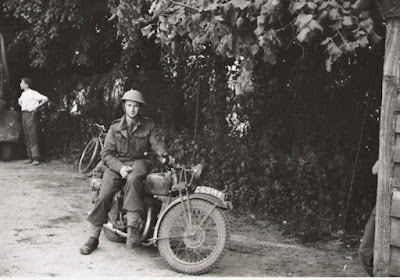
Lt. Geoffrey Keating posed with Royal Enfield motorcycle in 1940.
(Imperial War Museums Collections F 4776)

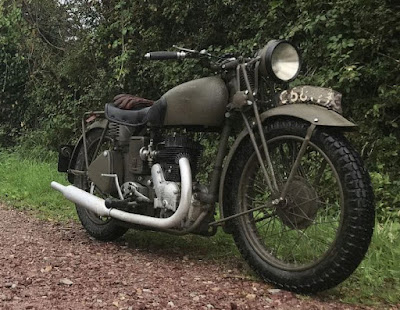
 A Royal Enfield military motorcycle, lost in the British Army's evacuation of France in 1940, and probably hidden under false documents and civilian paint after that, is found, rescued and restored.

 Incredibly it's the very motorcycle in a wartime photo of it in khaki paint, posed with the combat photographer who may have used it to document the BEF's final days in France.

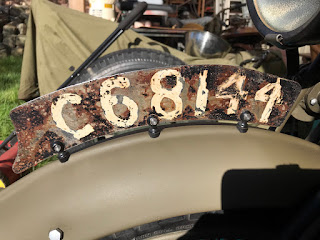
 In the photo from 1940 the Royal Enfield's front wheel is turned, as if to show off its registration number. It's almost as if the photo is a message across 80 years: "Find me!"

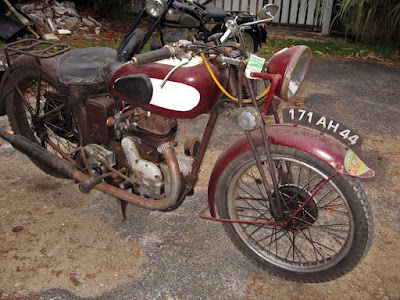
 The Royal Enfield is a WD/C, a side-valve, single-cylinder motorcycle probably sent to France with the British Expeditionary Force as a utility vehicle. Jan Vandevelde, a student of Royal Enfield military motorcycles, discovered it in France, where it was being incorrectly restored as a pre-war Royal Enfield.

Before that it had been used by a priest, somehow picking up a variety of incorrect parts from other makes and being described as an older motorcycle, perhaps to create a false history for it.

Royal Enfield motorcycle in civilian colors.
As originally found, the Royal Enfield had many non-original parts

Jan has found other Royal Enfield WD motorcycles, and owns one similar to this one. He recognized the Royal Enfield as likely having served with the BEF, although its crankcase lacks an important identifying number.

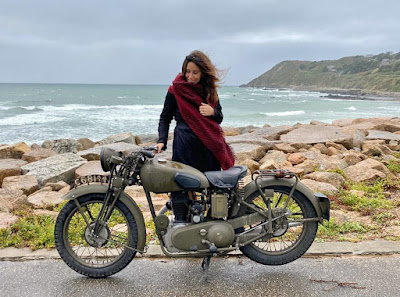
Alex Schmidt of Holland, a collector of military vehicles, acquired the motorcycle in 2018 and began an exacting restoration to return the Royal Enfield to its military appearance.

If he was aware of the 1940 photograph of a Royal Enfield WD/C with Lt. Keating, he "had not given it much thought really...," he told me in an email.

"My mate Ron Pier in the UK, whom I had commissioned to do the restoration, as he had already done 10 Enfields or so, and he knew how everything had to be... I asked him not to sandblast the front number plate, as there was a thick layer of black paint on it, and could reveal something; so he said that I best take the plate home with me and sand it off myself.

"So I did!

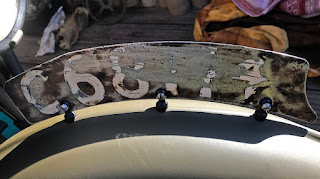
"It took me a couple of afternoons to carefully wet and dry sand, and the number came from under the layers; the Frenchman had put the French registration on with sticky self-adhesive numbers, so that was easy to remove."

Alex even wrote on the Historic Military Vehicles Forum (HMVF) in March, 2020 "Hopefully I can retrieve the C number on the front number plate; there's something under the layer of high build primer."

He was correct. In April, 2020, he told the forum:

"OK, sorry, long time, no updates, but since I have the bike at home, I've done 91 miles, and it's a very nice bike to ride!! Have found out about the history as well, and did various technical jobs, I knew that needed to be done. But the icing on the cake was that the front number plate revealed that this is the bike that Lieutenant Keating was sitting on in June 1940!!!"

Woman with restored Royal Enfield motorcycle.
A friend poses with Alex Schmidt's restored Royal Enfield WD/C.
(Photo courtesy Alex Schmidt)

While the motorcycle's war record isn't known for sure, Lt. Keating's history is known, and it's a proud one.

When the Second World War broke out in September, 1939, just one Army photographer, Geoffrey J. Keating, accompanied the British Expeditionary Force to France.

Born and educated in London, of Irish parents, Lt. Keating was a 25-year-old former Fleet Street journalist now serving as an (unarmed) War Department photographer. By the time of the photo with the Royal Enfield he already had covered the British expedition in Norway in April, 1940.

Later, as a Captain, he would photograph the Long Range Desert Group crashing over a sand dune in a truck on March 27, 1941; Churchill in a pith helmet viewing positions at El Alamein on July 8, 1942;  and cheery generals Eisenhower and Montgomery together in North Africa on March 31, 1943.

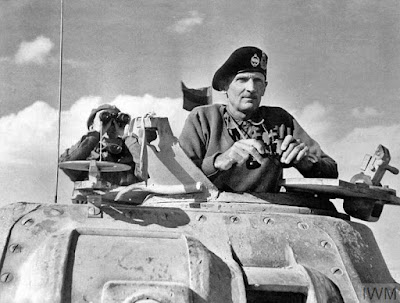
His is a photo of Monty in his beret, binoculars in hand, watching the beginning of the German retreat from El Alamein from the turret of his Grant tank, Nov. 5, 1942.

Gen. Montgomery with beret on tank.
Gen. Bernard Montgomery views enemy retreat at El Alamein.
(Geoffrey Keating photo, Imperial War Museums Collections E 18980)

Wounded several times, Keating eventually was with the army in Sicily, Italy and Normandy and was present at the German surrender to Montgomery in Luneburg.

He rose in rank to Lieutenant Colonel, head of the Army Film and Photography Unit, 8th Army, adding the initials "MC" to his name with the award of the Military Cross for gallantry in Tobruk in 1940. 

"Former Catholic Press photographer 'captures' Sicily town singlehanded," reads one wartime press clipping about him.

But on June 7, 1940, Keating was a lieutenant leaning on a Royal Enfield motorcycle near the Bresle River, and looking pretty composed, given the circumstances, which were alarming.

The evacuation of Dunkirk had ended on June 4, but thousands of British troops and British vehicles and weapons still remained in France. On June 5, German divisions had pushed back the depleted French and British divisions to the Bresle. This was the final German offensive, which defeated France.

From here on out, Keating would be covering a catastrophe.

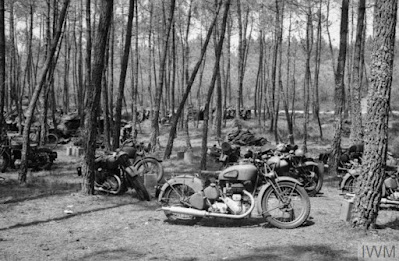
He shot a photo captioned "Abandoned British Army motorcycles at Monce-en-Belin near Le Mans," dated June 13, 1940.

Motorcycles abandoned by British Army.
British Army motorcycles abandoned in the fall of France.
(Geoffrey Keating Photo, Imperial War Museums Collections F 4841)

Keating's photographs typically show things in good military order, soldiers calmly getting on with business despite crisis. Perhaps that's just the way it was in the British Army, or perhaps it was his job as a War Department photographer to make sure everyone had his cap on.

But he also has photos of abandoned and burned lorries, and trucks being used to block roads on the outskirts of Cherbourg, dated June 13.

Dated that same day, he has a photo of British vehicles neatly lined up on a quay at Cherbourg for evacuation. The British would leave thousands of vehicles in the flight from France, but some equipment did get away from this port.

Then there is a photo from shipboard entitled "British and French troops on board ships leaving Cherbourg en route for Southampton," also marked June 13, 1940. This suggests how Keating escaped. He must have been on that ship to make the photo.

In the photo with the Royal Enfield, Keating is thought to be holding a light meter. Was the Royal Enfield his machine, or just a place to perch for a self-portrait using the camera's timer?

Perhaps he wanted to mark the roll of film (which would be processed by others) with his picture so it would be recognized as his work. Maybe he just wanted to use up the last shot on the roll so he could get the camera reloaded.

Restored Royal Enfield WD/C motorcycle.
Alex Schmidt's restored Royal Enfield C68144.
(Photo courtesy Alex Schmidt)

Close-up of number on license plate.
Close-up clearly shows C68144.
(Photo courtesy Alex Schmidt)

Other side of license plate show C68144.
"C68144" is even more clear on other side of plate.
(Photo courtesy Alex Schmidt)

Keating's wartime photos are in the Imperial War Museums collections and can be viewed at the website GJK Images.

In the years after the war he became head of public relations for British Petroleum, which meant travel to exotic locations and contact with international leaders, politicians, diplomats "and the like," according to one obituary.

"He made an unparalleled contribution to Anglo-Middle East relations at that time in history," the obituary states. His job included "special duties," and he "spoke fluent Arabic."

"Apparently he liked to be called an Irish adventurer; I would also call him an international man of mystery!" daughter Rima said of him. He died in 1981, at only age 66, at home in London.

Looking at the 1940 photo I think Keating had a connection to that Royal Enfield, even an affection for it. Maybe it had just been issued to him and he was proud of his new ride. Or perhaps he was moving on as the enemy approached, and the photo was made to remember the one he left behind.

Alex is in contact with Keating's daughter Rima, and hopes to fill in more details. Perhaps she will remember hearing her father tell a story about a little motorcycle in the great war.

Photos in the Imperial War Museum Collections show that Keating shot pictures in France as early as September, 1939, the start of the war. But he left to cover the Norwegian campaign in April, 1940. He was in Norway as late as April 30, 1940, when he shot a photo of HMS Bittern ablaze after an attack by Stuka dive bombers.

He is definitely back in France by June 6-8, 1940, as he has a photo captioned "men of the 7th Argyll and Sutherland Highlanders, 51st Highland Division, holding a position in the River Bresle area, 6-8 June, 1940."

The Highlander's Stag Head insignia is seen on the fender of the truck in the background of the photo of Lt. Keating and the Royal Enfield motorcycle.

A photo of an exhausted soldier sleeping on board the MV Royal Sovereign en route to Southampton, in the evacuation from Cherbourg, is dated June 13, again suggesting that is the date Keating himself escaped France.

The fact that so many of his photos are dated June 13 might suggest that the date was arbitrarily applied when all his film was processed and printed on his return to England. Or, perhaps, he simply shot every interesting subject he could find on that, his last day in France, since there was no longer any need to hoard his supply.

I first learned of Lt. Keating and the recovery of his motorcycle from Andreas Papadakis on the Royal Enfield Owners Club-International-Greek Branch Facebook page. Always something interesting there!

Friday, June 4, 2021

One woman's story of riding for Britain in World War II

Women soldiers pose with motorcycles.
ATS women dispatch riders on Royal Enfield motorcycles in 1943.

It's a classic wartime photograph, and now we know a bit more about it.

The time is 1943, and the five young women in uniform are dispatch riders for the British Army's Auxiliary Territorial Service, assigned to the great military base and naval dockyards at Chatham in Kent. Their three motorcycles are Royal Enfield WD/C models.

The women are identified on the back of the photograph as, from left, Bobbie, Vera, Eileen, Joan and Joyce. We know only Joyce's full name, as the photograph was kept by Joyce Preece.

Joyce's daughter Lorna Sargeant recently emailed me a scan of it.

We know a good deal about Joyce's service in World War II because in 2005, under her married name Joyce Sargeant, her memories were added to the BBC's WW2 People's War archive.

A 1945 photo of her in uniform on a Royal Enfield WD/CO motorcycle appears with the BBC memoir.

You can still read online most of what Joyce wrote at this link.

It's a light-hearted story of a very brave girl, 20 years old in 1941 when she joined up. She'd never driven even a car before but was accepted for training as a driver, starting on three-ton lorries. Later she'd volunteer for training as a motorcycle dispatch rider and was "thrilled to pieces" to be accepted.

Unfortunately a few key paragraphs Joyce wrote are omitted from the online archive. Joyce died in 1999, but Lorna was able to find and email the missing bit, which completes a fascinating story. I'll get to that in a moment.

First, it's helpful to know two things:

One, the Auxiliary Territorial Service was the women's branch of the British Army during the Second World War and since members were originally volunteers they were at first required to salute only their own officers. That changed in July 1941, when they were given full military status.

Two, the popular phrase "What is this, Scotch Mist?" became current after 1940. "Scotch mist" is an ironic term for rain in Scotland. But the phrase "What is this, Scotch Mist?" is roughly equivalent to saying sarcastically "Oh, yeah? Well what do you suppose this is, then?"

The "missing part" of Joyce's story goes like this:

The Despatch Rider course like all the others, passed too quickly and before long we were on our way back to Chatham, all of us proudly having passed the course. Four of us bike-riders shared a bedroom in the Victorian house, way up in the attic. Eileen came from Tottenham, Ver's home was Hull, Joan came from Cornwall and I was the Essex girl from Woodford Green. Our friend Bobbie made up the fifth member of the team.

There was often much amusement in being a Despatch Rider. We rode around Chatham wearing leather jackets, riding breeches, knee-length leather boots and, of course, crash helmets. We were all slim in those days (not so now!) and must have looked like men in the crash helmets with our hair all tucked out of sight; but we still wore our make-up as usual.

One day I was taking the post down to Chatham Post Office and when I came out four sailors were lined up alongside my bike each nudging each other and saying 'go on you ask,' 'no you ask,' 'no you,' but none of them had the courage to ask what they wanted to know: was I male or female?

So I got on my bike and said to them "So what do you think I am? Scotch Mist?" and rode off on my trusty bike.

One day I rode into a near-by barracks and on entering the office almost bumped into a rather gorgeous blond officer, but he scowled at me and walked past. I went to see the Regimental Sergeant Major I had to deliver the package to and was amazed when he bawled at me, at the top of his very lungs: 

'What’s the matter with you soldier, don’t you salute an Officer when you see one?'

I was so shocked, I couldn’t answer him. I just blushed scarlet, dropped the package on his desk and fled. I reached my bike and kicked the engine over to start it up. I was furious to hear roars of laughter coming from the office. Then a sergeant came out and said he had been sent to apologize. All the others in the office had realized the Regimental Sergeant Major had made a mistake.

I was still very angry and told him to go back and tell his R.S.M, 'Yes! I did salute officers, but only A.T.S. officers!' and with that, I roared away on my bike.

I was, though, to see again, my lovely blond officer. He was to attend one of our dances a week later. He came up to me and said. 'I have to speak to you. When I bumped into you at our barracks, I had just been into the office to ask if there was a motor bike available for me to ride and was refused. I went out sulking, and of course when I saw your bike parked there I thought: typical. There's no bike for me to ride but this slip of a girl is riding around barracks on one. I was livid.'

I told him what I thought of his R.S.M and we both finished up having a good laugh. I was to see Blondie often, for we became very good friends. He told me quietly one evening that all the barracks were moving on. By morning, they would be gone. We said our goodbyes.

Many months later, several of his men arrived back at our barracks. Sadly, they told me that Blondie had been killed over in France. He had been on his beloved motorcycle and had ridden straight over a land mine. He was killed instantly. My pillow was wet with tears that night. I will always remember him fondly as an Officer and a Gentleman.

It's well worth taking the time to read Joyce's full story on the BBC website.

And there is more. Daughter Lorna noted there were stories her mother told her that did not appear in the version that went to the BBC.

"For example," Lorna wrote, "if the girls were going out for the night they wore their hair in curling 'pins' under their helmets. One day she arrived on a parade ground with a full troop of soldiers being drilled; the bike skidded, mum fell off and her helmet (which wasn't done up) also came off and the soldiers ran to pick her up curlers and all. She was very embarrassed."

Jan Vandevelde, a student of Royal Enfield military motorcycles, identified the three motorcycles in the 1943 photo as Royal Enfield WD/C models. The model C used a 350cc single-cylinder side-valve motor. The Royal Enfield Joyce rides in the 1945 photo is the WD/CO, the "O" standing for the overhead valve version of the motor in a substantially similar motorcycle.

Woman soldier seated on motorcycle.
Joyce Sargeant on her Royal Enfield WD/CO motorcycle in 1945.


Friday, February 14, 2020

Tiny foam gliders bring aviation museum to life

Front and back of package glider came in, showing what it looks like.
My grandchild has probably loved her foam P-47 Thunderbolt glider to death by now.
On a visit to an aviation museum in Maryland I came across some Styrofoam gliders in the form of World War II fighter planes, for sale in the gift shop.

These little (only 8 inches long) foam gliders have been around for years but they can be hard to find in stores, perhaps because there is so little profit in selling them.

They were only $1 each at the gift shop, a fair price for what, after all, are just flat foam cut-outs of wings and fuselages you fit together and throw. Each has a plastic propeller that fastens to the nose and spins when the gliders are tossed.

The brand name appears to be "Power Prop." Of course, the props receive no power whatsoever except the breeze as they fly through the air.

But never mind that. The gift shop collection included some of my favorite historic fighter planes: the P-39 Airacobra, P-40 Tomahawk, P-47 Thunderbolt and a P-51 Mustang. They might have had a Spitfire. And there were some Japanese and Russian  fighters, which interested me less than the Allied planes.

So I bought a selection, thinking to share them with my granddaughter, who accompanied us to the museum. Not yet two years old, she could say the word "airplane" but I was not certain she knew what an airplane is. (Ironic since, of course, in this day and age, she already had flown several times as a "lap baby" on an airliner.)

Given her age, I thought it best to dole the gliders one at a time. One now, and the next in five years, maybe!

Of course, her first interest was to crush the P-47 I gave her. Styrofoam crushes so nicely.

I'd run across this brand of toy gliders decades ago, in some store, and bought a supply. When assembled they fly OK (not great) but what impressed me back then was the relatively authentic looking markings.

Often these are in "off" shades of color printing, and the foam shapes seem to be cut mostly to resemble Spitfires (elliptical wings) or ME-109s, regardless of their markings. But they are still evocative.

When I got home from the museum this time I Googled the markings on the P-47 glider and discovered that it represents the airplane of U.S. ace Gabby Gabreski. They even got the tiny tail number right! I plan to investigate the others and see what historical connections they may have.

It impresses me that they bothered to even try for a hint of accuracy. Most potential buyers wouldn't know a Navy Hellcat from a Focke-Wulf 190, much less the plane of a particular ace.

The cut-out shapes are not perfect for each particular plane, but they aren't completely random either. For instance, in that first batch I bought, so many years ago, there was a P-38 Lightning, an unconventional, twin-boom airplane. The foam model inside the package made every effort to reproduce that peculiar shape.

Some people collect these things. There's a blog, now dormant, entitled "The Styrofoam Glider Squadron," that gives more information about some really rare airplanes modeled in foam.

Can you believe there was even a foam glider devoted to the odd British Boulton Paul Defiant? That was a fighter plane with all its guns located in a turret instead of in the wings or nose.

At $1 per, these things aren't precious mementos. I kept that first batch for years until a co-worker began bringing her young son in to work some days. The combination of a handy kid and that second-story staircase in the office was perfect. I brought in my collection of foam gliders and the staircase became the boy's wind tunnel.

I tried to make it a learning experience: he taped pennies to the fuselages to help the planes fly straighter. But it was really just pure, destructive fun. He flew the planes (and I fetched them back upstairs) until they were battered beyond use.

I hope my granddaughter will humor me like this someday in the future.

At the museum gift shop I tried to explain my interest in the toy planes to the cashier.

"You have to get more of these!" I bubbled. "They're the best!"

Friday, November 11, 2016

On this Veterans Day, bless 'em all

"To our fallen heroes," my wife said, as we clinked our martini glasses together on Memorial Day last May.

I congratulated her for remembering the service of those who sacrificed their lives, or their well being, in our nation's wars.

"It's all I did do," she said. "At least you put out the flag."

And that had been all I had done.

I should at least have prepared a post on Memorial Day for this blog. So here, on Veterans Day, is what I should have said then.

I've written many times about how my Royal Enfield motorcycle represents to me the motorcycle I'd wanted as a kid, in 1955. My childhood preoccupation with motor vehicles is the foundation for this blog.

Clarence "Lefty" Blasco, U.S. Army,
Ninth Infantry Division, World War II.
But consider this: In 1955, while I was wishing for yet another toy, my father was only a decade out of uniform as a combat soldier in World War II. Ten years is nothing, especially if it is 10 years of not talking about it.

All I knew of that war was what I read in comic books — my father never mentioned it.

If you asked him then about the war, my dad's usual response would be "hmmm." Followed by silence. But he had a Purple Heart in a desk drawer.

His silence didn't encourage me to want to be a soldier. I avoided military service, stretching a school deferment to stay out of Vietnam.

My kid brother, on the other hand, volunteered for the Army. When my dad found out about that, he was angry. My brother would serve his enlistment honorably and, in that day, without much thanks.

When my dad passed away, my brother sent me dad's medals, carelessly mixing in his own in the batch.

"Never mind," he replied, when I offered to return them. He wasn't a comic book soldier, either.

Dad never joined a veteran's group. He would not have wanted a military salute at his funeral.

But that is not to say that he wasn't proud of his outfit. He wasn't joking when, once, he suggested that vets his age, given rifles, could still get the job done.

Laugh if you want, but if you'd heard his tone of voice, you would not have doubted that they would have tried.

So here's to them all, living and dead, with gratitude and admiration.

Tuesday, March 22, 2016

World War II photo of dispatch riders hides a secret

See anything odd about this photo of Royal Navy dispatch riders?
UPDATE: Mark Mumford has cracked the case of "The Mystery Man in London." Why is the fellow on the right blocking the back of the van? Mark writes:

 "The film may have been made by the Crown Film Unit which was the successor to the GPO (General Post Office) Film Unit. The van appears to be a Morris Z Type apparently made from 1940 onwards and used by the GPO. Circumstantial (evidence)? The appearance of the Unit's logo on the van doors maybe spoiled the verite (that's yer actual French,) of the natural feel of the shot as pioneered by the Unit and Director Humphrey Jennings?"

This motorcycle photograph has something to hide. It's the World War II era photograph of Royal Navy dispatch riders I featured recently on this Royal Enfield Motorcycles blog.

The photo of women motorcyclists riding in formation near the Admiralty in London never was meant to go on the Internet. But it has, and now its subterfuge is exposed.

The photo would have been shot by a wartime information (propaganda) department to encourage women to do their bit for the war effort. Prints of the photo would have been widely distributed to newspapers and magazines.

These print publications would have engraved the photo, introducing a dot pattern that disguised any small flaws or retouching.

Sure, the editors would have noticed retouching on the original print. But publications of that time (and even much later) did not object to retouching and in fact most photos approved for publication were retouched to improve their appearance once printed.

Add a little "shadow" around someone's head to make it stand out from the background, for instance.

But this photo has been retouched, not to improve it, but to hide something.

We can see the retouching for ourselves in today's digital format.

In fact, even without close examination in PhotoShop, the photo has suspicious elements. Why is the man at right looking away from the motorcyclists? Why is he wearing such an enormous overcoat? And why is he holding it out in front of him?

That "coat" is hiding something.
He's not holding it that far out. He couldn't be, unless his arms are twice human length. And the coat wasn't originally so big. It was made the size of a tent by an artist who even expanded the collar of the coat in a vain effort to make it seem real.

It's logical to conclude that whatever the "coat" is hiding has something to do with that van behind it. It's a tidy little vehicle, not big enough to hold anything or anyone very important. Why go to the trouble to disguise any markings or registration numbers on it? Note that the vehicle behind it is clearly showing a partial registration number.

My guess?

Well, we suspect from my blog item that this same group of Royal Navy Wrens spent a day riding around the Admiralty building in London as still pictures were shot.

But I also believe that motion pictures of them were made, and that they are the same women who appear in this short film clip from the 1943 documentary The Battle of Britain.

That's the key. Motion picture equipment is bulky and likely got to the location in a van like the trim little vehicle we see in the photo. Something written on the back of that van gave away the photographer's presence. It turned a supposedly unposed photograph into an obvious set-up.

Propaganda isn't nearly as effective if we don't believe it's the truth.

Perhaps the man staring out of the photo in the greatcoat was positioned to block the van, but didn't succeed in blocking enough of it. Luckily, a skilled artist was on hand to do the job with a paint brush.

It was unforeseen that we would ever see through the make-up job.

One last thing: what makes me think the retouching was done by the official department (Royal Navy?) that originally distributed the photo, rather than later by some random newspaper or magazine?

Simple. In my experience, newspaper artists were so loaded with work, and most newspaper printing was so poor (and thus forgiving), that retouching at that level was much less careful. It's the attention given to the collar of the coat that convinces me this was a careful counterfeiting job.

Collar is too big, and you can see through it!