Showing posts with label V-twin. Show all posts

Friday, February 28, 2025

V-twin, hand gearchange, foot clutch? Yes

Motorcycle gearbox has odd extra lever.
Can you see the little black pedal behind the kick-start lever? It operates the clutch. (Mecum Auctions Photo) 

 I had to puzzle over a feature I noticed in a photo of a 1930 Royal Enfield Model KL sold at the January, 2025 Mecum auction in Las Vegas. 

The 976cc side-valve V-twin sold for $27,500 at auction. Its description said that it had been used by a dealer in Oldham, UK, to collect motorcycles, using a sidecar. 

The big side-valve V-twin was "Royal Enfield's ideal sidecar puller," the auction noted. 

This machine was restored in the 1990s and was part of the David Silver collection. 

Its gearbox is a Sturmey-Archer three-speed. What caught my eye was a small pedal on the gearbox, obviously meant to be operated by the heel. 

It's not the brake pedal, or the kick starter, both of which are visible nearby. 

I wondered: could it be a neutral finder? Royal Enfields did come with gearbox neutral finder levers after World War II, but not in 1930.

After examination I concluded that the pedal on this Model KL (the "L" means it came with lights) operates the clutch. It serves as an auxiliary to the normal handlebar clutch lever, which is present on this machine.

I think I can see the little pedal connected to the same cable that appears to come from the handlebar clutch lever. I sure hope that is one strong cable!

My first thought was that such a feature would be rarely used. I supposed a rider would benefit from having both hands free, should he wish to wait momentarily at a crossing with the motorcycle in gear.

The Model K V-twin was often linked to a sidecar, and so it would have been easy to sit at a standstill with a heel on the lever and, say, refill the bowl of your pipe.

But that's wrong.

Clutches were meant to be used momentarily, while shifting gears, and no responsible motorcyclist would have sat with his foot on the clutch pedal, adding unnecessary wear.

Besides, imagine finessing the clutch engagement with your heel when moving off. Yes, you can do it nicely in a car with a manual gearbox, using the ball of your foot on the pedal. My heel is not nearly so exacting! I'd stall it for sure.

I don't think the this foot clutch was used to move off, but I think it nevertheless was a valuable feature, and probably led to a whole different style of riding. I imagine it went something like this:

No need to finesse the disengagement of the clutch -- just drop your whole leg on that pedal when you want to stop.

Remember, it's 1930: your gear shifting is done by your right hand, using the lever attached to the gas tank. Once your heel is on the clutch pedal, put the gearshift into neutral. You can now lift your right foot off the clutch pedal and push on the rear brake pedal, to bring the motorcycle to a halt.

(The little pedal had to be short, so as not to interfere with that rear brake pedal, which is also on the right side on this motorcycle.)

When it's time to move off, you again drop your leg onto the clutch pedal to disengage, move the gearshift into first, and firmly grab the (now slack) left-hand clutch lever; then lift your heel off the clutch pedal. Gently release your grip on the clutch lever, and off you go.

Thus the heel does the hard work and the left hand does the delicate job of letting in the clutch. I'm sure a skilled rider would eventually always use his heel this way, a real savings in effort.

Graham Scarth of the Royal Enfield Owners Club (UK) studies the factory records the club owns. He agreed that the pedal I saw is, indeed, a foot clutch, and added that a foot clutch is "listed against a few of the later 1,140cc KX machines."

Wait! This made me wonder if the little heel clutch pedal was a Royal Enfield factory item.

Let's cut directly to the answer: No.

I sent the photo of the auctioned motorcycle to Axel Winklebauer, of Germany, who is familiar with Royal Enfield V-twins, and other period motorcycles. He replied:

"I have seen such a short pedal on other vintage bikes of the '20s, but it is not original on an Enfield Model K."

1930 Model KX with short clutch pedal.
Licensed GO7815, this is the only 1930 Model K I've seen with the short clutch pedal. (Mecum Auctions Photo)

I've looked at photos and illustrations of 1930 Model Ks, and can see no other examples fitted with the short clutch pedal. Perhaps this was an accessory or an early owner's clever creation.

But Graham was correct: later Royal Enfield V-twins would get clutch foot pedals. These would be much more substantial, full-length pedals, operated by the toes.

And, sure enough, in the press clippings in the Royal Enfield Owners Club (UK) archives is a January, 1933 article from The Motor Cycle magazine, introducing the new 1,140cc big twin for 1933.

"Since strong clutch springs are required with this type of clutch when running in oil, a large leverage has been arranged and the clutch may be operated by either hand or by foot," the article says.

1933 1,140cc V-twin for foreign markets.
January, 1933 article in The Motor Cycle. Note that the hand gearchange lever is missing, moved to the left side. Clutch pedal is on the left, as well. Not clear how it connects to gearbox. (REOC Archives Clipping)

But wait a minute. Confusingly, the clutch pedal has shown up on a model not available in England, and on the "wrong side" of the motorcycle!

The same month, the other great British magazine, Motor Cycling, described the new 1,140 as "Especially for Overseas Riders and Police."

"It will definitely not be available in this country," the magazine advised UK readers. Instead, it was adapted to countries with "right hand rule of the road."

The hand gearshift lever had moved to the left-hand side of the tank on this "overseas" machine, and so had the foot clutch pedal.

Foot clutch pedal on left side of motorcycle.
Foot clutch pedal of the "overseas" 1,140cc V-twin, illustrated in January, 1933 Motor Cycling. (REOC Archive Clipping)

An illustration showed the foot clutch pedal on the left. It is clearly so long that it would have interfered with the rear brake pedal if it had been installed on the right.

The caption of the illustration specifies that an "auxiliary" hand lever was fitted as well.

Britain would have to get by without the 1,140cc version of the Royal Enfield V-twin. But not for long. 

And now the hand gearshift lever on the tank and the long clutch pedal would move to the right, as they should be, for Britain. The clutch pedal would displace the rear brake lever, which would move back to the left side of the motorcycle.

Photo shows how clutch pedal worked.
The clutch pedal is back on the right, and you can see how it worked. (KX Owner's Archive Photo)

Jan-Peter Mueller-Kose of the KX Owner's Archive sent me a photo of a later KX foot clutch pedal. If you study it you can see exactly how depressing the lever with the foot would operate linkage, alongside the handlebar clutch cable, to disengage the clutch.

Photo of 1938 foot clutch mechanism.
Another look at the foot clutch lever, from a March, 1938 publication. (REOC Archive Clipping)

More details came from Allan Hitchcock, of Hitchcocks Motorcycles, who provided the November, 1935 Royal Enfield engineering drawing for the foot clutch lever of the 1936 1,140cc Model KX. (Hitchcocks has a collection of the original UK factory's technical drawings.)

This drawing shows an overall length of 11 1/2 inches, or 14 inches if the lever was to be used with floorboards. Substantial, indeed!

Drawing shows design of foot clutch pedal.
Engineering drawing for 1936 Model KX clutch pedal. (Hitchcocks Motorcycles)

Motor Cycling's introduction of the new Royal Enfield models for 1938 gave this description:

"A foot clutch and hand change is fitted to the K and KX (deluxe) as standard equipment, but a hand clutch and foot change can be fitted for solo work only for one pound extra."

Note the reference to "solo work." The foot clutch really made sense only if you were hauling a sidecar. Riding solo, you'd prefer to have that foot available to put on the ground when you came to a stop.

Incredible how the motorcycle adapted over the years to the human body. We have only so many hands and feet; hands are flexible but weak, feet are powerful, but the heel will not dance like the ball of the foot.

Hitchcocks Motorcycles lists Part No. 23326 "Clutch Foot Pedal," but states it is "currently unavailable." As the engineering drawing shows, No. 23326 would be the long, 11 1/2-inch clutch pedal, not the mysterious little shorty that caught my eye in the Mecums auction.

Line up of 1938 Model Ks for police.
Line up of solo machines from a January, 1938 publication. (REOC Archives Clipping)

The big side-valve Royal Enfield V-twins were popular with tradesmen for pulling sidecars. Police liked them for their relatively high speed. (A solo 976cc model was advertised as capable of 70-75 mph on level ground.)

They would finish up in 1942, and not return after the war. With so many surplus military 350cc motorcycles on the market, most with overhead valves for power and fuel economy, the day of the Model K was over.

They must have been awesome to see, even more impressive to ride, and they still have their admirers.

Friday, February 22, 2019

Concept Kx meant to create an impression that lasts

Filippo Corticelli, Royal Enfield chief designer, was at the International Motorcycle Show in Chicago this month with Royal Enfield's surprising new Concept Kx.

The Concept Kx — introduced to the world in Milan last November — is surprising because it is unlike any Royal Enfield motorcycle since World War II: very low, very sleek, and with a muscular looking V-twin motor at center frame. It is meant to evoke the Royal Enfield KX V-twin of the 1930s while employing modern technology.

I couldn't get to Chicago, so I was pleased when Filippo Corticelli immediately shot back the answers to questions I asked him by email. His responses below include an important correction to mistaken information I published earlier about the origin of the motor in the Concept Kx.

Q. Do I have your title right? Group Manager, Industrial Design, Royal Enfield? Could you tell me a little bit about your background and other designs you've worked on?

A. That is indeed my title. It is roughly equivalent to "chief designer" in the car industry.

I was born in Italy and started my professional design career in the mid-nineties at Honda's advanced design studio in Japan. I then moved on to Ducati, where I was part of the team responsible for the 999 and the first gen Multistrada. At Yamaha I was mostly involved in scooters for the European market, such as the first X-Max and the little Neo's. I went independent for a few years, mostly consulting on performance cars (mainly Aston Martin and Lotus), before spending two years in China as digital design head for Geely (the group who owns Volvo cars and more recently Lotus). When I was offered to get back into motorcycle work I didn't hesitate for a second, and joined Royal Enfield in early 2015, one of the first handful of UK based staff.

Man standing in front of mock-up of proposed Concept Kx.
Watch the video of Filippo Corticelli describing the Concept Kx.
Q. In Royal Enfield's Concept Kx video you emphasize the importance of the team in design, as opposed to some iconoclastic single creator. How how big was that Kx team? Regardless, are you the individual who held up the original KX and said "this should be the target" or goal, or the inspiration?

A. While I was the person who first identified the KX as something that would be awesome to work on, during the early concept phase the bar was held up high by the head of industrial design Mark Wells, who pushed all of us not to compromise an inch on the proportions of the original bike and gave us the ambitious requirement of a concept model that should create a long lasting impression. I then had the privilege and opportunity to be in charge of making this concept happen, fine tune the appropriate balance between heritage and futuristic elements, and deliver the finished article to a very high standard, down to all the little details that (we're glad) everybody noticed and got excited about.

At Royal Enfield, all projects are open from the start to all our designers across both locations (India and the UK), then each project team narrows down later. Once Concept KX reached the physical stage, I was supported by young designer Antoine Borsik who came up with the strongest idea among all for the front end of the bike, Nick Graveley who is a very expert contract clay modeller, and Antonio Tentorio who is one of our two concept engineers. The Concept KX would not be what it is without any of them doing their absolute best — it was the hell of a team.

Q. In the video you indicate that the V-twin motor and long, low lines were the starting points. Is that correct? 

A. Absolutely. The V-twin is a celebration of our mid- and late thirties Model KX, which was the largest capacity motorcycle built in Britain before World War II and also a V-twin. The "proportional guide" for the bike is as shown here below.

Original motorcycle with marks showing component alignments.
Original Royal Enfield KX of 1937 shows off its lines.
Q. One of my readers noted that the big motor is the most striking aspect of the design. It reminded him of the Vincent Black Shadow. To me, while Vincent motors were undoubtedly beautiful, the Concept Kx motor looks "emphatic." It seems to have its lower jaw thrust forward in an almost combative expression. It's muscular rather than beautiful. Your reaction?

A. Hopefully that is answered in the image above — the protruding crankcases "chin" was a unique visual element of the old KX.

The concept motorcycle with lines showing component alignment.
...and the same elements are visible in the new Concept Kx.
Want to seem more? Here's a link to the best collection of Concept Kx photos.
Q. It's startling for Royal Enfield to show a V-twin at this moment, when it has a long recent history of making only singles and is just now introducing new vertical twin motorcycles. Was it exciting at this stage to be handed another whole new set of possibilities?

A. Other than the much higher excitement that V-twin seem to provoke in people compared to a parallel twin, again this was an opportunity to remind the world that Royal Enfield produced  V-twin motorcycles from 1909 to 1938. The engine was indeed at the heart of this concept: it was very interesting to size up a V-twin and give some thought to what could be a good engine capacity to work on, explore the upper end of what our brand could carry whilst keeping to our mission and concentrate on the "middle segment."

Speaking of the powertrain, I also would like to correct what is written on your blog here: "The liquid cooled, dual overhead cam motor developed out of a now ended partnership between Royal Enfield's parent company Eicher and Polaris Industries, maker of Indian motorcycles." There was indeed a short collaboration with Polaris in the past, but that went away before anything relevant could come to fruition. We have therefore been absolutely clear that nothing shown by our Company would and/or could be linked to that joint-venture — not even the cylinder layout or the (single, not double) overhead cam setup. I am sure you will understand this is a sensitive subject, and is definitely one of the key points I would have been more than happy to explain in person, rather than reading later about factually incorrect speculations.

Note: I regret the error and have removed that from this blog. — David Blasco.

Q. Is it uncouth to ask whether the Concept Kx motor could have been polished? In photos its finishes look soft. Your reaction (which I hope is not to take offense!)?

A. We looked at a number of finishes, including fully polished or gloss black like the original chain cover. The choice of the current powdercoated finish was chosen to complement the satin copper details with a related darker hue. Photos don't give it much justice. Allow me to also risk being uncouth and say, especially not the current photo on your website, taken with a cameraphone and with the flash on!

Side view of new Concept Kx.
A fully lit photo of the Royal Enfield Concept Kx.
Q. The Concept Kx is not only a styling showpiece, the technology it displays is remarkable. The monoshock rear suspension designed to look like a hard tail, for instance, and the girder front suspension. There is so much going on here aside from styling. How did you define the mission?

A. The goal for concepts is generally to show ideas that would have as a priority to be perceived as unique (i.e. not seen on other motorcycles before) and believable, rather than fully production feasible. The rear suspension layout was one of the most controversial points during development; we looked at four or five different ways to do a modern take on a hard tail. The same for the girder front resolution integrating the headlamp nacelle, which is the result of several iterations including tubing, pressing and suspended or integrated lamp.

Q. The original KX was often engaged in pulling sidecars. Was it ever considered to design a sidecar to go with the Concept Kx? Perhaps it could have emerged as something like a gentleman's Ural?

A. The original bike compelled us to show it as a single seater; we have not developed a sidecar — not a bad idea actually, I might take you up on that if we ever get the chance to take the Kx further!

Q. Is the Concept Kx rideable? And this may be irrelevant to a styling exercise: is the motor even real?

A. While the motorcycle is fully packaged, the engine has no internals and the shocks are locked rigid. Part of the loom works, so that you can switch on DRLs and light up the speedometer. Therefore it's not a runner, but more of a pusher — believe me, it's hard work to bring it up and down stands and trucks, with some delicate parts and with no fluid in the brakes!

Q. At its introduction Royal Enfield waved off questions about whether the Concept Kx would ever be produced. Mark Wells said in the video that it was to be designed "without the constraints of production." But, if the public demanded it? What do you think about a Kx for the 2020s? My reader suggested that it could be a premium model, produced by Royal Enfield but positioned above the rest in the market place.

A. Working on a concept is similar to what Morpheus said about the Matrix: "some rules can be bent, others can be broken". The layout was done taking into account everything that makes a bike work, from the airbox to silencer volumes. On the other hand, we were free to cheat, slam and exaggerate some features, like on all concept cars that you see. We are of course glad to see that our brand can apparently "carry" a more premium product than our current 650 twins, but whether that actually results in an action plan or not is a much bigger and delicate discussion. We have made clear that the Concept Kx is not something you should think about putting down a deposit for, and please don't let it stop you doing that on a brand new 650 twin!

Q. What is the future for the Concept Kx itself?

A. The plan is for the KX to be experienced at a few more motorcycle venues around the world. Some day I hope it will return "home" to the UK in one piece, and be on permanent display in our office entrance lobby, next to the old '37 that inspired it.

Q. You were obviously aware that in the Interceptor there would be reference to the 1960s, a period my cohorts recall with some fondness, as we were young and the Interceptor was the pinnacle of our aspirations. But with the Concept Kx, the choice was made to refer to a Royal Enfield history — of the 1930s — that few living people recall first-hand. What motorcycles are we familiar with today from the 1930s?

A. All the fifties and sixties have been "redone to death" already in motorcycle styling, so it was immediately appealing for us to have the chance to work on a different part of our history as a celebration of the twins. We found our KX as a survivor still in regular use on a farm estate and just fell in love with it, simple as that. Like you say, the thirties are a time not many people alive today would have experienced first hand, which makes it even more worth remembering and get people to talk about.

Friday, October 31, 2014

Musket V-twin Royal Enfield order form posted

The Musket V-twin Royal Enfield. Now you can order one.
"Awesome." That's what I called a Jan. 1, 2009 YouTube video of a home-made Royal Enfield V-twin starting and running as the excited young man who built it rejoiced.

"What do you think of THAT!" he yells, as the motor runs. Royal Enfield enthusiasts around the world loved it, and have viewed it 186,000 times so far.

Now Aniket Vardhan has posted the order form for the complete Musket V-twin Royal Enfield.

There are six motors available, for now, to customers in the U.S. You can buy it as a kit for $5,990 or have Aniket put it together for you for $12,750 plus your good donor iron barrel Royal Enfield Bullet 500.

Extras — such as Carillo rods and roller big ends to withstand the Ace performance modifications — will cost extra. Many things will cost extra as your Bullet clutch, just for instance, will have to be in good condition to suddenly confront 998cc.

The Musket is, obviously, a custom product. Any illusions you might have about how cheap and easy it would be to double the size of the old Royal Enfield motor and put it into a Bullet frame will disappear when you view the step-by-step photo gallery.

Many enthusiasts have day-dreamed about making a V-twin out of the Bullet and returning it to the glory days before World War II when you could have purchased a Royal Enfield V-twin from Redditch, England.

Aniket Vardhan, a young Ohio man originally from New Delhi, did it. That was impressive. The fact that he has made it possible for you to come along on the ride is, well: Awesome!

Monday, January 20, 2014

Norcroft Royal Enfield V-twin project roars back to life

Back on the road again: the Norcroft V-twin Royal Enfield.
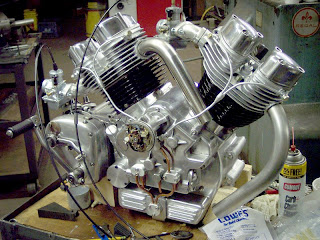
Before there was a Musket, Bill Hurr and Richard Hurst of the UK built their own Royal Enfield V-twin. Their 2004 effort went as far as a running prototype. Now Paul Crowe reports in The Kneeslider blog that their Norcroft V-twin project has been revived.

There's a new website, with pictures of castings — made in India — for the bottom end of a new motor. The website suggests production would be in India, where there certainly would be huge demand for it.

The hope of Hurr and Hurst had been to build a classic British V-twin. Bore and stroke of the Royal Enfield Bullet matched that of the iconic Vincent Black Shadow.

The prototype proved the soundness of their engineering, but financial constraints and "increasingly stringent legislation" put plans for limited production on hold.

With new backing and a production connection in India, Norcroft now hopes to go forward.

There's a clever video, shot in December 2013, of the prototype on the road. It ends with "To Be Continued."

It's worth a look:


Friday, October 18, 2013

First Royal Enfield lines up to become a Musket V-twin

The first "customer" Bullet ready for conversion to a V-twin Musket.
Whatever else happens to it, the unassuming Royal Enfield Bullet shown here will always have the distinction of being the first customer bike converted into a Musket V-twin.

Aniket Vardhan, the young Columbus, Ohio man who built his own double-barreled Bullet in 2009, recently announced that his design is about to go commercial.

And now, "Here it is, the very first customer bike," he wrote on his blog.

"An immaculate 500ES, ready for the full treatment. Got here last week, practically unused, a bare 600 miles on the odo. Belongs to a collector from Massachusetts who has been very supportive throughout the project and expressed the clear intention to have a Musket done as soon as things got rolling production-wise.

"Well, he bit the Bullet, shipped it over to me and here we are! This complete build for a customer bike will be very useful in calculating the costs for the whole job for those who would rather go that route.

"Will be putting heart, soul and body into this machine; hope I can handle the stress of sending it out when done, with the hope that it gives the owner many miles of smiles and doesn't drive him nuts."

This gallery of photos of Aniket's prototype 998cc Musket gives some idea of what the customer bike will look like when done.
The award-winning 998cc Musket prototype.

Tuesday, July 23, 2013

The Musket V-twin Royal Enfield heads for production

A Royal Enfield with twice the motor?
A limited production V-twin for the Royal Enfield Bullet is closer than ever, advises Aniket Vardhan, of Columbus, Ohio,  in a recent update on his 998cc Musket project.

The update appeared on the Royal Enfield Yahoo Group. Its members include potential customers hoping to get in line to buy a V-twin kit that Aniket says will turn a Bullet into "an absolute beast."

He invited anyone interested to contact him through the group, with questions or feedback.

"In about a week, my first production batch (around five engines) will begin; the new patterns are at the foundry," he wrote.

The rest of his message provided a capsule history of the project:

"Some of you might remember the 700cc Musket V-twin completed in 2009... I've spent the last three years completely redesigning the concept from the point of view of a practical bottom end kit available to riders. All new patterns, castings and machining on the new prototype were completed a few months ago and it has now done 1,500 miles...

"The V angle is now a more compact and 'classic' 59 degrees versus the wider 70 degrees of the 700. This resulted in a more compact engine that is much simpler to install in the frame...

"The oil filter is now the paper element Enfield UCE one, freely available. The filter housing is now incorporated into the timing cover casting as opposed to the exposed housing with additional oil lines...

"The ignition housing is now formed into the timing cover apex...

"Last but not least, the new design allows either 350 or 500 top ends to be chosen by the rider for a 700 or 1,000cc engine. The 700 with its much lighter pistons is a smooth, mellow and understressed option. BUT the new 998 is an absolute beast. I have to say, the pull of that thing the first time I opened it up was a bit scary!"

Monday, February 4, 2013

New video of Royal Enfield V-twin, The Musket 998

The smile on his face tells you how well his Royal Enfield V-twin runs.
Aniket Vardhan gives us a hint of what it's like to ride his homemade Royal Enfield V-twin in this new short video of The  Musket 998 running through a parking lot.

He writes: "After a long freezing cold stretch, a gift from God — a 60 degree day in late January! Obviously, some noise had to be made! Had to do this quick, after work, before the sun went down. Had no helmet at work, I know, tsk tsk, shame on me, but needed to grab the moment. Did I mention that this thing GOES."

The smile on his face says it all, but turn up the volume anyway.

Wednesday, January 23, 2013

Musket 998 V-twin does Royal Enfield one better two ways

Aniket Vardhan's Musket 998 is not just beautiful looking.
"Aniket's Musket 998 is a study in persistent pursuit of a goal," Paul Crowe writes in The Kneeslider,  commenting on the remarkable progress of a home built (but professional looking) Royal Enfield V-twin.

In 2009 I called Aniket Vardhan "The Man Who Built His Own V-Twin Enfield." The Columbus, Ohio industrial design teacher  (originally from New Delhi) was seen on YouTube almost dancing with joy as his combination of two 350cc Royal Enfield Bullet motors roared to life.

He built a beautiful looking stretched Royal Enfield motorcycle — the Musket — around that motor.

Then Aniket  revealed that he intended to improve on it with a 1,000cc V-twin in a better Musket. What a pleasant day dream you'd have assumed, expecting that time and tides would surely interfere to prevent it.

Persistent pursuit of a goal, indeed! The Musket 998 exists and is inspiring more dreams as enthusiasts hanker to own it.

Many hurdles no doubt remain. But how can you count out anyone so determined?

Most reaction to Crowe's article focuses on the difficulty of gracefully curving the V-twin exhausts to each side of the motorcycle. This problem will no doubt find a solution.

The surprise I spotted is that the Royal Enfield four-speed gearbox, originally designed to shift on the right, was provided to the Musket 998 shifting on the left (as required in the U.S. and accomplished by the factory with a flimsy and trouble prone exterior linkage).

Aniket converted his transmission to shift on the right with a robust looking exterior linkage. If that linkage is as good as it looks, those of us stuck with the factory right-to-left bodge can't help but wonder if Aniket could sell us his patented God's Own No Slop replacement.

Nevermind the motor; how much for the shift linkage?
It could shift on the right, as on the Musket 998, or perhaps Aniket could market a version that would accomplish what the factory could not, and seamlessly shift on the left.

Oh well. I can dream.

Friday, December 14, 2012

Royal Enfield Musket V-twin, running with 998cc

Aniket Vardhan combined two Royal Enfield motors to get 998cc.
Royal Enfield will gently add 35cc to the displacement of its existing 500cc single-cylinder motor for use in its  racy looking new Cafe Racer.

Meanwhile, working alone, a young man from Columbus, Ohio has combined two 500cc Royal Enfield motors to make a 998cc V-twin. Not only did he get it to run and fashion a motorcycle around it, he has refined his design to allow small-scale production.

Aniket Vardhan's steady progress started with his 700cc "Musket," a classic looking motorcycle powered by his V-twin made of two Royal Enfield 350cc singles.

Aniket's latest YouTube video shows the start-up of his latest 998cc Musket V-twin.  Here's his description:

"Completely redesigned for small scale production, the new engine takes into account feedback from bike enthusiasts across the globe, has many technical detail improvements, more efficient CNC manufacturing process and last but not least, aesthetic refinement.

"Briefly, it has a tighter 59-degree V angle, ignition and oil filter housings incorporated into the timing cover with simpler oil plumbing, easier frame fitment with all the rear engine mounts needing no modification and a very simple right-side shift conversion for the four-speed... gearbox.

"The test bike also has a new down-tube mod that allows the frame top-tube to be stretched only 2.5 inches for a wheelbase around 56.5 inches."

Obviously, one man working with a few potential customers in mind is much different than an international company working to mass produce motorcycles for a worldwide audience. But what an inspiring story he makes.

Wednesday, December 28, 2011

Enfield Musket 1,000cc V-twin makes progress

Wooden casting pattern is a glimpse of the future.
A 1,000cc Royal Enfield V-twin that you can buy is the goal Aniket Vardhan. He is the Columbus, Ohio man who made the day dreams of thousands of Royal Enfield fans around the world come true when he successfully molded two 350cc Bullet motors into a V-twin and then built a motorcycle around them.

That 700cc motorcycle is the Enfield Musket, a lovely, running, vintage styled V-twin motorcycle. The next step is to 1,000cc (combining two 500cc Bullet motors), while adding the five-speed transmission and other modifications to make a marketable motorcycle. Aniket reports significant progress.

"Just a quick note to tell you that I've finished building the new casting patterns for the production design, actually worked through the entire holiday weekend! Pics and info are up on my blog. Do take a look and tell me what you think!"

Although his hands were shaky after the constant sanding of the wooden forms, Aniket accompanies his photographs with stirring commentary on problems encountered and overcome. The five-speed required changes, the V angle is now a more compact 59, the oil filter is relocated and cooling fins are sculpted into the timing cover because — well, because it just looks better that way.

The wooden patterns are works of art in and of themselves. Aniket and his Musket project continue to inspire.

Need a dose of inspiration? The video below is of the 700cc Musket.

Wednesday, August 3, 2011

Doubling up: Imagine a Musket V-twin with Fireball power

Aniket Vardhan and his V-twin Musket, right, with Sumanth Janardhan, left,
and Tom Lyons and the first Ace Fireball. From MusketVtwin.com
The Musket, a V-twin Royal Enfield Bullet created by Aniket Vardhan, is featured in a recent story in the Mumbai Mirror. I was about to applaud the article as an interesting update on his plans to create a 1,000cc version and market the Musket.

Then I noticed that Aniket himself had made a comment/correction to the article. Performance figures cited in the article didn't explain that, to attain them, the Musket would have to be even further modified, he wrote.

Aniket's first motorcycle successfully combined two single-cylinder 350cc Bullet motors into a V-twin of 700cc. He's now working on combining two 500cc Royal Enfield motors.

That sounds like double the power of a 500cc single. But it still wouldn't achieve the 130-145 mph performance the article imagines.

Aniket writes:

"Top speed estimated for the 1,000 is with the 'Fireball' performance package, which comprises a custom high-comp piston, ported heads, lighter valves, cams and bigger carb. This package, developed by my friends Sumanth Janardhan and Tom Lyons (here in the U.S.) has been dyno proven to get 37.5 bhp from the 535cc single. Doubling that will get 75-80 hp from the V-twin, at 1,070cc. This bike will be capable of... around 130-140 mph."

The article may contain other misunderstandings, but it surely is on safe ground when it suggests that any double-barreled Bullet motor would sound fantastic.

Wednesday, September 29, 2010

Carberry's Royal Enfield V-twin underway

Update: Two readers from Australia graciously came forward to answer my question as to whatever happened to the Carberry Enfield V-twin.

Jeff writes from Alice Springs: "David, there are about three Carberry Enfields on the road in Australia and more on order plus one engine exported to New Zealand. This is a hand built motorcycle and apparently it is a slow process to construct one. I have seen the prototype and ridden around Canberra with Paul aboard it and it is an impressive machine. I understand the production model is even nicer."

And Norm Keen writes: "If you are interested there are now a number of these bikes running around Australia and one in a race bike in New Zealand. It is always a long slog with basically a one man opperation."

To dreamers and doodlers like me, the idea of putting two Royal Enfield Bullet motors together to make one V-twin seems perfectly logical. Aniket Vardhan, working alone in a borrowed shop, actually did it.

How much easier, then, would it be for Carberry, an Australian firm with multiple minds and real resources, to design, manufacture, market and sell their Enfield V-Twin?

But I'd heard little of the Australian firm since encountering their awesome website in 2008.

It's rather discouraging that the website still features a link to "Progress Report as at April 2009." When you click, there is an update for "January 2010," but nothing since.

Whatever happened to Carberry?

Paul Crowe tells us in an article on the blog The Kneeslider.

"The Carberry V-Twin has been through a very slow and methodical process on its way to production... I just got word they're now taking orders with 12 crankshafts being assembled and 12 crankcases being machined, not to mention they have a number of the gorgeous V-Twin engines already on the road."

If you'd like to order one, the inquiry form is on the web site.

I guess that dreaming and doodling are one thing. Making a motor, putting it in a motorcycle and getting it certified to sell to the public is another. It takes time.

Meanwhile, here's a recent doodle of mine for your consideration.

Monday, January 11, 2010

Royal Enfield V-twin builder unveils plans

The young man from Columbus, Ohio who built his own V-twin Royal Enfield tells how he did it and how he's trying to make it possible for you to have your own 700 or 1,000cc Royal Enfield V-twin motorcycle.

Aniket Vardhan tells how years of day dreams and more years of hard work resulted in his beautiful Enfield Musket on his new web site, MusketVTwin.com

It's a stirring story, one of those rare times outside the movies when the lone hero overcomes all to create something marvelous. The web site explains how Aniket hopes to improve the castings at the heart of the Musket and make them available to those courageous enough to follow in his footsteps.

The web site includes a splendid gallery and links to the inspiring videos of the Musket in action.

Pictures are worth thousands of words, but Aniket also shares a little of his design philosophy. The full story is on his site, but here's what caught my attention:

"1. Keep it as ridiculously simple as the original Bullet engine. Therefore, no modern updates to major engine internals, so it still has the stock tappets, no hydraulics, and the stock piston oil pumps...

"2. Improve the oil filter – I machined a new filter housing which uses a standard modern cartridge type filter available at Advance. This is not a screw on car type filter – that doesn’t look right, so I have a finned aluminum housing I made.

"3. Aesthetically — and this was very important to me being an industrial designer — keep the “vintage” and “Enfield” cues strong. I thought I would pick up from the last Enfield big twin, the Interceptor. The rounded profile of the front of the crankcase and pleasingly smooth and gently radiused forms of the castings and the cooling fins on the side of the wet sump. A wet sump simplifies matters and also ties in with the last Enfield big twin, the Interceptor Mark 2, which also had a wet sump.

"4. I love the external copper oil pipes that are such beautiful visual elements on vintage engines, so I decided to incorporate that as well...

"5. Keep the frame mods to a minimum and again keep the “vintage” feel going by keeping the single down tube — the Enfield big twins of yore had single down tube frames and handled well..."

The web site also includes a contact form for more information, should you be interested in getting in line for your Musket kit. Oh, and by the way: Hollywood? What are YOU waiting for?

Videos of the Enfield Musket V-Twin in action.

Friday, April 24, 2009

Pretty pipes bring out V-twin look

When Aniket Vardhan created a 700cc V-twin motor from two Royal Enfield 350s, most would have expected him to test it, if at all, in a cobbled up "mule" of a motorcycle.

Nothing of the sort. Vardhan, a Columbus, Ohio resident originally from New Delhi, had dreamed of creating a Royal Enfield V-twin. It turns out his dream included mounting it in a fine looking motorcycle and actually riding it.

He keeps improving the appearance of the slightly stretched Royal Enfield Bullet he has nicknamed "The Musket." His latest modification are classic and very classy twin mufflers. He writes:

"Here are a few pics of the bike with the exhaust added. I had to do the 2 into 2 double-stacked mufflers for the vintage Brit V-twin look! This is as close as I'll get to the poor man's Brough/Vincent/BSA Y13."

I wasn't able to find an exact parallel in my limited library, but this 1938 AJS 38/2 has a bit of the flavor. If anything, The Musket, with both pipes emerging forward, is prettier. The AJS is seen here in the book Classic Bikes by Peter Henshaw.

Saturday, April 18, 2009

Homemade Enfield V-twin on the road


In a new video, Aniket Vardhan explains the latest modifications to the Royal Enfield V-twin motorcycle he built from two 350cc Royal Enfield Bullets. His latest YouTube video takes us for a ride "with a bit of throttle."

The young man from Columbus, Ohio, accomplished in a borrowed machine shop what Royal Enfield riders have often dreamed of: a double-barrelled motor. It's fun to watch him in action. His tentative nickname for his creation is: The Musket.

Wednesday, April 8, 2009

Carberry salutes man who built a V-twin


No one expects Aniket Vardhan and his homemade Royal Enfield V-twin to go into serious production against Carberry of Austalia, which has been working on a Royal Enfield V-twin it will market to the public.

Vardhan's motor, made from two Enfield 350s, is a soul satisfying personal triumph but not something he has so far offered for sale.

Still, it was great to see this comment, left on this blog:

"Vardhan,

Well done. All (4) of us at Carberry think what you have done is tremendous. A Herculean Effort. Congratulations. First production Carberry is on the road next month come what may so we know what you must have gone through to do what you have done.

Mike Floyd"

I checked with Carberry to make sure the comment was genuine. Guy Brown, at sales@carberryenfield.com.au, assured me it was.

"Yes all of us at Carberry salute (him), well done."

Brown also attached Carberry's progress report for February. It concludes: "These machines are shortly to be released in Australia and shortly thereafter to the rest of the world."

Carberry's 1000cc V-twin Royal Enfield and Vardhan's 700cc V-twin are important because the answer the question so many Royal Enfield riders around the world have asked, sometimes after a few beers.

The question is: "Well, couldn't you just add more power by sticking another cylinder back here?"

The answer is: Yes you can, but it isn't easy. Royal Enfield fans were delighted when Carberry tackled the project and then posted video on its web site of the prototype running. There was actual astonishment when Aniket Vardhan, one man in Columbus, Ohio, managed to do something similar in a borrowed machine shop.


Sunday, April 5, 2009

New pictures of homemade Enfield V-twin

Feast your eyes. Aniket Vardhan provided these close-up pictures of his homemade Royal Enfield V-twin motorcycle. The young man in Columbus, Ohio built his own Royal Enfield 700cc V-twin motor from two 350 motors. He installed it in a stock Royal Enfield Bullet 350 frame stretched to accommodate it, and went for a ride.
He shared the video of that ride last week with the world last week.

The still pictures provide a closer look at the machine Bulleteers online everywhere applauded. Some asked if Vardhan could build one for them. For the moment, his thoughts seem to be of how he'll finish this bike.


"Working on the pipes and mufflers right now -- definitely going to keep the vintage British V-twin aesthetic," he writes.

Vardhan is originally from New Delhi. He came to the U.S. in 1999 for a master's degree in Industrial Design. He left his job as an assistant professor of Industrial Design at an art and design school in Columbus in July, 2008 to pursue his dream of building his own Royal Enfield V-twin.

Wednesday, April 1, 2009

Video! Homemade Enfield V-twin hits road


Aniket Vardhan's homemade Royal Enfield V-twin motorcycle is running and on the road. The young man in Columbus, Ohio built his own Royal Enfield 700cc V-twin motor from two 350 motors. Now, he writes:

"I'm utterly thrilled to finally be able to show you the almost complete bike. Still needs mufflers and a few odds and ends but I have been riding it every day. First ride on Friday night, did a 40-mile ride on Saturday, she's running perfectly well! Hasn't skipped a beat, no signs of overheating, no pipe bluing on the long ride, (did a very short burst heavy on the throttle -- saw the needle hover between 140-150kmh), still had some throttle left.

"I have a 20-tooth output sprocket right now (Ed: standard is only 17 or 18!), for a final ratio of 4.22/1 and I think this may be a good choice. She feels like she could do a bit taller still.

"Torque is really nice -- she pulls smoothly as low as 40km/hr in top gear and accelerates right from there without any snatching. Idles steadily regardless.

"It feels really mellow and almost hypnotic to hear the steady rumble at around 90 kmh (55 mph), when the engine sounds perfectly relaxed and unhurried, cruising along. Engine revs have dropped 25 per cent below the 350.

"Had some major clutch slippage first time round (expected), that seems to have gone with new plates and heavier springs. was thinking of trying the five-plate clutch but seems to not be necessary yet."

Here's his walk-around description of the motorcycle, which has a frame he stretched six inches.


Vardhan is originally from New Delhi. He came to the U.S. in 1999 for a master's degree in Industrial Design. He left his job as an assistant professor of Industrial Design at an art and design school in Columbus in July, 2008. He says his dream has been creating a Royal Enfield V-twin. He first showed the world his V-twin in a YouTube video posted in February, 2009.

Now he is on the road. A terrific accomplishment.

Monday, March 16, 2009

His Royal Enfield V-twin near ready to ride

Aniket Vardhan, the young man in Columbus, Ohio who built his own Royal Enfield 700cc V-twin motor from two 350 motors, says he is two weeks away from having a rideable motorcycle.

Vardhan's accomplishment, seen on YouTube, has brought attention from around the world. Yes, the Carberry firm in Australia is doing a V-twin from two 500cc Royal Enfield motors. But the fact that one young man could do something similar in a borrowed workshop truly captures the imagination. Here's his latest update:

"Well, not much longer! I just got back from the shop a few minutes ago; the motor is completely test mounted in the bike with the newly made mounting plates with modified hole positions. The cut frame top tube has been connected and the timing cover has been re-installed after dismantling to check how things looked.

"Need to reposition a couple of mounts for the seat and gas tank, complete the electricals, lengthen the drive chain (bigger output sprocket and slight change in engine position compared to stock).

"This phase did take a bit of time as I had to check and recheck that alignment and access to top end was not hindered -- you can still remove rocker covers, head and cylinders with motor in frame, a must for tinkering ease, making sure that none of the fasteners fouled with anything etc.

"All this is done and seems to have worked according to plan.

"It really should be only a week or 2 before she's rideable!"

Vardhan is originally from New Delhi. He came to the U.S. in 1999 for a master's degree in Industrial Design. He left his job as an assistant professor of Industrial Design at an art and design school in Columbus in July, 2008. He says his dream has been creating a Royal Enfield V-twin. As the world saw in the YouTube video, he is thrilled. His excitement is contagious.