Showing posts with label museum. Show all posts

Friday, October 28, 2022

The Wright brothers' planes kept one feature of their bicycles: chain drive

Wright Flyer in Smithsonian museum.
The real 1903 Wright brothers Flyer in the Smithsonian. 

 The Smithsonian National Air and Space Museum in Washington, D.C. opened up new and revamped galleries this month, and I was privileged to visit. 

There's a lot more material, arranged with all new interpretation, but you'll still see the Wright brother's 1903 Flyer there, and the V8 motorcycle that made Glenn Curtiss the fastest man on earth in 1907. 

The Wright Flyer and Curtiss motorcycle are real. (The full-size X-wing fighter from "Star Wars: The Rise of Skywalker" is an admitted movie prop.) 
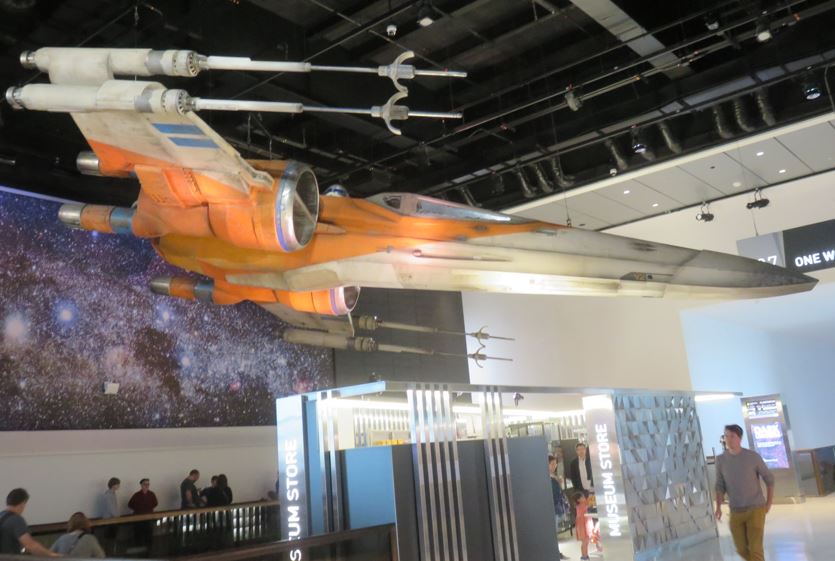
T-70 X-wing from "The Rise of Skywalker."
Smithsonian National Air and Space Museum has X-wing fighter.  

It was all the expanded interpretation around the Wright Flyer that interested me. 

The Wrights were bicycle builders from Dayton, Ohio, and the Air and Space Museum has one of the very rare examples of a Wright bicycle.

Signage notes that the Wrights realized any airplane would need the strong structure and light weight of a bicycle. They also had faith that an airplane could be controlled; after all, a bicycle could be controlled even if it could not stand up without a rider to balance it. 

What really caught my eye was a separate display of scale models of the airplanes produced by the Wright Company before 1916, when Orville Wright sold the company (Wilbur had died in 1912).
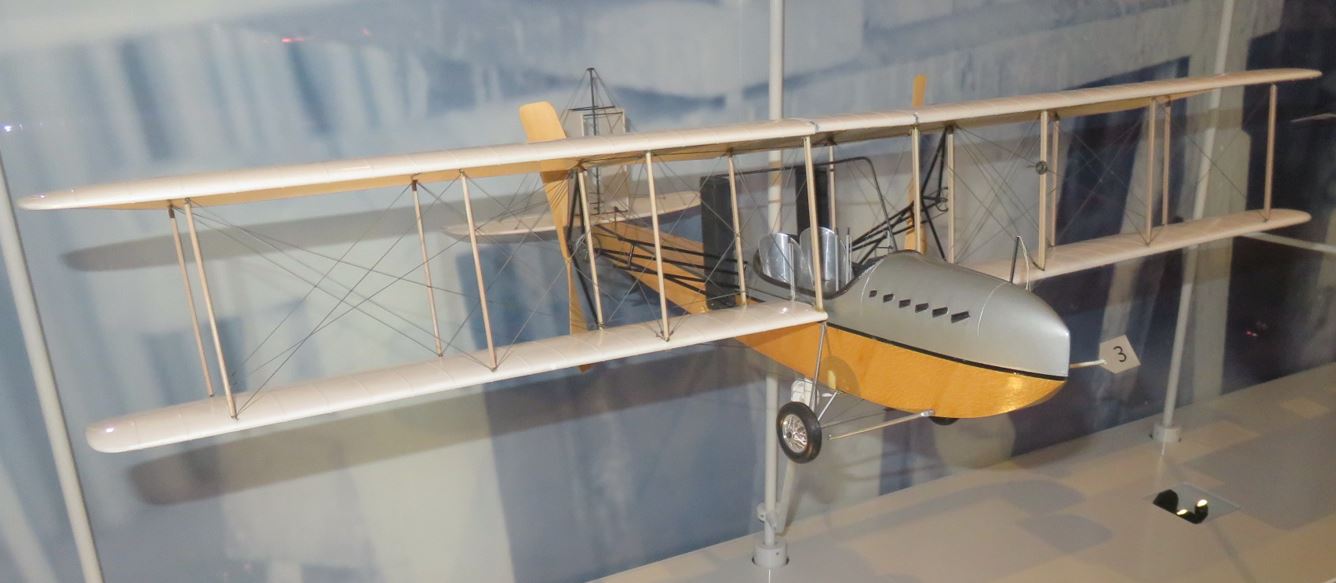
Scale model of Wright Model F airplane.
Wright Model F used chain drive from fuselage to the propellers. 

Orville Wright estimated that the Wright Company built only approximately 120 airplanes across all of its different models between 1910 and 1915.

These varied greatly in design, but they were all alike in that they each were powered by only one motor, and this was the case even when they boasted two propellers.

What? How?

Scale model of Wright Model G.
Wright Model G Aeroboat stuck with chain drive to props.

It was easy, and this is what really amazed me: the Wright airplanes of the 19-teens made frequent use of chain drive to their propellers. It was as though the company founded by bicycle makers could not do without it.

Even with the motor mounted ahead of the wings, in the fuselage, the Wright Company typically did not just bolt a propeller to the crank shaft. Instead, as in the Model F, a long run of chain would emerge on each side of fuselage, carrying power to wing-mounted propellers.

It looks crazy, like something that would exist in a Steampunk or other alternative universe.

Scale model of Wright Model K airplane.
Wright Model K: chain drive from near front of fuselage to props. 

For the Wrights, chain drive solved more problems than it created. They had used two pusher propellers on the early Flyers and, of course, they wanted them to counter-rotate to balance one another. This was accomplished by simply mounting one of the two chain runs to the propellers in the shape of a figure 8.

Only a bicyclist or motorcyclist would have thought of that.

There is a list of early Wright airplanes here.

Wright Model L airplane of 1916.
Model L, last airplane produced by the Wright Company, finally attached the propeller directly to the motor, eliminating chain drive. More photos of actual Wright airplanes here.

The listing notes that the Wright Company never made a Model I or a Model J. These were made by the Burgess Company, which licensed Wright patents. The Wright Model L of 1916, last product of the company, finally did away with chain drive.

Friday, September 6, 2019

Meek looking 1922 Royal Enfield had an oddly racy look

Small motorcycle on display in museum.
It was a little Royal Enfield tiddler of the 1920s. But note the footpeg.
I didn't know much about the little 1922 Royal Enfield two-and-a-quarter horsepower motorcycle I saw at the wonderful Owls Head Transportation Museum in Maine this summer. But I was about to learn a lot more.

That's thanks to Sarah Dunne, archivist and librarian at the museum, and to Paul d'Orleans, author and editor of TheVintagent website, who once owned a similar Royal Enfield and wrote an article about it.

Plus, both Sarah and Paul had letters, written in the 1980s, by a Royal Enfield expert, that together shed light on the Royal Enfield two-and-a quarter horsepower Model 200 of the early 1920s.

Sarah looked up for me what the museum knows about its motorcycle:

"The registration number is WY3717, the engine number is E9361, the magneto number is 890T, and it has a Brown & Barlow carburetor. In 1980 the museum corresponded with several Enfield aficionados in an attempt to find out more about the bike; we had very little information on it then, not even the year," she wrote.

"After some dead ends, we were referred to the wonderfully named Ivor Mutton, with whose name you are almost certainly familiar but was new to me. I'm attaching a scan of his letter. He backs up your surmise that the registration was from West Yorkshire. A handwritten note in our records indicates that the bike had been purchased by a previous owner, a Pennsylvania resident, as a 1919 model. There are photocopies of what I believe is a 1966 Pennsylvania registration slip for the bike.

"Our ground vehicle conservator says that he believes the pegs are wrong but that the rest of the bike appears to be correct. It is a runner; we haven't started it or ridden it around since early this summer, but it had no major problems then." (Since this was written, she advises that volunteers have again had it running this summer.)

Oh, those pegs. I had noticed that the museum's Royal Enfield has foot pegs instead of floorboards. Period ads show this model with floorboards and 1922 seems too early to me for foot pegs to appear on motorcycles.

(The Barber Vintage Motorsports Museum in Birmingham, Ala. has a 1926 Royal Enfield Model 200 with footpegs but it shows other evidence of progress since 1922, including a proper gearshift lever on the side of the tank instead of the coffee-grinder handle above the tank on the Royal Enfield in the Owls Head Transportation Museum.)

In his 1980 letter to Owls Head, Mr. Mutton (the now deceased specialist on Royal Enfields for the Vintage Motor Cycle Club in the UK) notes the lack of floorboards, and considers them "missing."

Letter to museum from Royal Enfield expert in Redditch, England.
1980 letter to the museum from Ivor Mutton, Royal Enfield authority in Redditch, England.
But a whole different image of the Royal Enfield emerges from the 2008 blog item by TheVintagent.

In it Paul describes his Royal Enfield two-and-a-quarter of the same vintage (1921 not 1922), and publishes photos of it. Amazingly, he believes his motorcycle was a "Sports Model" further modified as a factory racer for a noted competitor of the time.

Who would race such a seemingly toy-like motorcycle? Paul's article explains that the little Royal Enfield had a number of competitive advantages in its day.

It used chain final drive in an era when many motorcycles used troublesome belts. And there was that two-speed transmission, which, he points out, was not a true gearbox. Instead, there are two primary chains between crankshaft and clutch. The coffee-grinder handle above the tank chooses between the two — "a very simple system," he calls it.

The photos show that his motorcycle has what appear to be the same sort of foot pegs that are on the Owls Head motorcycle!

Paul's article reprints a 1982 letter from Mr. Mutton, written in reply to a request for information about the motorcycle Paul would later purchase (and has since sold on).

In his reply, Mr. Mutton wrote that the Sports Model was only introduced in 1922, but that the factory could have built some 1922s in 1921.

Mr. Mutton sent with that letter two Royal Enfield factory images showing the Sports Model — both show that the "Sports Model" would have had foot pegs.

Period advertisement for Royal Enfield Model 200 Sports.
Royal Enfield advertisement for the Model 200 Sports.
It shows footpeg and specifies "adjustable footrests" are included.
It all boils down to this: the foot pegs on the Owls Head motorcycle clearly could be factory original, as they appear. Perhaps, as well, it was a "Sports Model," although Mr. Mutton wrote in 1982 that if so it should have a "straight through exhaust pipe, flat bars, Senspray carburetor and Lucas magneto."

Either he is too specific about all these or the museum motorcycle is perhaps a non-Sports model jazzed up with the available factory foot pegs.

Does it matter? Only for fun.

Perhaps the greatest surprise at all is that in the 1920s people actively raced Royal Enfield 225cc two-stroke motorcycles.

Friday, August 16, 2019

MG cars and more wonderful stuff at Owls Head Museum

Studebaker Champion with propeller attached to spinner-nose front.
1951 Studebaker shown by Bob and Nancy Stover of Belfast, Maine.
Not a museum piece, but it suggests the whimsy of the Owls Head Museum.
NOTE: The prestigious 2019 New England Auto Auction is 9 a.m. to 5 p.m. Friday and Saturday, Aug. 16-17, at the Owls Head Transportation Museum in Maine. The auction catalog includes more than 200 automobiles and motorcycles and automobilia.

To be honest, the wonderful thing about the Owls Head Transportation Museum in Maine is not the 1922 Royal Enfield Model 200 motorcycle on display there.

The wonderful thing is the way this museum pulls together all that stuff you dreamed about as a kid: roaring through the air in a World War I Sopwith biplane, blasting down the road in a classic MG, or showing up your friends in a really neat kiddie car.

Our visit Aug. 4 was special because there was a car show and air show at the museum that day. Some of the cars and plane we saw aren't there every day.

But any day at this museum would be a blast. Literally a blast. The museum is dotted with genuine antique bulb horns you're invited to TOOT!

Vintage automobile bulb horn.
1913 Rubes horn. The Rubes brothers started making horns in Brooklyn in 1904.
How fun is that?

Line up of vintage MG sports cars.
Early MG sports cars line an entire wall of the museum.
I love vintage planes and antique motorcycles, but the fantastic collection of MG cars at Owls Head really caught my eye. It's not all the MGs, but it certainly includes a lot of the interesting ones. The core of this assemblage is The Cobb Collection, loaned to the museum by Dick and Dottie Cobb.

1931 MG J2 on display in museum.
1932 MG J2 is a noticeably small car, almost childlike in size.
The museum's Morris Garage line-up starts with the 1932 MG J2. MG had just turned racing's handicapping system on its head, proving that displacement wasn't the only thing that counted. A light car could take on more powerful cars. This J2 is small, even noticeably smaller than the other MGs here. You wanted your J2 with all the racing accessories, including bonnet straps.

1933 MG L1 Magna on display in museum.
MG L1 Magna's ride was likened to a mountain goat.
The 1933 MG L1 Magna, produced only that year, was just one of the bewildering number of variations MG produced from 1929 to 1936 — more body styles than in any other period. It came with a six-cylinder motor and you could get it with a supercharger. And look: even a back seat!

1931 MG L1 Continental Coupe.
1933 MG L1 Continental Coupe; based on a sports car, the back seat was unusable.
The 1933 MG L1 Continental Coupe is an odd ball. It encumbered the sleek MG with an enclosed body, preferred by MG principal Cecil Kimber. It became known as "Kimber's Folly." Only 100 were built and they sold slowly. The sliding sunroof, with oval windows, provided both light and ventilation but was hardly attractive doing either.

1934 MG PA on display in museum.
1934 MG PA, stylish in red.
The 1934 MG PA here and the PB that followed were considered by some the "last of the Midgets" because later models replaced the overhead camshaft with pushrod motors. Was this the beginning of MG fans considering each new model (which would go on to build its own fan base) a betrayal?

1946 MG TC on display in museum.
1946 MG TC, the car that started the sports car craze in America
even though it was only ever made with right-hand drive.
The 1946 MG TC appeared only five weeks after the end of World War II, and they sold well, with 10,000 produced. These were the cars American service members saw, and introduced the United States to British sports cars. The museum's TC is equipped with a "30 light." This is a light on the dash alerting the driver he has reached 30 mph, a common limit in England.

1937 MG VA.
1937 MG VA, big, prestigious, but not fast enough.
The 1937 MG VA shown elsewhere in the museum was meant as competition for Jaguar. It had expensive looking style, but only a four-cylinder motor. How wonderful that it even existed.

Here are other interesting things I spotted at the museum and in a car show held there Aug. 4:

View of car with transparent roof.
1970 Rover 3500S V8 with transparent roof,
shown by Garrett Bourque of Jefferson, Maine.
View of car with transparent roof.
Rover offered this option but owner knows of only one other in existence.
View of rear of car with fins and a lot of chrome.
Magnificent rear end of 1959 Plymouth Sport Fury.
View of biplane on floor of museum.
A Curtiss JN-4 Jenny, right? Well, no...
Airplane on museum floor is a model next to the real thing.
That was just a model. A real 1917 Jenny is behind it.

Friday, August 9, 2019

1922 Royal Enfield at Owls Head Museum in Maine

1922 Royal Enfield motorcycle on display at museum.
Note that this 1922 Royal Enfield has bar-shaped footrest instead of full floor boards.
The round pedal near footrest must be for rear brake! Coffee-grinder shifter is above tank.
NOTE: The prestigious 2019 New England Auto Auction is 9 a.m. to 5 p.m. Friday and Saturday, Aug. 16-17, at the Owls Head Transportation Museum in Maine. Preview days are 9 a.m. to 5 p.m. Wednesday through Friday Aug. 14-16. The auction catalog includes more than 200 automobiles and motorcycles and automobilia.

It wasn't necessary to fight the crowds to see the 1922 Royal Enfield Model 200 motorcycle on display at the Owls Head Transportation Museum in Maine last weekend.

There were more expensive and exotic motorcycles to be seen in the museum, along with priceless vintage automobiles and airplanes.

And — oh yeah — there was a car show going on outside the museum.

Also an air show, complete with flybys by a World War II P-51 Mustang.

Period advertisement for Royal Enfield motorcycle.
Period ad touted Royal Enfield's two-speed transmission.
So, yes, there were distractions. But I couldn't get over the little Royal Enfield, with its 2-and-a-quarter horsepower, two-stroke motor and two-speed gearbox.

I also couldn't get over or around the displays on either side of it to get a good photograph of it.

I didn't mind, since one of the neighboring exhibits was one of my favorite airplanes, the F.E.8 of World War I. This dandy little British fighter plane put the pilot and his machine gun in front of the motor, so that it could not shoot off its own propeller.

By the time the F.E.8 reached combat the Germans had worked out how to synchronize their machine guns to safely fire through whirling propellers. The F.E.8 was obsolete.

Replica F.E.8 fighter plane on display in museum.
F.E.8 was shown nose down, displaying the cockpit.
It also had a reputation for going into a spin and crashing — a terrible thing with the heavy motor situated to crush the pilot. Royal Aircraft Factory test pilot Frank W. Goodden demonstrated that correct procedure could pull the F.E.8 out of a spin. He was not the first pilot to recover from a spin, but Goodden began to formalize the procedure, and soon British pilots were being taught it.

The museum's F.E.8 is, of course, a replica, built from factory plans. Disappointed it's not original?

"How would you like to fly in an airplane with 100-year-old wood in it?" noted one pilot we met at the museum.

Replica F.E.8 in flight.
The replica F.E.8 as it appeared in flight.
This F.E.8 replica earned its wooden wings, flying from California to Maine in 1980 with only a compass for navigation. Flying at 80 mph it spent 57 hours in the air — but with "trials and tribulations" the trip still took more than 32 days.

View from cockpit of Sopwith Pup replica fighter plane.
Sopwith Pup was light as a kite, but gun sight shows it meant business.
The F.E.8 didn't fly last weekend, but another World War I look-alike, a 1916 Sopwith Pup replica, did take to the air. Some "replica"! It has a 1918 motor. I'd call that originality.

After the Pup took off a gusting crosswind came up and the crowd wondered if it might flip the kite-like little airplane when it tried to land. (It landed safely, out of sight of the crowd.)

1919 Sopwith ABC motorcycle on display at museum.
1919 Sopwith motorcycle was surprisingly sophisticated.
A 1919 Sopwith motorcycle parked inside the museum had no such problem. After World War I, with demand for fighter planes gone, Sopwith purchased the rights to make the ABC motorcycle. With a  horizontally-opposed twin-cylinder motor, gated H-pattern shifter, four-speed gearbox, leaf-spring suspension front and back and carburetor heat, it was quite sophisticated.

Sophistication made it expensive and production ended in 1921, two years before BMW introduced its remarkably similar and far more successful motorcycle.

1919 Excelsior motorcycle on display at museum.
1913 Excelsior V-twin displays perfect patina.
The 1913 Excelsior Model 7C V-twin at the museum sported truly wonderful patina as it leaked oil into its drip tray. Great to see.

Navy SNJ trainer of World War II makes low-level pass.
Low and loud: World War II vintage Navy SNJ trainer buzzes the airfield.
But the real excitement came when a visiting World War II era Navy SNJ trainer and a P-51 Mustang fighter plane started doing low-altitude passes.

My wife Bonnie got some short videos of the planes. Take a peek:


Friday, July 19, 2019

College Park Aviation Museum flies you back in time

Man in aviation gear with toddler walking away behind him.
My grandchild is on the loose as I try on a helmet and goggles.
College Park Aviation Museum, an affiliate of the Smithsonian Institution, is holy ground for aviation.

Start with the fact that it is on the grounds of the world's oldest continuously operating airport, located outside Washington, D.C.,  in Maryland. Wilbur Wright chose this location for the airport in 1909, initially as a place to train America's first military aviators.

True to say, that was only the beginning for College Park Airport.

The first woman to fly as a passenger in the U.S. went up here, in 1909. She was Sarah Van Deman. There was no seat belt, but a string was tied around her skirt to keep it in place. Wilbur Wright was her pilot.

Manikin dressed as pilot in front of recreated Wright biplane.
A figure representing Hap Arnold with a recreated Wright Model B Flyer.
The Model B flew from College Park Airfield from 1911-1913.
Powdered aluminum coating makes its wooden structure appear to be metal.
Future General of the Air Force Henry "Hap" Arnold set aviation records at College Park, becoming the first pilot to fly a mile high, in 1912.

He was the first to fly over the U.S. Capitol, took up the first Congressman to fly and also moonlighted as a stunt pilot in silent films, earning his nickname (it stood for "Happy") in the process. Hap trained new military pilots here, and went on to command the Army Air Corps, leading it in World War II.

The first Postal Airmail Service operations would begin here, in 1918. The airmail's hangar and its large compass rose ground marker remain. The airport's code "CGS" originally stood for the airmail's "ColleGe Station" of the 1930s.

Stylized image of woman pilot leaning out window of B-26 cockpit.
WASP Elizabeth L. Gardner's iconic image in a B-26 Marauder during World War II.
Women including WASP Elaine D. Harmon learned to fly at College Park.
Her flight log, uniform and Congressional Gold Medal are on display at the museum.
The first controlled helicopter flight took place at College Park, in 1924. Father and son Emile and Henry Berliner created a complicated looking machine, nothing like what we consider a helicopter today — they didn't even call it a "helicopter."

Historic photo circa 1924 of Berliner helicopter at College Park.
The 1924 Berliner Helicoplane.
Terrifyingly, it not only maneuvered, but could go 40 mph in any direction except up.

Incredibly, one of the Berliner machines survives and is at the College Park Aviation Museum on loan from the Smithsonian's Air and Space Museum.

Built from a World War I surplus Nieuport 23 fighter plane, the "Helicoplane" uses two massive counter-rotating propellers above the wings for lift. A small propeller atop the rear fuselage tilts the machine slightly up or down, causing the downward force of the main props to move it forward or backwards.

Side view of Berliner helicopter.
Main rotor atop each wing provided lift. Louvers allowed it to bank for tuns.
A system of louvers on the wings reacts with the downward prop wash to tilt the machine for turns.

The triplane wings allowed gliding in case of engine failure, but with them in place the Berliner could not auto-rotate to land, a safety feature of helicopters and autogiros. More striking, the Berliner's motor wasn't powerful enough to lift the thing out of its own ground-effect down wash — about 15 feet!

Side of fuselage is open so tail rotor mechanism is seen.
Fuselage is cut away to show drive mechanism of small control rotor.
Note the tail skid, sprung with wrapped bungee cord.
This is ironic, as Emile Berliner's 1908 development of the rotary engine (the round motors used in the Nieuport 17s, Fokker Triplanes and Sopwith Camels of World War I) demonstrated the rotary's value to aviation. His historic first rotary engine was donated to the Smithsonian Institution in 1913!

My favorite part of College Park's aviation history, though, is its link to the ERCO Ercoupe. Henry Berliner founded the Engineering and Research Corp. (ERCO) in 1937 and tested its airplanes at College Park Airport.

Chief among these was the Ercoupe, a lovely little two-seater with twin tails, intended to be a safe and easy airplane anybody could fly. Indeed, there are stories of children flying them.

Airplane is hanging in front of a mural of the sky.
Meant to be the plane for everybody, the Ercoupe was clean, cute, and unwanted.
No rudder pedals! A steering wheel provided all the control the Ercoupe needed. It was the first airplane certified by the Civil Aeronautics Administration as "characteristically incapable of spinning" out of control.

ERCO naturally expected flyers returning from World War II to want to go on flying, and began full-scale manufacturing in 1945. It began full-scale marketing, too — you could buy one at Macy's.

It was a bust. Veterans wanted families, homes and automobiles, not airplanes. Production of the type continued fitfully by other manufacturers, up to 1970, but the Ercoupe never became everyone's airplane.

There are other great planes on display at the College Park Aviation Museum, including the barnstorming JN-4 Jenny that taught America to love aviation. But the Ercoupe continues to spark my imagination.

Like so much else, it all started at College Park.

Wednesday, November 21, 2018

Barber Museum brings a 1924 Sunbeam to light

Motorcycle of the 1920s on display in museum.
The 1924 Sunbeam Model 9 was a fast and desirable British motorcycle of its era.
I've made an effort to learn the rich (and complicated) history of Royal Enfield motorcycles but, while I admire other vintage motorcycles and their fascinating quirks, I don't know much about individual brands.

Yet another reason that my visit to the Barber Vintage Motorsports Museum in Birmingham, Ala. was so special.

You know what it's like. You see something interesting, do a little research, and end up falling down the rabbit hole. In this case, the object of my admiration was a 1924 Sunbeam Model 9 motorcycle.

Why? To tell you the truth, what caught my eye was the little tool case tucked, of all places, between the chain runs.

Tool box mounted very low on motorcycle.
Here's an interesting place to put the tool box.
What inspired that, I wondered? Did Sunbeam figure you'd be kneeling beside the bike trying to fix it? Was it an effort to get the weight down low for balance? Whatever the reason, it appeals to me.

The other feature I love is the tiny (really tiny!) pad on the rear fender, which would have made no passenger happy. Undoubtedly it was there so the rider could slide his bum back and lean across the tank in pursuit of those extra few miles per hour.

Tiny seat pad on rear fender of motorcycle.
Pad was for speed, not for a pillion rider. No rear foot pegs are fitted.
While these aspects were visually intriguing, the 1924 Sunbeam Model 9 was much more significant in motorcycle history.

The bare specifications are simple enough.

British, single-cylinder, 499cc, overhead-valve pushrod motor. Three-speed hand shift, front girder forks, rigid rear. Top speed 75 mph. The museum's Sunbeam "is believed to be the earliest surviving example of this model." But there is much more.

Motorcycle Trader magazine wrote in 2013:

"Of all the British motorcycle manufacturers during the 1920s, Sunbeam reigned supreme as the purveyor of quality, single-cylinder motorcycles. Built by craftsmen dedicated to attention to detail, Sunbeams exhibited the finest workmanship and finish of all singles built in England. When the Model 9 Sunbeam was released in 1924, motorcycles of its class were still priced in guineas (one pound, one shilling), not pounds, reflecting their role as a gentleman’s conveyance.

Flat tank of motorcycle is labelled "The Sunbeam."
"The Sunbeam" expresses the bespoke quality intended for this motorcycle.
"The Model 9 soon earned a reputation as a very fast and reliable sports tourer... engine layout was state of the art for 1924.

"The two overhead valves were operated by pushrods and rockers and inclined in a hemispherical cylinder head at a steep angle. Each valve had three external coil springs and the rockers were supplied with greasers and equipped with return springs.

"The cylinder head included dual exhaust ports and the lubrication was dry sump with a mechanical double gear pump. The conrod ran on roller bearings and the crank in three ball bearings and, unlike most British singles of the time, the primary drive chain was totally enclosed in an oil-bath, cast alloy case....

Streamlined housing filled with oil encloses chain drive.
The Sunbeam Little Oil Bath Chaincase.
"Sunbeam designed an entirely new frame for the Model 8 and 9, providing... a detachable, sloping top rail to facilitate access to the cylinder head."

The Marston-Sunbeam Club & Register notes that the 1924 Model 9 was called "the Parallel" because of this top frame tube and the one above the flat tank.

Photo illustration showing lower of two two rails removed.
Detachable frame rail is shown in 1924 article in The Motorcycle.
And here's something I should have noticed: "There was no kick start so being fairly adept at a running start was a necessity." A kick start was added for 1926 and the old-fashioned flat tank was replaced with a saddle tank for 1929.

Why had I never known more about The Sunbeam? An old story. Sunbeam fell into the hands of a conglomerate that sought to cut costs. Parts were outsourced, quality declined. The Great Depression forced prices down.

"The Model 9 cost 105 guineas in 1924 when it was released but, 12 years later, the list price was £66," Motorcycle Trader wrote.

Motorcycle on display in museum.
The Sunbeam Model 9 didn't pamper its owner. There was no kick start until 1926.
BSA acquired the Sunbeam name in 1943, moving production to Redditch. Motorcycle Trader again: "BSA Sunbeams bore no relation to the pre-war machines. The final Sunbeam motorcycle was built in 1956 but scooter production continued until 1964."

A sad history, perhaps, but one I was glad to learn.

Friday, November 16, 2018

What to see at the Barber Vintage Motorsports Museum

Capt. America motorcycle like the one in "Easy Rider" on display.
It can't be; and it's not. This Capt. America bike like the one in "Easy Rider" is a replica.
For me, classic Royal Enfield motorcycles were the stars of the Barber Vintage Motorsports Museum in Birmingham, Ala.

But of course the enormous museum displays hundreds of other motorcycles and cars, especially Lotus cars. It claims to have the largest collection of Lotus automobiles and they are among the first things you see as you enter.

Familiar from photographs, Lotus cars are surprising, even shocking in person. The most dramatic, for me, was a "see through" 1957 Lotus 14.

Car body lit from within shows how thin the bodywork is.
Unpainted 1957 Lotus 14, lit from inside, demonstrates how lightly built it was.
"The Museum decided not long after its purchase to leave the car unpainted to showcase Lotus founder Colin Chapman's genius design of a fiberglass monocoque," signage explains.

"Chapman was all about keeping it light and simple."

In this car fiberglass is almost the only material used. Steel frame is visible around the windshield and doors and almost no where else. The resulting car weighed only 1,484 pounds.

"Only 1,050 cars were ultimately produced as the production costs of the advanced monocoque meant the car was sold for less than it cost to build," the museum sign notes.

Large motor.
Enormous Rolls Royce Meteor motor powered World War II tanks.
Next surprise: A Rolls Royce V-12 Meteor motor. An engine from a tank! It's a relative of the famed Merlin engine that powered the Spitfire and P-51 Mustang fighter planes.

"The Rolls Royce Meteor was a British tank engine developed during World War II and was used in the Comet, Cromwell and Centurion tanks," signage advises.

Using airplane motors in tanks might seem uneconomical, but the Meteor was a bargain. It left out the Merlin's supercharger, greatly simplifying casting. Since light weight was less important (in a tank!) some expensive light alloy materials were replaced with steel.

Since reliability was less important, Merlin components rejected for poor quality could be used in the Meteor. In 1943, a shortage of V-12 blocks was met by dismantling surplus older Merlins to make Meteors.

It's still a monster 27-liter motor. It holds 25 gallons of oil!

High quality V-twin motorcycle.
Very rare, the Crocker was the best of pre-war American motorcycles.
The 1938 Crocker V-twin is famed as the Duesenberg of American motorcycles. Only about 75 were built between 1936 and 1940, so I never expected to see one. The work of Albert Crocker, who had built racing motorcycles, these were superb road machines, capable of cruising at 90 mph.

Look closely at this little Honda. Does it seem slightly stretched out? That's to make room for the extra crankcase that turns the little speedster into a 98cc V-twin.

Small motorcycle has combination of two motors.
Can you spot what makes this former Honda 50 so special?
The 1974 creation of British engineer Allen Millyard, the SS100 claims all of 10.5 horsepower. A single seater, why does it have rear foot pegs? Undoubtedly so the rider can stretch out over the long tank for streamlining.

Here's another SS100: the 1938 Brough-Superior, looking every bit as superior as it was when T.E. Lawrence favored the brand. Broughs were assembled from parts — here a Matchless motor and Norton gearbox — but only the best ones. This one has front and rear Royal Enfield brakes.

Large shiny vintage motorcycle.
Only the best bits made for a Superior Brough.
The 1894 Hildebrand & Wolfmuller, from Germany, was the world's first mass produced motorcycle. Some aspects of its design did not catch on.

For instance, the piston rods operate on the rear wheel — it's in effect the crankshaft. If you want a different  drive ratio you have to fit a different size rear wheel.

Complicated looking old motorcycle.
It's complicated looking but you have to love the rubber bands.
Museum signage says that the enormous rubber bands on the sides of the machine assist starting. Maybe you push the machine backwards to tighten the bands, then lift your feet? The bands would snap the machine forward for a "push" start. Maybe. (Other sources say the bands are there to return the pistons for the next stroke, as there is no flywheel except the rear wheel.)

Who doesn't like a magnificent failure? The 1920 Militor (initially designed for the U.S. military) was both magnificent and awful. It seemed to lack for nothing. It had a sidecar, four-cylinder motor, front and rear suspension (telescopic on the front, leaf at the rear). Wheels were wagon style, with wooden spokes, and the frame was massive. A curved steel bar ran through the center of the front wheel to stabilize it.

Heavy looking motorcycle.
"Military might" never came mightier than the Militor.
At 800 pounds the few Militors sent to the front in 1918 sank into the battlefield. But part of the fascination of any museum is seeing what worked, and what didn't, what became famous and what sank into oblivion.

So I am not offended that the Barber's "Captain America" Harley-Davidson, displayed so proudly at center stage, is a replica of the motorcycle in the movie "Easy Rider."

The 1960 Vincent Black Lightning on display is a replica as well, although "a very accurate replica," signage notes. After all, the real Black Lightning (no more than 40 are reputed to have been made) was itself just a tuned version of the Vincent Black Shadow.

Big black powerful looking motorcycle.
Vincent Black Lightning was first to break 150 mph. But its looks mattered more.
Our museum guide pointed out that what made these Vincents so influential was not just their speed or mechanical sophistication. Those have been surpassed. Oddly, what has lasted is the importance of the color black. Motorcycles, before the Vincent, were black only if they had to be. Otherwise they tried to be colorful and shiny.

The "Black" Vincents made black cool.

I'd never thought of that.

Shiny bicycle with motor and whitewall tires.
At the other end of the spectrum, a Whizzer powered bicycle.