Showing posts with label Royal Enfield motorcycles. Show all posts

Friday, March 28, 2025

Royal Enfield headlines, explained

 If you set up a Google Alert for "Royal Enfield," as I have, you'll get a fast education in current speech. 

For instance, the headline "Royal Enfield drops limited edition," doesn't mean Royal Enfield is discontinuing a model. It means the opposite: Royal Enfield is introducing a limited edition version of its motorcycles. 

"Drop" now has several meanings, including the opposite of "drop." 

You probably knew that. 

But did you know that a Royal Enfield motorcycle described as having a "Dangerous Engine" is not a menace, except in so far as it has a "powerful engine"? 

Other oddities include variations on a headline that has been appearing around the internet for months:

"Do you know how much a Royal Enfield Bullet 350 cost back in 1986? You will not believe your eyes."

The headline is based on a 1986 invoice for a Royal Enfield Bullet in India, compared to what a Bullet costs today in India.

The implication is that you'll be wowed by how much the Bullet has gone up in price.

It hasn't.

What has happened is that India's rupee has gone down in value. Adjusted for inflation a new Bullet is effectively about the same price it was in 1986.

Who could resist clicking on such an interesting link? And, as long as we keep clicking, the invoice will continue to be discovered over and over again.

It's like that ad that claims to explain why you should put a plastic water bottle on your tire when you park your car.

Anyone watching for internet references to "Royal Enfield" quickly learns that the vast majority of stories online come out of India, where Royal Enfield is respected and far more prominent than it is in the United States.

So a headline that claims "Royal Enfield Bullet 350 Come With Super Engine Like Monster With Killer Look," makes sense in India, but certainly not in North America.

This is an article about a normal 350 Bullet with a look that has not been killing anybody since it was introduced, in 1955. It is no "monster" motorcycle.

Finally there are the articles that gleefully announce that Royal Enfield plans to introduce a modern 250cc motorcycle.

It may be that Royal Enfield plans to introduce a 250cc motorcycle in India. Supposedly the company has confirmed this, and Royal Enfield has, in its long history, produced 250cc motorcycles before.

But I begin to wonder, when so many articles about this include so much speculation, regurgitating the few details reported elsewhere, and are illustrated with photos of the existing 350cc models, "for representational purposes only."

India is a very cost-sensitive market, and the possibility of a coming cheaper and more economical Royal Enfield would tend to excite potential customers.

Stories about a 250cc Royal Enfield therefore make great clickbait.

You'll have to wait for the real thing, but don't worry; you won't miss it when it comes. It will be all over the internet.

Friday, July 5, 2024

Retro motorcycles aren't going away

 The market for retro motorcycles like those from Royal Enfield will show strong growth between now and 2030, according to HTF Market Intelligence, a market research company in India. 

The retro motorcycle market "will witness a Compound Annual Growth Rate of 12.46% during the forecast period," it calculates. That's an increase of $98.34 billion over its current $56.9 billion market value. 

The report considers Royal Enfield, BSA, Honda, Yamaha, Kawasaki, Moto Guzzi, Triumph, BMW, Ducati, and Royal Alloy. 

It defines the retro motorcycle market as "a niche segment within the broader motorcycle industry that focuses on recreating the design aesthetics and styling cues of motorcycles from past eras, typically the mid-20th century. 

"These motorcycles are characterized by their vintage-inspired designs, which often evoke nostalgia and a sense of classic craftsmanship." 

The market is driven by its nostalgic appeal to older riders, but also by the appeal of retro styling to younger people.

The report states that, to compete, manufacturers will have to incorporate "advanced electronics, lightweight materials, and sustainable powertrains while retaining the timeless styling that defines retro motorcycles."

That won't be easy.

They will have to do this while competing with modern looking motorcycles, which, of course, will include all those features without the burden of limits on styling.

As an example I think of Royal Enfield's move toward water cooling with its new 450cc motor. Water cooling is more efficient, but it loses the graceful cooling fins seen on Royal Enfield's 350cc and 650cc air-cooled motors. 

The 450cc motor thus looks dull, in comparison, and is wisely delivered painted black to reduce its visual impact.

And as for putting modern features into retro motorcycles, even today Royal Enfield is criticized for offering motorcycles that don't include the latest features.

In fact, Royal Enfield has come a long way. Consider that my 1999 Royal Enfield Bullet lacked electric start, disc brakes, ABS, fuel injection, electronic ignition, and five or six-speed gearbox. All these features and many more are on today's "retro" Royal Enfields.

One more thing: realistically, retro motorcycles will also have to compete with the growing market for electric motorcycles, which, as something new, never had any particular style to be nostalgic about. 

Consumer preference for clean, quiet, reliable, and uncomplicated electrics will only grow as they improve. Will a Royal Enfield even be a Royal Enfield without the "thump" of internal combustion?

The full report can be ordered on line. Cost is $3,500.

Friday, November 29, 2019

Why the ordinary shape of a Royal Enfield is so sexy

Royal Enfield Classic 500 silhouette.
The unadorned silhouette of the Royal Enfield Bullet Classic 500.
I'm going to point out similarities I see in the design of so-called "standard" motorcycles like the Royal Enfield Bullet to the female human body.

I'm not an artist or designer. But, obviously, artists and designers have long been interested in the shape of women. They're generally creating art or objects they want people to look at; and they know people of both sexes like looking at women.

All I'm really trying for here is to make the point that this particular Royal-Enfield sort of motorcycle is a visual winner because it has this particular, classically popular visual appeal.

I am not insinuating it's anyone's fault that these similarities exist between humans and objects. It is a problem if it is exploitative. As a tribute to nature's original, though, it has its place.

And I couldn't help noticing. See if you agree.

Now, at first thought, it might seem that motorcycles, designed to fit between a rider's legs, might be more in line with typical male equipment. That's a crude simplification, and may be true of the motorcycles dubbed "choppers."

I'm looking at the more subtle visual cues in the standard motorcycle of the 20th Century, as represented by the Royal Enfield.

Royal Enfield Classic 500 side view.
The so-called "naked" motorcycle has everything you need, but nothing more.
These cues are subtle. In fact, the standard motorcycle is often referred to as a "naked" motorcycle, as it typically lacks anything showy, like a fairing, or exaggerated seating position.

Think back, before you owned a motorcycle. As a child, could you have drawn a picture of an ordinary motorcycle? I would have had trouble with this, as I didn't understand what all the "stuff" in view on a naked motorcycle was for, or where in the picture it should all go.

But this much I would have gotten correct, even as a kid: the headlight, instruments, tank, fenders, handlebars, wheels and seat. These are the most noticeable elements of the motorcycle. The rest of the gear is under there somewhere, doesn't matter much where.

Front view of Royal Enfield Bullet 500.
The Royal Enfield seems to turn its face toward you.
I submit that the first thing you and I look at when we gaze at a motorcycle is the headlight. The headlight is the "face," typically round and bright. Many Royal Enfields also feature two eye-like pilot lights above the headlight, but these aren't necessary to the effect.

A motorcycle headlamp that is not mounted in a fairing moves with the front wheel in the direction the motorcycle will go. The motorcycle headlight turns toward where it is going, as does the human face.

Royal Enfield nacelle holds headlight, pilot lights and instruments.
The Royal Enfield nacelle suggests a head, with eyes and "brains" (instruments).
As with the human head, the face of the motorcycle fronts a brain, represented by the instrument panel which, on the Royal Enfield, may be perfectly contained in a skull-like nacelle. Its twin pilot lights could even bring to mind human eyes. The nacelle is not necessary to the effect, but it sure is interesting it's there, isn't it?

Next, handlebars. These aren't usually as attractive as the human arms they represent, but they clearly mirror the shape and functionality of human arms. Notice that the handlebars end, like arms, in controls and levers that serve human hands as do fingers.

Top view of Royal Enfield Classic 500.
It's easy to see the human form in this view of a Royal Enfield motorcycle.
We now arrive at the gas tank, the first obviously female element. How? Well, recall how ungainly and plain motorcycles looked in the flat-tank era of the early 1900s. The curvaceous saddle tank design immediately carried the day when it appeared in the 1930s. There was just something about the curvy tank besides the fact that it could carry more gas.

That visual something was the similarity to rounded breasts.

I know you see this, so I don't even need to go on to point out that the saddle tank actually has cleavage (out of sight on the bottom, to accommodate the top bar of the frame) and, sometimes at least, a nipple on each side. (For simplicity the Royal Enfield Bullet only gives you one fuel tap but some motorcycles use two.)

Rear view of Royal Enfield fender, seat and tanks.
The Royal Enfield solo seat mirrors the part of the human anatomy it serves.
On to the seat which, on my Bullet and many others, is the tractor style solo seat. Like the handlebars, this mirrors the precise area of the human anatomy it is meant to serve. I need say no more, but you may go on to speculate why the solo seat has springs, even though these would seem unnecessary on a motorcycle that has its own complete rear suspension.

Finally we come to the fenders and wheels. Things are now really subtle, as wheels can't take any other shape, and fenders are sometimes reduced to being called "mudguards." No part of the human body performs the unseemly function of "mudguard." What an inelegant term for what are in fact the pleasing shapes of the Royal Enfield Bullet fenders.

Side view of rear wheel and fender of Royal Enfield Classic 500.
Some custom motorcycles minimize or even eliminate the rear fender. Too bad.
Its job is to carry the lines of the motorcycle to completion.
Humans don't just end and motorcycles shouldn't be "bobbed" either.
And, yes, the wheels and fenders are distinctly female in appearance.

Don't see it? Well, compare the rounded yet slim shape of the Royal Enfield Classic 500 rear fender to the fuller, yet angular design used on the B5 Bullet. The appearance of the Classic 500 is obviously better, although the B5 is probably a better mudguard.
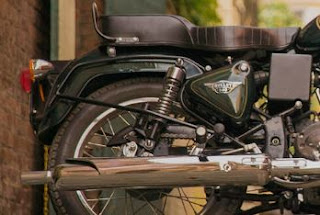
Rear wheel and fender of Royal Enfield Bullet 500.
The Bullet 500 mudguard will work to catch mud.
But it is certainly less pleasing to the eye.
Why does the eye naturally prefer one over the other? My guess is that we know what we are looking for when we see it.

After all, how did the "standard motorcycle" get to become the "standard" anyhow? Because we most all agree it's the right shape.

You would be foolish to attempt to improve on the shape of a woman.

Tuesday, November 6, 2018

Royal Enfield's V-Twin concept unveiled

Photo of Royal Enfield V-twin motorcycle.
The new Royal Enfield V-twin Concept Kx.
Royal Enfield just unveiled a V-Twin motorcycle concept it calls a "homage to the 1140 V-twin Royal Enfield KX from the 1930s."

The Concept Kx debuted at the 2018 EICMA show in Milan, Italy Tuesday, Nov. 6.

Get your first look at the new Royal Enfield Concept Kx in this video.

The V-Twin motor shown in the video bears the number 838, — presumably the size of the motor.

Concept KX Royal Enfield logo.
Note the world "Concept" on
the new Royal Enfield Concept Kx.
Jordan Gibbons, writing on MotorcycleNews.com described the Concept Kx bobber as a modern reimagining of the original KX, an aircooled 1140cc sidevalve V-twin produced before World War II.

The V-twin motor and long, low styling with front girder forks certainly suggests the 1930s.

But underneath is modern engineering.

"In what is believed to be a world first, the Concept Kx also has a single-sided softail rear-end," Gibbons writes.

Perhaps a bit optimistically, he adds:

"Officially, Royal Enfield say that the Concept Kx is not destined for production but there are far too many completely resolved details for us to believe that’s true. Give it 12 months and you might see the real thing rumbling into a showroom near you."

Royal Enfield Concept Kx motorcycle.
Girder front suspension and stacked exhausts mark the Concept Kx.
Writing in RideApart, Jason Marker subtly raises a question about the future of the Concept Kx:

"Royal Enfield told the EICMA crowd that work on the Kx started way back in March of 2017 and that it was largely built as a design exercise to see if the company could do it. As such, there aren't any plans to bring the Kx to market."

Man sits on full-size clay model of the Concept Kx.
Royal Enfield leader Siddhartha Lal tries out a clay model of the Concept Kx.
Even so, why reveal the Concept Kx now, just when Royal Enfield has the newly introduced 650 parallel twins to sell? Consider this comment from "Maynard" below:

"A year ago I thought I'd buy a Continental GT single. Then I started reading about the 650 twins so I thought I'd wait. Now that I've read about the V-twins, I think I'm gonna wait for them. I guess I can put off getting my motorcycle endorsement..."

Surely that is not the effect Royal Enfield wants the Concept Kx to create. Still, as Marker concludes, "That said, response to the unveiling was pretty positive, so I'd be surprised if we didn't see something like it on showroom floors in the next year or two."

Royal Enfield's own press release on the Concept Kx is on Motorcycle.com It contains this caveat:

"The Concept Kx 2019, takes pride of place at the very front of Royal Enfield’s extensive stand at EICMA. However, the motorcycle is only a concept, meant to showcase the prowess and creativity of the engineers and designers at Royal Enfield. The concept motorcycle has not been designed for production, but could serve as an inspiration for design language in future product portfolio."

Concept Kx Specifications

(as reported in Rushlane.com)

Displacement 838cc OHC V-twin
Bore X Stroke 3.15 in. X 3.28 in.
Fuel feed EFI drive-by-wire
Transmission 6-speed
Length 85 in.
Width 30.6 in.
Height 39.3 in.
Wheelbase 60.4 in.
Ground clearance 5 in.
Seat height 30 in.
Front wheel 3.50 X 19
Rear wheel 4.00 X 19
Brakes Twin disc front, Single disc rear
ABS All around
Engine Stressed member
Chassis Harris frame with integrated airbox
Front suspension Girder fork, single damper
Rear suspension Single damper with progressive link


Friday, October 6, 2017

Retro design makes Royal Enfields special

Will Royal Enfield's new twin capture the classic looks of the Interceptor?
Royal Enfield's success in India is based on its classic, retro-styled Bullet motorcycle, with its origin going back to the 1950s. The 2014 Royal Enfield Continental GT evokes the time-honored appearance of the cafe racer of the 1960s.

The new Royal Enfield parallel twin, rumored to be near introduction, likely will remind riders of the Royal Enfield Interceptor, last built in Britain up to the 1970s.

True, the newly launched Himalayan dual-sport bike demonstrates that Royal Enfield can create a contemporary looking design. But, otherwise, the company's portfolio is a string of motorcycles based on the styles of the past.

Under that old-fashioned style is modern hardware like fuel injection, electronic ignition and disc brakes. These features are expected by modern motorcyclists, but they can get them almost anywhere, on any motorcycle.

Royal Enfield is where you go to get your retro; and that is a marketing strength.

A really retro-inspired design confronted me this month when our rental car on vacation in California and Oregon turned out to be a Volkswagen Beetle. I'd never driven one before.

Our rental VW Beetle and a 1957 oval-window version.
(Found for sale on CraigsList in Phoenix, Ariz.)
Volkswagen markets the car as "The original original." The shape, though sleeker than before, is instantly recognizable, of course. Otherwise, we quickly found it a typical modern car.

But there was one retro touch that really was clever: The rear view mirror.

Yeah. If you look at the back of a new Beetle from the outside, it has an unexciting, rectangular rear window.

The rear view mirror itself, however, is oval.

Rear-view mirror is oval, even though rear window is rectangular.
This means that, as you sit in the driver's seat, your rear-view through the mirror is, of course, oval. You see out the back much as you might through the oval rear window of the original Volkswagen Beetle, back in the day.

Clever.

I don't even think the original Beetle had an oval rear-view mirror. Never mind. The use of this shape in the new car is a subtle but effective retro touch. Despite the car's other virtues (including a rear-view camera) it was the oval mirror I liked best.

The original Crater Lake Lodge looked grand but the roof sagged,
the septic system overflowed, walls were cardboard thin and,
 in the 1920s, lighting was so dim it was impossible to read or play cards. 
I was still thinking about retro when we arrived at the historic looking lodge at Crater Lake National Park. It completely fulfilled my expectations of timber construction, big rock fireplaces and dormer windows overlooking the lake.

But — no — it isn't a restored original. Construction on a lodge had begun in 1909 and there were expansions in the 1920s, but there was never enough money to do it right. It was cheaply made and cheaply furnished and was described as "a fire trap of the worst kind" as early as 1940.

Incredibly, the lodge was never originally completed.

"The original plans, if any ever existed, have never been found," a history of the lodge reports.

The redesigned lodge looks just as grand, but meets modern standards.
The Park Service acquired the lodge in 1967 and kept it in operation, but eventually proposed tearing it down. There was a public outcry to save what was one of the oldest public buildings in any national park. The Park Service changed its tack. The lodge would be "redesigned."

Very little original material could be preserved — even the original foundation had been nothing but rubble — but today the lodge is a modern building with the appearance of a building of the late 1920s.

Diagram at the lodge illustrates old (left) vs. new (right).
It's safer, sounder and has many more private baths.
The effect is splendid, truly transporting the visitor back in time. One small touch I loved: the interior designer insisted on separate hot and cold spigots for the sinks, as the lodge would have had a century ago.

Like the Beetle's oval mirror, and the water taps in the lodge, little things can mean a lot. I hope Royal Enfield reminds us of this when the new twin is revealed.

Tuesday, June 13, 2017

The 'Special Bullet' came in three Royal Enfield flavors

The Royal Enfield Special Bullet brochure emphasized racing.
You got a dual seat and shiny alloy fenders, but otherwise the "Special Bullet" offered by Royal Enfield back in the day was mostly all business.

This vintage Special Bullet brochure was recently posted on the TrialsCentral forum. You can view the complete brochure there.

The brochure offers the Special Bullet in three models, each in 350cc and 500cc versions. All came with a sporty, small-size gas tank.

The Scrambler looked like it meant off-road business..
The "Scrambler" sported a choice of gear ratios, and even a choice of engine compression from as low as 7.25:1 on the 500 to a startling high of 10.5:1 on the 350. Wheels were 21-inch in front and 19-inch in back, with security bolts and an engine bash plate was standard. Naturally the exhaust was upswept and high mounted.

The Short Circuit Racer didn't come with a kickstarter.
The "Short Circuit Racer" brought racing valve timing, lightened flywheels and an Amal racing carburetor. You didn't get a kickstarter with this one (racers "bump" started). Wheels were 19-inch front and rear, with Dunlop racing tires. Footrests, gear shift and brake lever were rear mounted. A straight through exhaust pipe was standard and you could order a tachometer.

The Trials Model included a tool box and registration plates.
The "Trials Model" dropped the dual seat but still gave you a pad on the rear fender. Low compression piston, heavier flywheels and special gearbox ratios fit the needs of the trials rider. Low gear on the 500 was 18.2:1, a real stump puller. Wheels were 21-inch front, 19-inch rear. Only the Trials Model gave you a side toolbox and side stand in addition to the center stand.

Substantial side spike came standard on the Trials Model.
All 500s came in "Copper Beech" and all 350s in "Silver Gray." Weight ranged from 305 pounds for the 350 Racer to 328 pounds for the 500 Trials. Ground clearance was 7 inches for the Scrambler and Trials, and 6 1/2 inches for the Racer. A wide variety of engine sprocket and countershaft sprocket combinations were available to suit any race track.

The brochure isn't dated, but the same illustration of the Trials Model appears in Roy Bacon's book Royal Enfield, The Postwar Models, identified as a 1954.

The Special Bullets were clearly meant to be race ready.

And so, of course, it almost goes without saying that the "Guarantee" on the back page expressly states that "no guarantee of any kind" is made on any machines used in "any competition."

Friday, February 3, 2017

Royal Enfield Model DC motorcycle is rarer than I knew

Royal Enfield Model DC is so little known that they had to make up a name for it.
The graceful little Royal Enfield "Model DC" I spotted at the Dania Beach Vintage Motorcycle Show last Saturday is a far rarer motorcycle than I realized.

Lucky for me that Graham Scarth, chairman of the Royal Enfield Owners Club UK, does know something about the Model DC and this very example in particular. He has been in contact with the owner and has tracked down additional information about the little known machine.

Here's what Graham told me:

"This bike is one of Enfield’s second go at a lightweight 350cc machine, albeit not cataloged at all...

"It is a 'bored and stroked' version of the 1939 Model D side valve 250, which, along with overhead valve Model S/SF had a separate oil tank sandwiched in between the engine and gearbox.

"A number of these machines were 'conscripted' into Australian military service and are recorded in the Australian War Memorial Archives. We do not think it was ever sold on the UK market, and have no idea how many were built as the factory records have not survived.

Side-valve motor looks small, but it's a 350cc.
"We also do not know the official factory designation, so the DC moniker was agreed upon by our WD (War Department) machine specialist Jan Vandevelde and myself to avoid confusion with the (standard) 350 Model C with oil compartment in crankcase."

Owner Bob Losik of Boynton Beach told me in an email that his little Royal Enfield appears to have been restored, perhaps in the 1990s. Bob has dealt with restorations enough to sense when something has been altered, and this Royal Enfield looks essentially original to him.

That's particularly interesting because it suggests that his Model DC was meant to be a civilian motorcycle.

Jan told Bob that he believes that the Royal Enfield Model DC was the progeny of a prototype lightweight military motorcycle Royal Enfield offered the British Army before Dunkirk. It was essentially a 250cc sized motorcycle with a 350cc motor.

The Army rejected that design. But someone at the factory must have liked it because apparently some very small number of these little motorcycles were made anyway. Having seen photos of Bob's Model DC, Jan's theory is that these were meant to be civilian motorcycles, without the prototype's modifications for the military.

He thinks the few DCs made by the fall of France were swept up by the war effort, but, as oddballs, they were shipped off to Australia to help with the war effort there. They became military motorcycles after all.

The British Army would take vast numbers of military Royal Enfield motorcycles during the war but for the civilian Model DC, the outbreak of the war apparently brought down the curtain. After the war, with so many surplus WD motorcycles to refurbish and offer the public there was no need to bring back the little Model DC.

All of which makes Bob's example rare indeed.

Tuesday, January 31, 2017

1939 Royal Enfield Model DC seen at Dania Beach show

Big headlight, but 1939 Royal Enfield Model DC is almost child-size.
With all the wonderful vintage motorcycles on display every year at the Dania Beach Vintage Motorcycle Show, it's still rare to spot a Royal Enfield.

Herb Doan's magnificent 1955 Indian Westerner dirt racer has been the only Royal Enfield product on show in recent years and I was delighted to see it there again this year.

But there was something else really special this year: the 1939 Model DC shown by Robert Losik of Boynton Beach, Fla.

Attractive little Royal Enfield drew a crowd.
Its girder forks, solo seat, massive headlight and maroon paint job instantly identified this Royal Enfield as a visitor from the past.

I was startled to see how small it is! My 1999 Royal Enfield Bullet would dwarf it. That's in part because this little motorcycle has no rear suspension. The result is a low, sleek look.

Tidy overhead-valve single "powers" this Royal Enfield.
The motorcycle is handsomely equipped with electric horn, toolbox and four-speed gearbox (no neutral finder, though!).

I was surprised to see that the rear brake is cable operated. I commented about it to another show visitor, who pointed out that cable works for the front; why insist on a piece of metal for the rear brake?

Cable operated rear brake, sweet little horn and chain case.
Toolbox, air filter, oil tank but no neutral finder.
Jewel like little tail light was good enough in 1939.
Petite center stand benefits from beer-can landing pads.
Indian Westerner, the only other Royal Enfield at the show.
...well, there was this Royal Enfield on display.

Friday, April 3, 2015

Read about Royal Enfields, motorcycles and bicycles

1935 Royal Enfield Cycar kept the grease off your clothes.
Do motorcycles and bicycles mix? I discovered they do when I encountered interesting items about Royal Enfield motorcycles and Royal Enfield bicycles in twin blogs produced by one enthusiast.

An experienced Royal Enfield motorcyclist and bicyclist, he produces full articles on two-wheelers powered and pedaled.

His motorcycle blog includes a handy index to vintage brochures he has scanned of such little known models as the Royal Enfield Cycar.

Another among the scanned brochures is one for the 1935 Whitwood Monocars. These wacky sidecars-without-motorcycles supposedly could be powered by anything from a 150cc two-stoke to a 1,000cc side-valve twin.

Did the front wheel have room to turn?

Looking at the illustrations in the brochure it is not at all obvious where they put the motor!

Allowing for the wheels, where did they put the motor?
I'll let author Richard Miller introduce himself:

"I'm glad you enjoyed my blogs, I am indeed behind both the Red Devil Motors and the Vintage Cycling blogs.

"I work at sea (five weeks on five weeks off) and I find writing the blog a good way to feed the motorcycle/bicycle passion whilst I am away from home. Home for me is the South of England (Dorset to be precise).

"I used to have a small business trading at bike parts fairs and importing vintage bikes from India. I had a small batch of 'cock a snoot' bike mascots made and found that I became known for them and people would ask after them. From that it flowed that I called my business Red Devil Motors. A designer friend drew up the logo.

Red Devil Motors logo.
"I dropped the business when I started working at sea seven years ago but I liked the logo so decided to keep it when I started the blog.

"Originally the Red Devil Motors blog was both bicycles and motorcycles but I found that there weren't so many folks out there that shared my interest in both so I decided to split them off. The motorcycle blog tends to get updated a lot more frequently that the bicycle.

"I've had a fairly long term connection with Royal Enfield which began back in 1996 when I went to India with my former partner. We both bought Royal Enfields, mine a Redditch '58 model and hers an Indian '97. We rode both of these around India and then back home to the UK.

"I've still got both of these bikes. A few years later I took the '97 Bullet down to Morocco. About nine years ago I did a trip from home down to Capetown and back with my then girlfriend, now wife, on a '55 Bullet. Bullets have served me well so I am rather fond of them!

"The bicycle interest goes back as long as I can remember. As a teenager I worked as a mechanic in a cycle shop and raced at the weekends. I still enjoy my cycling but am far off racing fitness these days!

"I've attached a snap of myself taken in Lesotho, Southern Africa, with my '55 Bullet. That's about eight years ago. I've gotten married and had children since so have aged considerably from then!

Richard Miller on tour with Royal Enfield Bullet.
"Do feel free to use images you like from my blogs, I try to mostly put up original material but it's all for fellow enthusiasts to share so I am not precious about it."

Thursday, March 10, 2011

Royal Enfield Bullet 500 and Classic Chrome on sale now

The latest Community Newsletter from Royal Enfield USA contains more information about the two new models due in 2011: the bargain-priced Bullet 500 and the fancy new Classic Chrome.

The bottom line seems to be that only limited numbers of each will be available. If you want one, order it now.

Royal Enfield Bullet 500 (the B5).
According to the newsletter, the Bullet 500 "is an updated version of the original Bullet as sold in a 350cc form in India. This basic bike has been built for over 55 years but was never sold in the export markets. We refer to it internally as the 'Bullet Black' or B5. It is built on the original Bullet frame and has the same new fuel-injected UCE engine and disk brake that the rest of the bikes have. It also sports an old-style metal badge on the tank and the original 19-inch wheels. It is only available in black.

"This bike has a very aggressive introductory suggested retail price of $5,495 (California model may be slightly higher). They will be available in March."

The newsletter calls the B5 (as it no doubt will be known from now on) "the best value in the motorcycle market today."

Royal Enfield Classic Chrome.
The Classic Chrome "is built on a C5 platform and features chrome tank, fenders and the oval cover that looks like an air box. It has a brown solo seat (with an accessory matching pillion seat) and has a beautiful red stripe with pin striping down the middle. It is very reminiscent of the Interceptor," the newsletter says.

"It will not be available until April at the earliest. Because of the beautiful handmade chrome tank it is a very difficult bike to build and will also only be available in limited quantities as a special order type bike. We will be offering each dealer an allocation of these bikes."

The newsletter notes that Royal Enfield is still cleaning up the 2010 model year. The 2011 bikes will have a price increase between $100 and $200 so now is the time to buy.

Until the end of March, Royal Enfield is offering $150 in free accessories to all purchasers of a 2009-2010 model, at participating dealers.

Monday, July 5, 2010

Is a Royal Enfield motorcycle right for you?
Try taking this guy's kitchen sink test

I can hear the steady drip-drip-drip from the kitchen faucet as I write this. It has been leaking for years. I've tried to fix it, but it's apparently an off-brand, and the counter guy at the plumbing store told me he had no gaskets to fix it: "Never seen nothin' like that."

My kitchen sink came to mind when I read the following description of a Royal Enfield Bullet, written by a seller on eBay:

"How do you tell if you're right for a Royal Enfield? Well, do you like to camp out or stay in hotels? Do you fix the sink or call a plumber? There's a difference, and the charm of the Bullet is its minimalism and enriching sense of history. If that describes you — Get ready to ride today!"

That description struck me as just about right. My faucet leaks. To conserve water, I keep a dish pan underneath the faucet while I try to find a fix. (Slathering the worn gaskets with plumber's putty didn't do it.)

"Call a plumber!" the wife said. That was for the first two years. She hasn't mentioned it lately, and may have given up on me.

The eBay seller goes on to describe his motorcycle, a 2008 Military:

"The bike fires right up, but the battery sometimes doesn't want to hold a charge. And let's be clear: It's bare-bones no-nonsense transportation, and these guys are known for being finicky. It's fun, though, and more-affordable transportation is hard to imagine. There is a minor oil leak from an unknown source. Also, note that the sale documents will carry the designation 'TMU' or True Miles Unknown."

"The motorcycle is designed with an old-school military look and feel, so it's no surprise that the paint doesn't shine and chrome isn't prevalent. This bike is in fair to good shape overall, despite some leaked oil on the exhaust."

Drip-drip-drip, my kitchen faucet goes on leaking. Every so often I carry a dish pan full of water out to water the flowers. I'm no better plumber than I am a mechanic. But my Royal Enfield suits me fine.

Monday, May 24, 2010

How to define Royal Enfield motorcycles?

My first posting on this blog tried to define the Royal Enfield motorcycle. Re-reading it, I see that my definition has not withstood the test of time.

For starters, I was really defining only the relatively poky, maintenance happy Royal Enfield Bullet of 1999, which I own. I ignored the fast twins from the 1960s that one still sees for sale in the United States, and for which I list ads on this blog.

Additionally, Royal Enfield has now increased the speed of the Bullet and bestowed it with maintenance free fuel injection, no-bother electronic ignition, O-ring chain (with the oil inside it, not on your pant legs) and self-adjusting valves. Yet it looks just as charmingly dated as my Classic.

So I admit I was incorrect or, at least, I didn't capture the whole picture. In retrospect, I think I was wrong to look at the specification sheet and performance to try to define a Royal Enfield. This morning, on the Internet, we have two definitions, of a sort, one from a fellow in India and one from a Brit.

They certainly ought to know. I wonder if these two would agree?

James Higham writes about political and social issues in his Nourishing Obscurity blog. A Europhile, he nevertheless argues for the preservation of British values and practices, with a pleasant sense of irony. "Even our very confusion over what is British... is British," he writes.

This morning he takes a moment to applaud a paragraph by another writer, William Gruff.

Here it is:

"When riding my Royal Enfield I wore black polished, steel toe-capped scaffolders’ boots with seaboot stockings rolled down to the tops, and fancied myself quite the young blade. I may have looked like a prat but the music I listened to then lives with me still."

Now that certainly gives you a mental picture, doesn't it?

The second definition comes from a young Indian student and blogger in My Life on the Roll.

Here it is:

Selfism is Individualism.

Selfism is Self-Reliance.

Selfism only listens to the sound of its own voice.

Selfism is Independence.

Selfism is Dignity.

Selfism is not Arrogant.

Selfism is not Anti-Social...

Selfism can change the World.

ROYAL ENFIELD IS SELFISM!

Monday, December 21, 2009

Royal Enfield blog gets new look for 2010

Royal Enfield motorcycles are my hobby. I ride one and I write about Royal Enfields on this blog. If you've been here before, you know that the appearance has changed.

There are now two columns of Royal Enfield motorcycles listed for sale in the United States, instead of one. The number of Royal Enfields for sale naturally increases as more of them come to the U.S.

I round up the ads by cruising the Internet. If you spot an ad I've overlooked, or have one to place yourself, email me at david@royalenfields.com

There is never any charge. It also goes without saying that I can not vouch for the truth or accuracy of these advertisements. Representations made are solely the responsibility of the original advertiser. If I can help someone out there find the Royal Enfield motorcycle of his or her dreams, I will be satisfied.

One other change you may note: my picture has moved from the bottom of the blog up to the right-hand corner. It's not vanity. My wife is an adjunct professor of multimedia journalism at Florida Atlantic University. She says "I like to see who I'm dealing with right at the top."

She's the professor. You're the reader. I hope you enjoy this blog.

Thursday, August 20, 2009

Royal Enfields are different, that's all

This blog was founded as a result of my enthusiasm for Royal Enfield motorcycles. Nothing more.

But in the more than a year since this Royal Enfields blog debuted, I've come to believe there really was a need for it.

My reasoning is that Royal Enfields are just special, that's all. And, because they are special, they are misunderstood.

Royal Enfield motorcycles have been made as long as Harley-Davidson motorcycles; but few people in the United States ever heard of Royal Enfield.

They are British style motorcycles. But they are built in India.

When they were built in Britain they were, for a time, sold in the United States as "Indians."

Their design had remained virtually unchanged since 1955 — until 2009, when they became almost modern.

Until recently, they shared all the finicky features of vintage motorcycles. The latest models are different, but for most of 50 years you could count on this:

They were powerful. But slow.

They were easy to kick start if you knew the procedure. If you didn't, they were impossible to kick start.

They looked old but came with dumb looking modern turn signals.

The horn brackets eventually broke. All of them.

Their transmissions had always been clunky but for or sale in the United States the shift mechanism was altered: it was made worse.

And then here was the ultimate difference: Royal Enfields were genuine, old-fashioned vintage motorcycles; but how could a vintage motorcycle have a manufacture date of 1999? You were buying a "classic" but not a rare one: they're still coming off the production line by the tens of thousands!

That means your "investment" is unlikely to ever increase in value. But it also means that you are free to modify the motorcycle, run it hard and just plain use it up (if you can — go ahead and try). It isn't an irreplaceable treasure bound for a museum.

Like I say, Royal Enfield motorcycles are just different. I love them for it.