Showing posts with label Royal Enfield art. Show all posts

Friday, June 27, 2025

The Lady on the Lawn and Royal Enfield

Woman posing on 1931 motorcycle.
We know the model of motorcycle, but not the name of the model.

 We don't know her name, but I think we have an appropriate nickname for her: "The Lady on the Lawn." 

Her nickname was coined by Bob Murdoch, archivist of the Royal Enfield Owners Club (UK), who sent the evidence to me in an email. 

"See attached, what I think is the artwork made from the photo session of the lady on the lawn, 1931," he wrote. 

Illustration of woman seated on motorcycle.
The motorcycle is rendered exactly; the rider not so much.

I had speculated that a particular photo shoot for the 1931 Royal Enfields had resulted in some racy illustrations the company used in its advertisements. 

I first noticed the woman model, dressed in white and seated on a powerful Royal Enfield, in photographs in the Hitchcocks Motorcycles archive of factory photographs.

The photos themselves weren't used in the advertisements of that day: they were traced for line drawings that could be colorized as needed, and even improved by artists.

In the course of being turned into art the woman model could be made to look prettier, or, at least, more comfortable on the motorcycle.

Her perceived emotions could be carried to extremes. I say the illustrations were "racy" because some showed the woman riding at breakneck speed, her scarf flying in the wind.

Ecstatic woman riding a motorcycle.
From the same year, but possibly from a different photo shoot, "The Joy of the Road" artwork was labelled "Cover for Leaflet."

The Hitchcocks archive has no doubt what kind of Royal Enfield motorcycle the Lady on the Lawn is riding:

It is "a 346cc Royal Enfield Model CO. This RE model was for the 1931 season and features OHV and a total loss oil pump mounted externally on the timing cover."

But who was the girl? Could she really even ride a motorcycle?

UPDATE: Jorge Pullin has found SEVEN additional photos of the ladies on the lawn (yes, there were two women models present the day of the photo shoot) posing for photos that could have been used in Royal Enfield advertisements for the 1931 model year. You can see the photos on his blog, My Royal Enfields.

What I can't find is any evidence that any of these other photos resulted in Royal Enfield advertisements. I will keep my eyes open.

Friday, April 18, 2025

More racy Royal Enfield artwork from 1930

Colorized 1930 image of rider and girlfriend.
This was the best I could do to enhance a 95-year-old magazine clipping.

 Found: a rare illustration of a roaring 1930 Royal Enfield motorcycle and its speed-obsessed rider and his pretty girlfriend. 

Last week I wrote how I had noticed the artwork in the official scrapbooks of the historic Royal Enfield factory in Redditch, UK. A black-and-white magazine photo of it and its caption were pasted into one scrapbook. 

I'd never seen this image before, anywhere. 

According to the caption, the image was available to Royal Enfield dealers as a poster, to be displayed in their windows. It would have advertised the 1930 Royal Enfield motorcycles inside the dealership. 

The caption also said that the posters were in color (the magazine clipping, of course was printed only in black and white). 

I took the liberty of using an artificial intelligence program to colorize the image in the clipping. After all, the original had been in color, so this wasn't cheating.

Color made it look even better, although the dot-pattern "screen" used by the magazine reduced detail.

To find out more about the artwork I emailed Bob Murdoch, archivist at the Royal Enfield Owners Club UK, which possesses the scrapbooks. Bob had laboriously photographed the many pages of the scrapbooks, and had shared these with me.

Had he ever noticed this image?

After all, this was one clipping on one page among hundreds of pages. To my surprise, he replied the next day:

"I do recognize this picture from the historic artwork folder of the Archives and have attached our copy, which you'll note is not a color painting, but a newsprint-prepared black and white print."

Screened drawing of couple on motorcycle.
Despite the dot pattern you can see the detail. (REOC Archive)

So the club had the image, a much better copy than the magazine clipping in the scrapbook! Unfortunately, it still had the dot pattern, and was still black and white.

But Bob was able to tell me a lot (and there was another surprise coming).

"Most of Royal Enfield's publicity images were created by line-tracing photographs with ink on a semi-transparent film laid on top of the photo. These were then enhanced with color, shade and movement lines, which is a very effective method for capturing correct detail and perspective.

"So, the painting mentioned would have been a color 'wash' of such a tracing. I was a technical illustrator in the aerospace industry for several years, so I recognize the method used. 

"Among the factory photographs there are quite a few posed riders on bikes, clearly for this purpose. My favorite one which comes to mind is the 1958 Crusader and rider balanced on a brick at a sporty angle, which was pen-and-washed for the 1958 advert/brochure."

Did the Archive have an original photo of a couple posing for the illustration that interested me?

"Unfortunately, no such photo survives of our adventurous couple in question, but one other aspect (from a different angle) was traced and enhanced from the same photoshoot. You'll see from the front number (license) plate that this is a Model JL of 1930."

Wait, there is another version of the speeding Royal Enfield, rider and pretty girl?

Different version of same scene.
A different pose for the rider and best of all, no dot pattern.

Yes, and Bob attached a scan of that, too. It's still black and white, but it has NO screen pattern, meaning it's as fresh as the copy-artist made it.

I like it even better. Note how much more lifelike and realistic the rider looks in this version. I would bet that his friends could identify the fellow who posed for it.

Interestingly, this version of the image IS signed by an artist; you can see "H. Wilson" clearly in the lower right corner.

Artist put name in corner: H. Wilson.
This time the artwork is signed: H. Wilson.

Unlike the first version, with the rider crouching low, I did find this second version on the Internet.

It appears, without explanation, in the humor section of Motorcycle Timeline, labelled "Joy of the Road." It is screened there, so it's likely it was published someplace in its day.

Readers, had you seen it before?

Couple rides motorcycle in line drawing.
Found by Motorcycle Timeline, this version is labelled "The Joy of the Road."

Friday, April 11, 2025

Racy Royal Enfield poster sold speed

 Packed with potential emotion, motorcycles are often depicted at the intersection of Art and Marketing. And there is nothing more moving than artistic depictions of speed. 

Except for one thing: just add the girl. 

"...but wait, the solitary knight of the prewar days has been joined by a hot girlfriend, as our hero hurtles down the road to prove he is no Model T owner," writes Paul d'Orleans in his essay "Selling Speed" on The Vintagent blog. 

His example is R.C. Reyrolles' 1946 painting of a prototype HRD-Vincent Series B Rapide. 

The painting shows the Vincent nearly airborne with speed, its manly rider tightly embraced by a terrified girl. Her skirt is blown back on her shapely and oh-so-endangered thigh. 

It's my favorite motorcycling image, although not one I'd personally seek to emulate.

Woman clings to man riding motorcycle.
1946 R.C. Reyrolles painting of HRD-Vincent and riders.

But wait!

I've found a rare Royal Enfield version of the same scene.

I noticed this artistic treasure in the Royal Enfield factory scrapbook of 1930 press clippings, made digitally available by Bob Murdoch, archivist of the Royal Enfield Owners Club (UK).

The clipping is a magazine report on advertising window display posters made available to Royal Enfield dealers in 1930.

With flying motorcycle, crouching rider, and pretty passenger, it could have served as the draft version for Reyrolle's Vincent painting of 1946.

Britain's Cycle Trader magazine showed two of the new Royal Enfield posters, including this one, in its edition of, Nov. 4, 1930.

Magazine clipping in scrapbook.
Magazine clipping in Royal Enfield factory scrapbook shows the poster.

The caption: "MORE 1930 POSTERS -- Two of the striking window bills that are available for Royal Enfield dealers. Both are produced in attractive colors. Equally powerful posters relating to pedal cycles are also issued, along with other well designed display matter."

Of course the Cycle Trader clipping is in black and white, so we don't know what "attractive colors" graced the original window bills.

For purposes of this blog item I let the Palette.fm program make its best guess. The result is not unpleasing.

Colorized version of magazine clipping
A version of the black and white clipping with color added by AI.

But who was the artist? I see no sign of an artist's name on the poster. What a shame.

And who was that girl?

The Royal Enfield rider and his girlfriend are less daring than the Vincent couple. Our girl doesn't wrap her arms around her man, or hide her face in terror.

But you have to give the Royal Enfield girl points for the scarf, or ribbon, flowing care free from her hat. And she is showing plenty of leg, enhanced exactly as in the Reyrolles painting by holding her foot just so.

I guessed, probably incorrectly, that the Royal Enfield in the painting is the Model JF31. That's the  488cc overhead-valve, four-valve single that made such a splash at the Olympia Motorcycle Show the same year the window poster came out.

The forward-sloping motor, long pushrod tunnels, and fat fishtail silencer look right; but all these features would have been shared with some two-valve Royal Enfields of that year.

What made me think of the 488cc four-valver is that it would have been the fastest of the Royal Enfield line, and thus most worthy of a painting.

But, then, maybe not. 

Woman in white poses on Royal Enfield.
A woman in white in a 1930 Royal Enfield photograph.

In the Hitchcocks Motorcycles archive of Royal Enfield factory images is a young woman in white, sitting on "a 346cc Royal Enfield Model CO. This RE model was for the 1931 season and features OHV and a total loss oil pump mounted externally on the timing cover."

Could this be the woman and motorcycle in the painting?

Take a look at another photo, this one from Royal Enfield's Instagram account. It's the same motorcycle, RX6637, and she is wearing the same outfit. And doesn't she look prettier in profile?

Girl in white on Royal Enfield motorcycle.
Another view of the same girl on the same Royal Enfield.

I found one more set of 1930 photos showing a similar looking girl, but in a different outfit with a different Royal Enfield. (She's NOT the same girl; Jorge Pullin has a photo of the two girls together at the gate in this blog item on My Royal Enfields.)

These two photos appeared in Peter Miller's book "Royal Enfield, The Early History." One shows her pushing the motorcycle through a gate, and the other has her perched fetchingly on another gate. (Check "gate, symbol, female, Freudian.")

Woman pushes motorcycle through gate.
A Royal Enfield, but not the motorcycle in the painting.

The caption in Peter Miller's book tells us this:

"Works promotional photographs of the 488cc OHV Standard Two-port Model EL. The implication is that it is the lady who is the rider and it is she who has taken her boyfriend for a ride, although hardly dressed for riding."

Couple talks next to gate, motorcycle.
Different dress, but is she the girl in the painting?

I will go out on a limb and say that whoever parked that motorcycle did a poor job of it. Is she supposed to pick it up?

No, the motorcycle is posed that way for art's sake. It would be a less eye-catching photograph if the motorcycle were solidly on its stand.

For one thing, an upright motorcycle would have blocked the view of her legs, wouldn't it?

Friday, December 28, 2018

If you must know: the Royal Enfield on the stamp was a 1955

Royal Enfield motorcycle on postage stamp.
The motorcycle on the stamp is a Royal Enfield of 1955, not 1954
I've never been to the island nation of Malta and I don't collect stamps. But I couldn't resist noting that a Royal Enfield motorcycle, in some ways similar to my own 1999 Royal Enfield Bullet, appeared on a 2007 commemorative stamp issued by the Malta post office.

I just thought it was attractive, that's all. Researching the stamp, I found that the artist who designed the stamp had worked from photos of the actual motorcycle. (Unfortunately, I never succeeded in reaching the owner of the machine pictured.)

The stamp showed a Royal Enfield in the red color of the Malta post office, and the year "1954." When the stamp was issued in 2007, newspaper coverage implied (but did not actually state) that the motorcycle on the stamp was a Royal Enfield Bullet.

I assumed that was the case, but more expert eyes said no. The motorcycle on the stamp was not a Bullet but a Model G Deluxe, something I'd never heard of before, and undoubtedly rare. The key difference is that the ordinary Model G would have had a rigid frame (no rear suspension) while the Deluxe would have the ground breaking swing arm rear suspension familiar to Bullet owners.

Online resources I consulted agreed that the motorcycle on the stamp looked like a Model G Deluxe; but that would make it a 1955 or later motorcycle, not a 1954. The Model G existed earlier, but the "Deluxe" only came along in 1955.

Maybe the year printed on the stamp was wrong, I guessed.

Unasked, Graham Scarth, chairman of the Royal Enfield Owners Club in the UK, generously came up with the definite answer. The club has the records compiled by Royal Enfield back when it made motorcycles in Redditch, Britain.

His email to me indicated that the year 1954, printed on the 2007 commemorative stamp, is off by a year.

"Whoever designed the stamp for the Malta post office definitely got the year wrong," Graham wrote.

"Three Model G (rigid frame) were sent to Malta in 1947 and another one in 1949.

"Six Model G Deluxe with consecutive frame numbers were sent to Malta in July, 1955 and were presumably all destined for Post Office use.

"These are the only Redditch 350s sent to Malta."

The difference of a year may seem insignificant and could easily be due to, for instance, budgetary record keeping at the post office. But it is always nice to know the definitive answer.

Friday, December 14, 2018

Which Royal Enfield brought the mail in Malta in the '50s?

Brochure illustration of a motorcycle.
1956 Royal Enfield brochure illustration of a Model G Deluxe.
Last week's blog item noted that Royal Enfield motorcycles were used in the 1950s to deliver the mail on the island of Malta. In 2007, Malta put a 1954 350cc Royal Enfield on a commemorative stamp.

I made a mistake. The motorcycle on the stamp isn't a Royal Enfield Bullet, as I at first claimed in that item. It's apparently a Royal Enfield Model G Deluxe.

The differences between the two models are significant enough that reader Mark Mumford noticed one of them.

"Actually, looking at that picture, it's not a Bullet but a Model G Deluxe? Note separate gearbox," he wrote me.

Postage stamp showing motorcycle.
Royal Enfield on Malta's stamp must be a Model G Deluxe, not a Bullet.
The gearbox of the Model G was held to the motor by mounting plates (they look like fillers), visible on the stamp, whereas the Bullet gearbox bolted directly to the motor.

The motorcycle on the stamp also clearly has the Model G motor, with its oil filler opening at the front of the crankcase. The Bullet motor had its oil filler behind the crankcase.

The Royal Enfield on the stamp has a rear suspension. I usually associate the Royal Enfield Model G with a rigid frame (no rear suspension), but eventually there was a Model G Deluxe with a sprung frame, courtesy of a rear swing arm, as visible on the stamp.

Mark pointed out that Hitchcocks Motorcycles shows a 1955 "350cc Clipper (Model G Deluxe)" in its online parts books. It has the rear swing-arm suspension. This is clearly the motorcycle on the stamp, although the year given is 1955 instead of 1954.

(Hitchcocks parts books also show a rigid-frame 1954 Model G.)

Was the motorcycle on the stamp really a 1955 instead of a 1954 as it is labelled? Maybe. Model years are slippery things.

A 1956 sales brochure page for the Model G Deluxe shows the Model G Deluxe of that year to be very much like the Royal Enfield motorcycle on the stamp.

One other possibility exists. A 1954 Royal Enfield Clipper — a 250cc motorcycle — would closely match the machine on the stamp except that I think its scaled-down motor would leave more space under the gas tank than is seen on the stamp. Also, a Clipper should have a headlight nacelle without the side pilot lights seen on the stamp.

The main thing is that the Royal Enfield on the stamp is a Royal Enfield, but it is not a Bullet. Which probably makes sense, as the Bullet would have been a more expensive motorcycle less attractive to a price conscious post office.

I only wish I could reach the owner of the Malta post office motorcycle to ask for more information.

Friday, December 7, 2018

Royal Enfields brought the mail in Malta in the '50s

A 1954 Royal Enfield appeared on a Malta postage stamp in 2007.
The Royal Enfield motorcycle on this Malta postage stamp was among four vintage British motorcycles featured on a set of stamps issued by Maltapost in 2007.

The stamps were the subject of a comprehensive article in The Malta Independent at the time. It wrote:

"The models featured on these stamps are a 1903 Minerva, a Matchless model much in use by Services dispatch riders, a Triumph model popular with police forces, and a Royal Enfield motorcycle much favored by the GPO."

It seems natural that British motorcycles served various roles in Malta, an island country in the Mediterranean. Malta became a British colony in 1815, withstood heavy attacks by the Axis in World War II, and only became independent in 1964. It remains a member of the Commonwealth. It became a republic in 1974 and is a member of the European Union.

The newspaper also had specific information about the Royal Enfield pictured on one of the stamps:

"The Royal Enfield motorcycle featured on the... stamp is a single-seater 1954 model which had been used by the General Post Office in Malta. This machine was renowned for its beautifully balanced and very fine 350cc engine, known as the Bullet engine. It was first used by the Call Office, as it was then known, in Melita Street, formerly Britannia Street, Valletta. The same model was also used for different duties in Branch Post Offices around Malta and Gozo."

I became curious about this post office Royal Enfield when I noticed the stamp pictured on the Facebook page of the Smithsonian National Postal Museum in Washington, D.C.

The Historic Motorcycle Club (Malta) also has a Facebook page. Member Albert Pisani helpfully put me on to the article in The Independent after I inquired about the stamp.

Member Stephen Zerafa added this perspective:

"Hello David, I don't recall ever seeing Royal Enfields being used for such work in Malta. It was usually BSAs and Triumphs. I myself own an ex-Malta GPO 1970 Triumph TR25W."

Stephen suggested I ask member Joe Anastasi about Royal Enfields at the GPO. Joe provided the juiciest tidbit of all:

"I remember that the Post Office had bought, I think it was six Royal Enfield Bullets, by tender in the late '50s. Previously we — my grandfather's, and later my father's company The John Bull Ironmongery Stores, regularly sold BSA Bantams to the post office and my father was quite surprised when they went for:

A. A 350, when they previously only ran small capacity two strokes, and

B. An Enfield, as the local Enfield distributors never sold any bikes in any quantity here, and did not give an after sales service. Somebody must have greased the hand of the purchasing manager at GPO. Nothing changes in Malta. :)"

So perhaps Royal Enfields weren't as common in Malta as being on a stamp might suggest.

Malta has its own Postal Musuem and even displays a motorcycle in Post Office Red on the floor of the museum building in Valleta. It's not a Royal Enfield, though. It's a James Captain motorcycle, of 200cc.

When I inquired about the stamp, Lara Bugeja, curator at the Malta Postal Museum, wrote me this:

"The Royal Enfield motorcycle that was featured on a stamp is sadly not in the collection of the Malta Postal Museum and I have no knowledge of any Royal Enfields being used in connection with Malta’s postal services (which is not to say they weren’t)."

The Historic Motorcycle Club (Malta) member Frans Deguara had specific recollections.

"I remember very well the 350cc Royal Enfield at the GPO in Blata I-Bayda... My apprenticeship was from 1958 to 1964. During this period I was doing servicing, repairs and full overhaul of these motorcycles... I remember this bike Royal Enfield 350cc. It was fun to drive with precise steering and a comfortable rear suspension too. One day I overhauled its engine and to my surprise the connecting rod was made of aluminum with a steel lower big-end cap. Interesting to note that the engine crankcase formed part of the the bike frame. This can be easily seen in the photo above."

I wrote to the designer of the set of stamps, Joe P. Smith, who both created the image of the Royal Enfield and designed the stamp itself. He photographed the motorcycles on location in the owners' garages, so the job involved hours of "post processing" to clean up the backgrounds.

"When Maltapost commissioned me to design the stamps I was directed to a couple of owners and one particular collector of motorcycles who provided the GPO Enfield," the artist replied.

Unfortunately, he did not immediately recall the name of the motorcycle's owner.

Jason Teuma, yet another member of the Historica Motorcycle Club (Malta) may have provided the answer:

"Yes, that bike belongs to Joe Zammit, ex-traffic policeman that lives at Haz-Zabbar; he is a motorcycle collector."

Tuesday, December 19, 2017

Royal Enfields at Art Basel: motorcycles as works of art

What's a cute little motorcycle doing amid all these expensive automotive icons?
In the same room are a new Royal Enfield Continental GT motorcycle, a 1958 Ferrari Testa Rossa, a 1955 Mercedes-Benz 300SL Gullwing, and a 1957 Jaguar XKSS.

"How much?" a young man asks a salesman, referring to the Jaguar.

"Three-hundred thousand," the salesman replies, "but it's a re-creation."

The young man doesn't blink.

"Do you take AMEX?" he asks.

His friends giggle, so, probably, the young man is joking. But in Miami's too-hip Wynwood art district, who knows?

Sweet whimsy in an art gallery: the Milagros Continental GT at Walt Grace Vintage.
The cars (and the Royal Enfield motorcycle) aren't in a dealership; they're in an art gallery. You don't come to an art gallery looking for practical transportation.

It seems like an odd place for a Royal Enfield (surely the least expensive motor vehicle present).

But, then, so was Art Basel, the edgy, avant-garde art festival in Miami and Miami Beach. By my count, Royal Enfield provided a total of four new motorcycles for commissioned artworks during Art Basel.

I'd seen two: a Royal Enfield Classic suspended in a transparent box, by sculptor Brookhart Jonquil, and a Royal Enfield Classic painted as part of an art installation by the Milagros art collective.

Milagros Continental GT looks, to me, somehow edible.
So, Friday, my wife and I returned to see the other two: the Royal Enfield Continental GT also by Milagros at the Walt Grace Vintage art gallery, and a Continental GT painted by artist Alexander Mijares on exhibit at the Imperial Moto Cafe.

These two will stay on display until Dec. 31, so you still have time to see them.

My wife liked the whimsical design by Milagros on the art gallery motorcycle mentioned above. To me, "whimsical" seemed out of place next to a Ferrari Testa Rossa and Mercedes Gullwing.

She thought the Mijares GT at the cafe looked "splattered" with paint as, indeed, it is.

Splattered with mud? No, with gold paint. The Mijares Continental GT at home in a coffee shop.
But the gold paint imitating the patterns of splashed mud seemed appropriate for a coffee shop that caters to cafe racers.

Imperial Moto Cafe is closed on Sunday, the sign on the door notes, because on Sunday "we ride."

The Mijares Continental GT wears its splattered paint with pride.
The other thing I liked about the Mijares GT was that he thought to paint not only tank, side covers and fenders: he also painted the grips.

Sweet.

Painting the grips struck me as truly inspired.
Yeah, that is right where mud would hit the front fender.

Thursday, December 7, 2017

A Royal Enfield is suspended for Art Basel, Miami Beach

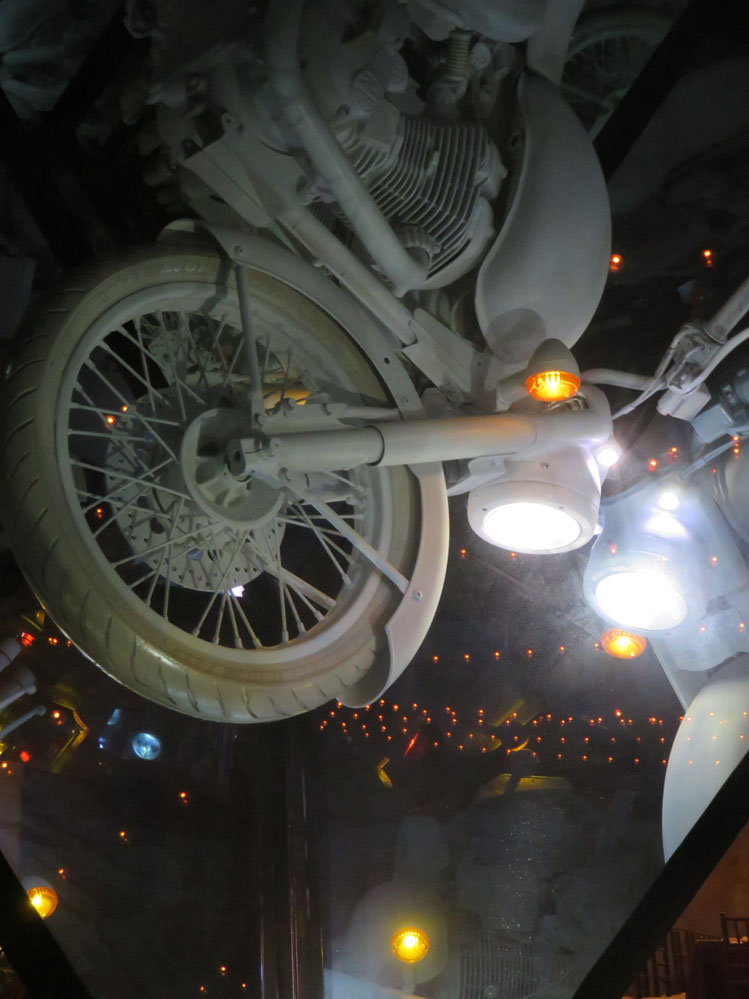
"Odysseus" is a Royal Enfield motorcycle suspended in a transparent diamond shape.
Royal Enfield's "Art of the Motorcycle" exhibits during Art Basel in Miami and Miami Beach this coming weekend caught me with  plans to be out of town. So, although I live only an hour away, I had to jump the gun a little to see them.

Literally the hardest to see was "Odysseus" by Miami sculptor Brookhart Jonquil, on display in the atrium of The Betsy-South Beach Hotel, 1440 Ocean Dr., Miami Beach, until Dec. 10.

It's described as "a Royal Enfield motorcycle hung within a mirrored, crystal-shaped structure."

Is the riderless motorcycle somehow menacing?
Jonquil's work is almost architectural, featuring triangular forms that are transparent and light but immensely strong looking.

The Royal Enfield hung vertically inside an almost diamond shape appears simultaneously precarious and yet secure. It isn't going anywhere, although its headlight and pilot lights are aglow.

"It looks like a Christmas ornament," my wife suggested.

Seen at night, the "crystal" reflects and multiplies the Royal Enfield.
According to the press release, Jonquil describes Odysseus as, “suspended vertically in an infinite and immaterial space, the motorcycle’s travel across land is transformed into the endless metaphysical journey.”

OK. Unfortunately, the direct Florida sun made it difficult to see into. I went back to see it at night.

The Royal Enfield seems like a creature embedded in amber.
The same sort of thing had happened when I went to view the Royal Enfield painted by the collaborative artistic duo The Milagros Collective, at the Young At Art Museum, 751 SW 121st Ave., Davie, Fla.

In that case the Royal Enfield was still in a hallway, waiting to be moved into the exhibit space. I'll have to go back to see it in its full glory.

There are two other Royal Enfield sponsored art events to see during Art Basel.

Artist Alexander Mijares has painted a Royal Enfield motorcycle for exhibit at the Imperial Moto Cafe, 7299 NW Second Ave., Miami. It will be displayed until Dec. 31.

The Milagros Collective’s second contribution to The Art of the Motorcycle is an installation at Made at the Citadel, 8325 NE Second Ave., Miami. The work will be unveiled on  Thursday, Dec. 7 and then  moved to Walt Grace Vintage, 2450 NW Second Ave., Wynwood, an art gallery and vintage luxury car showroom, until Dec. 31.

Monday, December 4, 2017

A Royal Enfield motorcycle offers inspiration to kids

This Royal Enfield Bullet Classic 500 is a work of art.
As an adult, I can think of all kinds of great reasons to put a Royal Enfield motorcycle in a children's art museum.

If you sell motorcycles, you'd want children to accept motorcycles as fun and non-threatening parts of their environment. Motorcycles, especially Royal Enfield motorcycles, should be exciting and creative elements in the futures children imagine for themselves.

This whimsically painted  Royal Enfield motorcycle certainly fulfills that mission. It's on display as part of an eye-opening exhibit at the Young At Art children's art museum in Davie, Fla. until April 21, 2018.

What child would not love the "face" of a Royal Enfield?
"Royal Enfield commissioned a motorcycle to be painted by Milagros to be part of their immersive installation in our Knight Gallery," advised Amanda Covach, visitor services manager at the museum.

"We are just waiting for the artists to place it into the space, which I believe will happen sometime soon; in the meantime it is just outside the exhibit," she wrote in an email.

Would the paint scheme make it a bit hard to concentrate on the instruments?
It's easy to imagine some of the issues that must arise putting a motorcycle in a hands-on children's art museum. It's really not a playground toy.

We'll see what the kids make of the Royal Enfield once it comes out from behind the rope barriers that protected it in the hallway where it was when I saw it.

But even in the hall, the child in me quite liked it!

Inside the exhibit it's possible to lose yourself.
A Royal Enfield painted like this should be invisible to radar.
Somehow this paint theme makes the fender stays more prominent.
The Royal Enfield motorcycle was roped off under glass when I visited.

Friday, May 13, 2016

Tommygun riders artist captured the imagination

Who created this stirring image of British Army motorcyclists?
I finally found my answer. (University of North Texas image)
Any boy with adventure in his heart will love the image of a uniformed rider firing a submachine gun over the handlebars of a British Army motorcycle.

The motorcycle machine gun mounting really was tested by the British Army during World War II, and the mounting was patented in Great Britain in 1941.

Royal Army test obviously inspired the painting.
Photos of the Royal Army tests obviously inspired the painting.

World War II Royal Army test of machine gun mounting on a Norton.
The idea is so awe inspiring that a modern Royal Enfield motorcycle and a real Thompson submachine gun were used to recreate the scene for the Military Channel in 2011.

But the Military Channel video shows the idea probably didn't work out nearly as well as the cartoon-style painting suggested it might.

Obviously, using the device would have been nearly suicidal in combat. But if the concept was flawed, the painting still fires the imagination.

Modern Royal Enfield armed with machine gun
in Military Channel video.
Seeing the comic-strip style illustration certainly played a role in my own decision to own a Royal Enfield (just to ride — I don't actually need the gun.)

Although the cartoon image is all over the internet, I didn't learn the original source until I encountered a version recently on the University of North Texas Digital Library.

There it's large enough to read the name "Roland Davies" in the lower right corner. Armed with that name, it was easy to learn more.

Roland Davies was a talented UK illustrator. He wasn't at all limited to the comic book style of the Tommygun riders. By 1928 Davies was doing realistic action covers for "Modern Boy" magazine.

He also did highly detailed — but action-packed — drawings of cars, motorcycles and British fighter planes for other customers.

Davies seems to have had a fascination for speed. But he used a simpler, comedic style for his long running newspaper comic strip "Come On, Steve!" This featured a clever and good hearted white cart horse who never spoke but was able to read signs — often misinterpreting them in humorous ways.

Davies, who died in 1993, finished his career doing landscapes and street scenes for the art market, according to Gordon Howsden.

Davie's painting of the Tommygun motorcycle riders is in The National Archives of the UK. There it is labeled Motorcycle reconnaissance troops. Ink, pastel and gouache on board. Date unknown.

"The piece is very much in Roland Davies' style," the Archives notes. "It is not known what the image was used for."

The Archives has the image filed under "Propaganda: The Fighting Forces." Whatever its precise use was, it certainly did a terrific job at selling military motorcycles.

Friday, June 26, 2015

Real Royal Enfield Constellation in painting still exists

Ian Cater's painting of a Royal Enfield Constellation.
My recent blog post about artist Ian Cater's new painting of a Royal Enfield Constellation speeding into the evening light brought instant recollection for reader Julien Audor of Austria.

He believes he owns the motorcycle shown in the painting!

Cater had told me he based his painting on a photo he'd seen of "a guy belting a Constellation along... I just tried to give it as much impression of movement and speed as I could."

Audor not only has the motorcycle, he also got hold of photos of it as it looked in a magazine story. He emailed them to me, writing:

Royal Enfield Constellation
on 1998 CBG cover.
"I am the present owner of the bike painted by Ian Cater. I bought it in England four years ago and one of the former owners told me that it had been featured in a magazine (Classic Bike Guide, Issue No. 85, May 1998). The front picture is the one used by the artist as basis for his painting. The same pictures are also shown in a book 'The History of British Bikes' by Roland Brown in 1999...

"This Connie was dispatched in May, 1960 to Walton & Coombes of Altrincham and it still has matching engine and frame. Registration shows 1964 which is mysterious..."

Audor would like to know more about his Constellation. Its registration number back in the day was LKE274B .

"In case someone can help tracking the bike's history I would be delighted!" You can write him at julien.audor@gmail.com

Julien Audor's Royal Enfield Constellation as it looks today.
The Royal Enfield Constellation is still undergoing restoration.
As for the original photograph on Page 63 of "The History of British Bikes," it's credited in the book to "Phil Masters/Roland Brown." The book has several similar shots of this same rider posing aboard different British motorcycles.

I wrote to both men at addresses I found online, hoping to ask for more information about the photo shoot that day and the motorcycle, but there has been no reply.

Friday, May 29, 2015

At last, a Royal Enfield painting by Ian Cater

Painting of a Royal Enfield Constellation by Ian Cater.
"Men and machines of character" are the subjects of artist and illustrator Ian Cater's work; specifically the cafe racers, human and mechanical, seen around the Ace Cafe, London.

And now he's done a painting featuring a Royal Enfield blasting into the early evening light.

It's not his only Royal Enfield painting. There was and earlier attempt — his first — of a Royal Enfield Constellation in a shed. He never finished it.

Ian explains:

"I’ve wanted to paint an Enfield Constellation for a long time as my brother owned one way back and it seemed at the time a very rare, exotic and powerful beast. It was originally attached to a sidecar but following an unfortunate incident with a parked car it got swiftly unhitched.

"The bike ended up in storage for a long time and I’m not sure where it is now.

"Anyway, recently I found a photo of a guy belting a Constellation along in an old book and used it for the basis of this painting. I just tried to give it as much impression of movement and speed as I could.

Ian's gallery of artwork can be seen at this website, Motorcycle Art UK.

There you can buy high quality, giclée art prints of his paintings . (Giclée refers to fine art digital prints made on inkjet printers.) They are printed on textured 310gsm art paper to capture as much as possible the feel of the originals, he writes. (GSM is grams per square meter. It's a measure of paper weight; 310 gsm paper is roughly 50 percent heavier than 210 gsm paper. One mil is 1/1000th of an inch).

Each print is available in two sizes, given in millimeters. Both sizes are large; about 17X24 inches and 12X17 inches.

"I've been trying to make a good Royal Enfield painting for some time without too much success, but this one turned out pretty well," Ian wrote me.

"There will be another one along in about 10 years."

Tuesday, March 31, 2015

Great old ads in Vintage Motorcycle Art Archive

Royal Enfield: The motorcycle that excels all others.
My favorite source for fantastic vintage Royal Enfield and other old-time motorcycle advertisements is now the Vintage Motorcycle Art Archive on Flickr.

Created by "bullittmcqueen" it contains 2,153 ads and artwork of familiar makes such as Triumph, BSA, Harley-Davidson and Indian and others less familiar (Ardie, Iver Johnson, Raliegh, Reading Standard).

Surprisingly, even Brough Superior found it wise to place carefully illustrated advertisements.

Artwork in the Vintage Motorcycle Art Archive dates nearly from the invention of the motorcycle through the postwar period.

Forward with Borgward.
Being period pieces, it's not surprising — but a bit chilling — to find a few examples celebrating the usefulness of motorcycles to the Third Reich. They really did celebrate the image of the Wehrmacht breaking through a flaming city behind motorcycle sidecar outfits.

More reassuring is a 1941 Ariel advertisement depicting workers in the background removing glass from showroom windows (to save it from the Blitz) as a rider in the foreground ponders the peaceful roads to come in a victorious Britain.

Browsing through the archive, some trends are pretty clear: the duller the motorcycle, the more expensive looking the advertisement.

Racing victories are touted but, lacking that, just add a pretty girl. Ariel (not Norton!) seems most reliably to go with a girl.

This one would never have gotten past MY editors.
Some slogans are a bit doubtful: "Rudge don't trudge."

Royal Enfield motorcycles "excel all others."
Another surprise is how often Royal Enfield claims its motorcycles excel all others. That's "excel," not just the familiar "By Miles the Best." Indeed!

For most makers, though, just evoking that mythic and undefinable spirit of motorcycling is a splendid fallback position!

Fantastic browsing.

Royal Enfield motorcycles "reign supreme."