Showing posts with label Royal Enfield Interceptor. Show all posts

Friday, May 22, 2026

A look at the Rickman Enfield from 1972

Rickman Metisse powered by Royal Enfield.
(Motacilla Photo/WikiMedia Commons)

 Maynard Hershon writes the "Back in the Day" section for Motorcycle Sports and Leisure magazine. The magazine has a rich archive of articles he can mine, dating back to 1962. 

As a reader, he first came across the original version of the magazine, as Motorcycle Sport, back in the 1970s. 

The magazine is published in the UK, but Hershon is American, and I sense that he shares my enjoyment for the oh-so-British perspective on motorcycles. 

Recently he sent me an item from a 1972 edition of the magazine, a review of the then new Rickman Metisse, powered by the Royal Enfield Series 2 750cc twin. 

Of course Hershon didn't write it. I don't know who did. There was no byline; British motor magazines had a tradition of anonymous articles, signed with pseudonyms, or initials, or not at all.

The Rickman Metisse reviewed in the magazine in 1972 is undeniably a collectible today, regardless of any flaws it may have possessed at the time. No one cares anymore how many miles per gallon it gets.

The anonymous writer's perspective and style are antiques as well, and just as priceless.

Maynard explains:

"The magazine was produced for lifetime motorcyclists, and for years the editors and writers were horrified by the new 'superbikes,' overweight, over-powered monsters. Eventually, the old magazine grew out of touch with the times and had to change, but handled the change well. I've been in there monthly since the mid-'90s."

Here's an example of what I call great writing, from the 1972 article by the anonymous author, on the Rickman Metisse. First comes the setup:

"The big Enfield engine's good looks have never, I feel, been properly appreciated. Surely it is one of the best-looking motorcycle engines ever produced. It is large, smoothly styled, yet not so 'bland' as to be boring, and with a weight and swell to the finning that give it an almost brutally powerful aspect... which must be a bonus in the looks of any motorcycle that does, in fact, happen to be an extremely powerful performer."

And then comes the kicker:

"Somehow this was never apparent when the engine was housed in the Royal Enfield frame."

Ha!

The Rickman frame doesn't escape unscathed either.

"Add the facts that the Rickman's seat is strictly average height from the ground, and the handlebar grips come rather far back, and you have all the ingredients for a thoroughly uncomfortable riding position for anyone except a motorbike-mad chimpanzee..."

And:

"Riding comfort is not particularly high, which can be blamed (if you think it is a blameworthy matter) on the firm suspension, and not particularly luxurious dualseat and the execrable riding position."

(So the ride is hard, but that's no discomfort, unless you happen to be seated on the motorcycle.)

The engine is "agricultural," and would be better with twin cams, the author reports. And then he writes that it "runs a little short of puff and flattens out at about 105. Still, who's grumbling..."

Who's grumbling! The author answers his own question by using ellipsis instead of a question mark there. Reader, are you so pedestrian as to think a mere 105 is satisfactory? Pity.

The whole article is a sly combination of pats on the back and jabs in the ribs.

And he never lets up, congratulating the Metisse for "no pandering here to effete pretty-pretty looks!"

The author makes it all seem effortless. No pandering here! Sure, the motorcycle is splendid, and well worth the money (insert ellipsis here) if you like that sort of thing.

Readers are left, really, to draw their own conclusions.

But, if they want to see a Metisse on their own, they are in luck, as the magazine posts not one, but TWO advertisements below the article for Elite Motors, sole suppliers of the Rickman, at Garratt Lane, Tooting Broadway, London.

That address, to American ears, must be the most Gilbert and Sullivan touch of all.

Sorry, Tooting is a real place (London's mayor lives in the district). The name is quite serious, and of ancient Anglo-Saxon origin.

No one knows for sure what it means, but it could be derived from an old meaning of the verb "to tout."

Friday, February 2, 2024

The girl who launched a Royal Enfield

Photo of girl on Royal Enfield Interceptor.
This photo wasn't an advertisement. But it became an inspiration. 

 Helen of Troy's face launched a thousand ships, it is said. 

I say that thousands of Royal Enfield Interceptor 650s have now been sold thanks to a photograph of a young, Swedish-born woman in Australia. 

Perched on the seat of an original Royal Enfield Interceptor, wearing a smile and a bikini, surf crashing in the background, she inspired the designers of the Royal Enfield Interceptor 650. 

Her photo, shot in the 20th Century, was on the designer's bulletin board as they shaped the new Royal Enfield Interceptor 650 for the 21st Century. Stuck to the photo was a sticky note marked with one word: 

"THIS!" 

Yes, that. The shiny bike, pretty girl, bright sun, beach and waves. The photo has it all. 

So who was this young woman, who launched the Interceptor. Who took the photo?

The photographer recently told the story of his photograph in an article reproduced on the REInterceptor forum, an outgrowth of the Interceptor website he founded in 2001 to connect owners of the original Interceptor.

His name is Michael Ahlberg. His wife Ann is the girl on the bike, pictured seated on their Interceptor on North Stradbroke Island beach, Australia, in 1981.

Michael, who went by the moniker "Royal" on the forum, posted the photo on the website years ago.

"This is not an arranged foto, we were riding along the ocean for miles. No problems on this great Island, which is a must see if you come to Brisbane Australia," he wrote in the caption.

Royal Enfield designers must have spotted it on the Internet, and thought a great deal of the girl on the Interceptor.

"THIS!"

Yes. That.

Royal Enfield would shape the new Interceptor to match the original in looks. Then they would introduce it on the beach at Santa Cruz, California. And they would advertise it with video of young men and young women cavorting on the beach in California to the sound of a young woman singing "California's Calling Out Ride!"

Watch the video, with the volume turned up.


As it happens, Royal Enfield invited me to see the new Interceptor at its Santa Cruz introduction in 2018.

To help explain the new motorcycle, Royal Enfield imported the bulletin board designers had used for ideas during development.

There were many good thoughts on that bulletin board. But the photo of Ann and her Interceptor was worth a thousand words.

Though I recognized at the time that I'd seen the photo before, I didn't realize until years later that I'd already met the girl in the photo and the man who'd shot it.

Michael and Ann had stopped by my Fort Lauderdale home in 2015 during their motorcycle trip around the United States. They are globe trotting motorcyclists and Ann is herself a dedicated photographer.

Four people standing in front of a tree.
From left, Michael, wife Ann, my wife Bonnie, and me.

I couldn't know then (and neither could they) that their 1981 photograph would be central to the style and shape of Royal Enfield's new Interceptor 650, and the marketing that would surround it.

As this is written, Royal Enfield's website continues to stress the California-cool appeal of the Interceptor 650 (labelled INT 650 in the U.S.). The website explains it this way:

"It marks the return of one of Royal Enfield's most loved classic motorcycles. Hailing from a time when all that mattered was that the California sun was out and the surf was up, the new INT650 retains every bit of charm that made it a legend."

Royal Enfield website for Interceptor.650.
Royal Enfield still promotes the Interceptor's California cool.

Michael's recent post reveals that Ann still has the Interceptor seen with her on the beach that day, and is restoring it. But there's more.

She'd purchased a new Royal Enfield 650, a shiny chrome model, like the old bike, in 2019. Only after her purchase did the couple learn from forum friend Jeremy Baxter, of Baxter Cycle, that a Royal Enfield artist had altered the original photo to show her, swimsuit and all, posing on the brand new model -- like the one she had just purchased.

"This story is like a movie script," Michael wrote in the article he posted. "It surely was meant to happen."

Friday, August 19, 2022

Praise for 1968 Royal Enfield Interceptor

Photo of magazine article.
M.B.E. normally means "Member of the Order of the British Empire." 

 The November 1968 Cycle Guide magazine road test of the Royal Enfield Interceptor declared it the "Interceptor, M.B.E." 

The honorific M.B.E., in this instance, stood for "Made By Enfield." 

"Royal Enfield that is," the headline explained. 

The Interceptor was worthy of honor, the magazine reported in its completely favorable review. 

Cycle Guide for Riders and Buyers was published monthly in Los Angeles, Calif. The November 1968 issue was only the 11th of Volume 2. The magazine kept going for 20 years. (A copy of the November, 1968 magazine is for sale on eBay in Phoenixville, Pa.) 

"It's not a bad bike, to the contrary, it's one of the better machines to come from across the pond," the U.S. magazine asserts. And there is no doubt why it thinks so. 

"With bags of low end torque available, driving in town was a pleasure. On the open road we found cruising speed to be in excess of our state speed limit. When the tap is turned, telephone poles become like pickets in a fence, one big blur as the Interceptor gathers itself and hurtles forward.

"Truly the Interceptor deserves to be placed in the category labeled 'Super Bikes.'"

The magazine was impressed that, when weighed, the Interceptor tipped the scales at exactly what sales material claimed: 425 pounds.

"Most manufacturers lie like hell on this point, sometimes as much as 20 percent. Congratulations to R.E. for telling it like it is."

The magazine reserved its "biggest praise" for the Interceptor's "lack of vibration."

"Above 85 mph the bars will start to grow a bit but where, except in Nevada, can the bike be ridden this fast?"

Touchingly, the humble neutral finder lever on the Albion gearbox was singled out for praise. A touch of the heel found neutral from any of the top gears.

"This feature is a nice touch that many other machines could benefit from."

A panel of specifications and test results gave the "Suggested Price" of the 1968 Royal Enfield Interceptor as $1,395. That's the price without taxes, delivery and other fees, of course, and in today's money would be the equivalent of about $12,000.

Friday, February 18, 2022

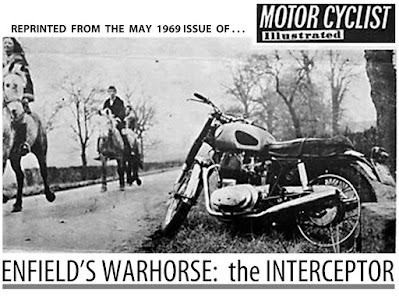
1969 Royal Enfield Interceptor was too good to be true

Horses trot past motorcycle in magazine story.
The Royal Enfield Interceptor of 1969 inspired awe and admiration.

 "Enfield's Warhorse: the Interceptor" is the title of a May, 1969 article in the Motor Cyclist Illustrated magazine.

 The reference to equine power is not just in the headline. The article begins:

 "It is an obvious, though romantic allegory, the Interceptor, and a Shire. Not the ponderous dray-horse of today, but their ancestors, bred in the Middle Ages as thundering great war horses; powerful enough to carry at full gallop a heavily armored knight; fast enough to run down the fleeing, poorly mounted foreign invaders, and magnificent enough in themselves to become as legendary as the men who rode them."

 The writer was Dave Minton, a motorcycle journalist and author. His words are a classic tribute to the mighty Royal Enfield Interceptors of yore. 

 Stirring words, indeed, but the comparison is perhaps more suited to the lithe and lean new Royal Enfield Interceptor and Continental GT 650s of today than the 750 Interceptors of 1969.

 That's right, I haven't got it backward. It turns out that Medieval war horses may have been bred for cut-and-thrust warfare, not bowling enemy soldiers over with their size.

"A team of archaeologists and historians searching for the truth about the steeds that carried knights into battle has concluded that most were probably only the size of a modern-day pony," The Guardian reported in January.*

But never mind. You know what Minton means. And he carries on:

"One of the best examples of large capacity British motorcycles has been virtually overlooked, at least in this country, despite its popularity in the USA -- the Royal Enfield Series II Interceptor, a 750cc Shire Stallion of the motorcycle world.

"A big, brawny, muscular machine. A deep-chested, galloping pacemaker, strong enough to give whatever is demanded of it without effort, it matters little as to the gear used, or where the throttle is, or what the revs are, or the weight carried, or how strong the wind is, or the steepness of the hill, the Interceptor will pound away until it has fulfilled the wishes of its rider. Without fuss or bother you simply fly away from the rest of the world followed by nothing except the deep baying of the exhaust.

"If you are the type who spends his days dreaming of hair trigger two-strokes with more working parts to the gearbox than engine, then forget it, put the story down now while your mood is still equable, because you will just hate this one. It's a bike to bring out the worst in a man...

"I just loved it." That might have summed and capped up his whole article.

But... no.

There's much, much more. The author writes that the 1969 Interceptor forever put to rest complaints that Royal Enfield motorcycles are slow and unreliable. It started from stone cold on the second kick without fail, didn't vibrate, and the clutch didn't act up in the heaviest traffic.

He even claims it didn't leak oil.

It's a four page article and we're still only on page one.

We finally get criticisms on page two and they're no fault of the motorcycle, but attributed to a decision to market it to Americans.

The Interceptor was comfortable for half an hour, but then its soft seat collapsed onto the pan and the forward positioned foot pegs took a toll on the thighs. Thankfully "American style" handlebars were not fitted, sparing the author "severe strain to the back, arms, and fingers bracing against the wind."

Minton turns a bit picky when he complains of the tool sizes required by the Interceptor. "Either two or three (I forget which) Philip head screw sizes. A similar number of ordinary slotted and Allen screws. Now that is not fair, for as well as the usual quantity of spanners even more tools are required."

If the Interceptor is as good as he says, why does he need tools?

Minton did not find the Interceptor's handling faultless, but he excuses his mention of this by explaining that Royal Enfield had encouraged him to be honest, making "my last few remarks a little more searching than is usual practice."

I thoroughly enjoyed reading his thoughts. Pointed, exaggerated and idiosyncratic, they place the Interceptor, British motorcycling, and motorcycle magazines in general in their period context.

No the Interceptor wasn't faultless; no one would have believed that. But reading about it sure was fun.

The now 53-year-old magazine article was posted on the Interceptor Forum by Ward, a member in New York state.

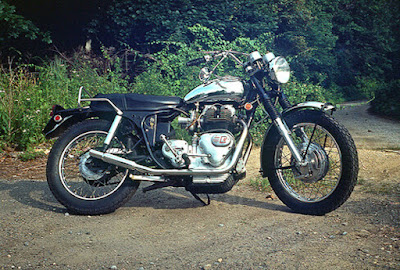
A Royal Enfield Interceptor pictured in 1977.
Ward's Royal Enfield Series II Interceptor, a heartbreaker.

Ward also posted a photo with it.

"Attached is my Series 2, in 1977. I sold it in a fit of pique in 1992, alas," he wrote.

In an email to me later he explained:

"I worked ceaselessly to correct my bike's faults, for 17 years, naively believing that if I got everything in top condition, bone stock, meticulously fitted and assembled, my efforts would be rewarded with a trustworthy machine, but it defeated my best efforts. And I am an aircraft mechanic by trade.

"I did manage to get $2,000 for it, as a gleaming showpiece that had the heart of a whore. Clutch, gearbox, oil leaks, we all know the list of genetic defects. My heart still aches at the thought of what might have been."

My thanks to him and author Dave Minton for an amusing wintertime read.

*Here's more about the actual warhorse of legend:

"It turns out that things are not quite as they have usually been portrayed,'' according to Alan Outram, study co-author and archeologist at the University of Exeter... "In popular culture, warhorses are often depicted as the size of a shire horse. It really wasn’t like that. Most medieval horses are surprisingly small. Selection and breeding practices in the Royal studs may have focused as much on temperament and the correct physical characteristics for warfare as they did on raw size.''

Thursday, November 11, 2021

Here's the Royal Enfield INT 650 you wanted all along

Customized Royal Enfield INT 650.
Baxter Cycle brought the 2022 Royal Enfield INT 650 closer to the 1969 Interceptor.

 It's accurate to say the sight stopped me in my tracks, even though I was cruising the Internet, not riding my Royal Enfield.

 Here was a 2022 Royal Enfield INT 650, lightly customized to better resemble an original Royal Enfield Interceptor of 1969.

Yes!!!

"This is what you wanted in the first place!" I nearly yelled. (Except I don't yell at the Internet; not much anyway.)

There's no question that Royal Enfield builds the INT 650 twin to remind riders of the glory days. In fact, outside the U.S. (where the name has been taken by Honda) "Interceptor" is the name Royal Enfield uses for the INT 650.

The custom look-alike INT 650 is the work of Baxter Cycle, of Marne, Iowa, where it is for sale, very slightly used, with time remaining on its warranty.

1969 Royal Enfield Interceptor.
Baxter's Jeremy Pendergast owns this 1969 Royal Enfield Interceptor.

Baxter's general manager is Jeremy Pendergast, himself the proud owner of an original 1969 Royal Enfield Interceptor.

Jeremy and his 1969 Interceptor co-star in the Royal Enfield video "Interceptor INT 650 Story," comparing his 1969 bike to a new Royal Enfield INT 650.

Watch the YouTube video of Jeremy and his 1969 Interceptor as they take on another rider on a new INT 650 on the roads of coastal California. You'll have a hard time telling which bike is half a century old.

2022 Royal Enfield INT 650.
2022 Royal Enfield INT 650 already looked great. But...

The Royal Enfield INT 650 already looks a lot like the mighty Interceptor of my youth. Now Baxter Cycle has closed much of the visual gap that still remained.

2022 Royal Enfield INT 650 custom.
2022 Royal Enfield INT custom goes for the glimmer.

How did this happen? I asked Jeremy.

"Here's the story," he responded.  "A good customer and friend of ours (Jim Crist) saw the video of my '69 Interceptor and wanted something similar, but that could be used daily. The allure of electric start and fuel injection made him consider a new 650.

"However, he really wanted the look of the older one, so when the new '22s were released with their chrome/red Mark 2 livery, we knew it would be a perfect base to start with.

"We first removed the large plastic tank badges and replaced them with period-correct vinyl logo decals. We also installed polished stainless steel fenders from Hitchcock's to more closely emulate the chrome fenders of the '69 and '70 models. 

Close-up of custom 2022 INT 650 tank.
1969-'70 period-correct decals on 2022 INT 650 tank.

"Additionally, we chromed a few extra pieces to more closely match the originals (the front fender brace and rear grab bar). We then added some black anodized fork ears and smaller black turn signals, and installed a black tail lamp housing.

"We also ditched the stock 'Mickey Mouse' chrome mirrors to the optically superior and visually less obvious Royal Enfield Touring Mirrors. 

"To cap it off, we installed the much more comfortable Royal Enfield touring seat.  

Close-up of tail of custom 2022 INT 650.
Shiny fender and grab bar, black tailpiece and turn signals, touring seat.

"Overall, a very mild custom with a dramatic effect."

I'll say. See if you agree. Compare the photos of Jeremy's 1969 Interceptor to the look-alike INT 650 Baxter has for sale. And watch the video. It will light your fire.

Friday, July 23, 2021

Selling a Royal Enfield: how do you sell love?

Royal Enfield Interceptor circa 1970.
The Royal Enfield Interceptor Series 2 looked the part.

A "rather dramatic write up," sniffed one member of the Royal Enfield Interceptor forum after reading a recent CraigsList ad for a Royal Enfield Interceptor built in Britain.

The seller described the "1971" Series 2 Interceptor as "a 56-horsepower, 120-mph twin."

The "ad is full of salesman's claims," one bemused Royal Enfield enthusiast wrote me. 

"The 120-mph Interceptor 750 was a Series 1 (that I suspect had some extra attention from the factory, and the 'A' special inlet cam sprocket). There were expectations of over 110 mph, but 120 mph would have been an exceptionally good engine. 

"Fifty-six horsepower existed in the minds of the advertisers working for the USA distributors; the factory was happy if their engines achieved 49 hp. The factory finalized shipments of bikes... in 1970, so there is no '1971' model," he wrote.

It doesn't matter, of course. Not many collectors or restorers would ride 120 mph, or try to exact maximum horsepower from a 50-year-old vintage motorcycle, with its drum brakes.

And besides, my amused enthusiast noted, the "ad is true to the form of the day. If they fibbed then, he can fib now."

That's another way of saying that the history of these motorcycles is well established. The time worn hyperbole still might puff up a buyer when he shows the motorcycle to friends. True or not, it's part of the legend of the mighty Royal Enfield Interceptor. Boasting rights come with the purchase.

But anyone knowledgeable enough in the first place to consider purchasing such a motorcycle is not going to be bamboozled by the wording of a CraigsList ad.

"Exaggerated as his figures may be, they won't impress anyone who is looking for big numbers," I replied. "I'm sure there are by now many less expensive used motorcycles that will better them easily."

Now that I think about it, what was the seller supposed to write in the ad? Take out all the empty boasts and all that's left are the words "excellent running bike."

Some CraigsList sellers simply write "if you're reading this, you know what it is," and name their price. 

There's not much poetry in that. Don't these treasured objects deserve more adoration?

I've never sold a vintage Royal Enfield Interceptor. But I recently attempted (and failed) to sell two living room end tables on Facebook Marketplace.

Faced with writing the ad I found myself describing why I loved the tables for their vintage looks. They reminded me of the kinds of furniture found in the elevator lobbies of grand old hotels. Never really designed to be used, these had only three jobs: to be inoffensive, easy to clean, and indestructible.

Trouble is, I had to admit, my wife found the tables offensive, for exactly those reasons. So they had to go, cheap, and fast.

It was a mixed message and, while many expressed interest, no one came to see the tables. We plan to donate them. I hope someone finds them who loves them as much as I did.

Friday, March 26, 2021

Nine great names for motorcycles and one that isn't

Person holding Royal Enfield INT 650 side cover.
Royal Enfield Interceptor 650 is called the INT 650 in the U.S.

Writer Michael Weyer reveals his nine favorite names for motorcycles in a recent column on HotCars.com

He also names his choice for the worst-ever motorcycle name. I won't give that one away (go read his column).

But I think his nine favorites are so well known you won't be surprised. They're all so great that I'm not certain what order he has them in, but whether it's top-to-bottom or bottom-to-top, I like the one right in the middle:

The Royal Enfield Interceptor.

The rest are:

BSA Thunderbolt (and sister Lightning).

Velocette Viper.

BSA Spitfire.

Norton Commando.

Triumph Thunderbird (and Thunderbird Storm).

Kawasaki Ninja.

Velocette Venom.

Vincent Black Shadow.

Note that all but one of his favorites is on a British motorcycle, although others have used them.

Honda has used the name "Interceptor" and still owns that trademark for use in the United States. This means that, in the U.S., Royal Enfield's Interceptor 650 must be marked and marketed as the "INT 650."

This drives reader John Donlon of Illinois wild.

"INT 650 belongs on the shipping crate and not on the machine," he told Royal Enfield more than a year ago. He thinks Royal Enfield should be trademarking the great names from its past more often.

He was happy to see Royal Enfield bring back the "Meteor" name for its latest new model (even though the name is on a single-cylinder motorcycle while the original Royal Enfield Meteor was a twin).

John thinks Royal Enfield needs to do the same with "Constellation." He noted that all it takes is "a filing fee and a stroke of a pen" to pin down the legacy of that famous motorcycle name (as long as no one else gets there first).

Last time I looked, the Constellation name was still available for motorcycles.


Friday, December 25, 2020

1964 Royal Enfield Interceptor brought back to life

Front end of 1964 Royal Enfield Interceptor.
The Royal Enfield Interceptor of the 1960s made quite a visual impression.

A sparkling blue 1964 Royal Enfield Interceptor is for sale in Florida. Its story is one of sitting ignored for many years before being saved, restored and then restored some more to bring it into its present condition.

Seller Kevin Lemire gave the motorcycle its most recent attention. He told me about it in an email:

"David, my story on the '64 Interceptor is pretty short actually. I purchased it this year from a fellow who bought it several years ago in from the John Stanley museum where it had been restored after sitting in an Idaho shop for about 30 years. 

"John Stanley I assume coordinated the restoration and I have receipts in the neighborhood of $4,500 worth of parts that went into the effort. The bike had not run in about four years when I got it and the carb slides were firmly stuck.

Left side of 1964 Royal Enfield Interceptor.
Twin exhausts add to the gleam.

"The owner dropped the bike off and headed back home to the west coast of Florida, a two-plus hour drive. I pulled the carbs, put them in the ultrasonic tank, freed them up, cleaned them and remounted them. Checked and filled fluids, fresh gas, checked for spark and had the bike running before the owner arrived back home.

"I was not happy with the frame paint so stripped the bike, powder coated the frame, swing arm, and front fork shrouds and reassembled all. Adjusted timing, valves, lubed everything and just gave it a thorough going over. 

"I attached a file that shows the parts and work done (scroll down to see it). The bike has been thoroughly refreshed and starts, runs, shifts, and stops great. And the clutch works very well, even lets you select neutral at a stop."

Kevin supplied a YouTube video of the motorcycle running.


The reference to John Stanley caught my eye. A Hood River, Ore. motorcycle restorer and collector, he's best known online for his on-line "museum" of the motorcycles he restored. It remains an amazing record of beautiful motorcycles he preserved.

The blue Interceptor was one of his.

Right side of 1964 Royal Enfield Interceptor.
Florida sunshine makes a ride on an Interceptor an inviting prospect.

"This was my first attempt at restoring a British bike," he wrote about it. "My brother bought one of these news in '63 or '64. According to Cycle World's road test, it was the fastest bike in that year. They claimed an honest 120 miles per hour."

The spread sheet of parts purchased indicate that Stanley did a lot of work bringing the motorcycle back. In the end, he judged it to be "a very comfortable, smooth and powerful bike."

(Note: The advertisement, written by a friend who placed the ad, refers to the motorcycle's "wet sump" motor. The 1964 Interceptor has a dry sump motor.)

Spread sheet of work done.
A spread sheet of work done.


Friday, October 30, 2020

Three Royal Enfield Interceptors for sale as a package

Restored 1965 Royal Enfield Interceptor Mike Warde has owned since 1970.

UPDATE: The motorcycles have sold.

Wanted: a good home for three vintage Royal Enfield Interceptors, now located in South Florida. At 76, Mike Warde is parting with his collection, including a restored 1965 Interceptor he has owned since 1970. He's done with kick starting, is downsizing before a move, and would like his motorcycles to go together to a collector or enthusiast. His hoard of extra parts go with the package deal.

If you think you might be the one, email Mike at mikeawarde@gmail.com

Here is his description of what he has:

"All have been used very little. They all have the appropriate original frames and transmissions.

One 1965 Interceptor is together and running.

"1965 Interceptor YB16159 I bought in 1970 while based at Naval Air Station Lemoore, Calif. from another pilot. It is together and running great when parked (about seven years ago). There is an oil leak from a misaligned pushrod tunnel oil seal...

"1965 Interceptor YB16625 was bought not running in 1973 and taken apart for restoration, which was never accomplished. All the parts are there and some extras... The engine is complete and ready to be vapor blasted and reassembled. The frame is painted black with no blemishes... The wheel rims are quality rechromed. Cad plating on spokes and other bits. New boxes of wheel bearings with extras. Both tanks are Candy Apple Red. Chrome fenders not installed. There are too many buffed and polished side covers for engines and transmissions, wheel hubs, fork tubes and the other aluminum pieces. The buffing and polishing was done professionally at a cost of $700. They were then sealed up (that's why their communal pictures look hazy in clear plastic. But they look great.) New front end stanchions or whatever they are called. I have receipts for most. No title.

Polished parts wrapped for preservation.

Chromed fenders.

Candy Apple Red.

"1968 Mk 1A 526. It is desirable because of the Series one engine and, if accurately restored, the beautiful later lines of the tank, seat and fenders. (It is) an incomplete basket case... No attempt to restore or reassemble done by me. No instruments, seat and more. There is a big box of parts. The front end is different from the YB's. This will be a project for someone who knows the 526 era bikes. There is a rebuilt mag, new and old chain guard, side cases and a spare or two. Polished hubs and cad plated spokes, new wheel bearings. No title."

This Royal Enfield is a project.

There's always a story behind vintage motorcycles. I asked Mike how he came into such a wealth of Interceptors.

"My Interceptor experience was not colorful: no racing, cross country journeys etc. The first bike was a 1965 Honda S-90. I was working for the summer on Cape Cod and needed transportation. I used all my life savings, $300, to buy it.

"While back at C.W. Post College I rode the S-90 to a motorcycle shop at Huntington Station, Long Island, N.Y. (and) I saw this gorgeous Royal Enfield Interceptor: maybe someday I could afford one?

"By 1970 I was a Navy A-4 Pilot with a wife and baby. Between aircraft carrier (USS Hancock) cruises to South Easy Asia, I bought a 1965 R.E. Interceptor, YB16159.  Another attack pilot's wife was told to sell it while he was also flying combat missions in and around Viet Nam.

"By 1973, I had gotten out of the Navy after seven years. Found another non running 1965 Royal Enfield Interceptor, YB16625, that needed saving. The rationale was the spare parts were hard to come by and that in the long run maybe it would be restored because it was so complete.

"Part sources were difficult. U.S. sources were Sammy Pierce, Green Light, Dick's Royal Enfield West, Sam Avellino. My wife and I visited UK sources on all our trips: Alan Hitchcock, Burton Bike Bits-Mick Page, Keith Benton.

"I used only the first Interceptor around town, wherever we lived. I started flying for the airlines in 1980 and retired in 2003 at 60. I refrained from riding much to protect my flying (physicals) career during those years.

"I restored the first Interceptor and readied the second Interceptor for assembly. But: a 1967 Triumph Mountain Cub needed saving, as did a 1966 Ducati Sebring, a 1982 Honda CX500 Turbo, and then a gorgeous BSA Gold Star DBD, (impeccably restored and documented by Mike Loper).

"I also acquired a very nice 1958 Velocette Venom 1 1/2 years ago...

"The Cub and CX500 were sold; now the rest need good owners.

"But we still have the 1964 Austin Healey I bought in Pensacola in 1967."

Mike Warde's son Kevin, now 51, on 1965 Interceptor.
I love the fact that his feet are on the retracted passenger pegs.


Wednesday, October 10, 2018

A 750 Interceptor owner rides the new INT650

Royal Enfield Interceptor motorcycle with chrome tank.
Jeremy Pendergast's 1969 Series II Royal Enfield Interceptor was the iconic Brit bike of its day.
For just a few years in the 1960s Royal Enfield produced a motorcycle that was among the most powerful, most beautiful, most desired of British bikes: the Interceptor. Its terrific reputation has survived its production years by half a century.

Now Royal Enfield has created a new Interceptor, with a parallel-twin motor, wire wheels, and classic seating position, as on the original. You can even get it with a chrome tank.

There are plenty of differences, too. For one thing, the new Interceptor 650 is a thoroughly modern motorcycle with — zounds — electric start. It also has front and rear disc brakes with ABS, a six-speed transmission and state-of-the-art tires.

Also different: it has a ready-made cafe racer variant, the Continental GT 650. Same motorcycle, different style and seating posture. The 650 twins are attractively priced and will come with three-year warranties and a year of roadside assistance.

Two men and two motorcycles on the beach near a pier.
Chris Kimball, left, and Jeremy Pendergast discuss the Interceptors of 2019 and 1969.
But how does the experience of actually riding the new Interceptor 650 measure up to the original?

Royal Enfield sought to answer that in the video Easy Got Back with racer Chris Kimball and Interceptor owner Jeremy Pendergast.

I asked Jeremy to expand on the experience. He is general manager at Baxter Cycle, the British motorcycle superstore in Marne, Iowa. Baxter has been a Royal Enfield dealer since 1995 and has been buying, selling and restoring vintage Royal Enfields since 1977.

Jeremy's personal collection of Royal Enfields includes 1960 and '61 700cc VAX Interceptors, 1962 through '64 750cc Interceptors, and 1968 and '69 Series 2 Interceptors. The 1969 Interceptor in the video belongs to him.

Two motorcycles on a mountain road. One is in the lead.
The new Royal Enfield Interceptor 650, foreground, on the road with an original 750.
Here's what he wrote, in an email:

"Having now ridden both the original Interceptors (in 700 and various 750 guises) as well as the pre-production 650, and, now finally, the full production-ready 650, I can honestly say that the newest, production-ready version is the best of them all (though I still like the raw 'I'm going to explode any minute' feel of the 700 VAX Interceptor).

"I think the ergonomics are really good — obviously, the  Interceptor is a closer match than the GT. The original Interceptors are actually a bit awkward in so far as 'ergonomics' had not been invented yet (the footpegs were too far forward and probably too wide, the handlebars were too high with a sort of awkward pull back, the kick start lever rests on your right calf, the seat locks you into a single position with its pronounced dip)... I sit more naturally on the new bikes.

"The feeling is very much the same 'sit up and beg' position, but just tweaked enough to feel suitably more modern, or, at least, refined.

"I like that the handlebars on the new Interceptor still have that relatively 'high and wide' feeling, but not as dramatically awkward as the original.

Two motorcycles lean into a curve on a mountain road.
And away they go, taking on the mountain curves near Santa Cruz, Calif.
"It feels to me that the engineers did an excellent job of styling a concept of what a modern version of the Interceptor should be, then went back and fixed things to make a better bike (the Continental GT). That's not to say the GT is superior; I just think the body posture and overall ergos on the GT are suited better for the performance potential of that beautiful motor.

"HOWEVER, it's not all about speed, and if I were to choose just one to have, it would be the Interceptor, if for no other reason than the name alone. But I do also like the slightly more upright, laid-back feeling. 'Easy Got Back' sounds about right.

"When riding with Chris in the mountains around Ojai, Calif., I was stunned at the relative 'puny-ness' of the original 750 motor. It was a fast bike for its day, but the modern 650 didn't really seem to care about things like altitude, lean angle, or grade, and (despite the temperatures climbing to over 100 degrees), it certainly didn't exhibit things like brake fade and clutch drag like the 750.

Two motorcycles on mountain road.
Two capable riders on two capable motorcycles designed 50 years apart.
"Chris was able to go into and exit corners much faster, climb steep hills easier, and pitch the (new) bike over without grinding anything off. And he never once had to adjust a carburetor...

"The newer bike with its slip-assist clutch makes gear changes effortless, both in terms of effort and planning. The old bike doesn't have the heaviest of clutch levers, but it would still get tiring filming a scene over and over again. And anyone familiar with an iron barrel Bullet's gearbox — well, all I can say is the original Interceptor's is no different or better. Awkward and imprecise. More of a mallet than a scalpel.

"We did both agree (as did the film crew) that the '69 Interceptor sounded much better. I certainly look forward to the official release of the accessory S&S mufflers for the 2019 models.

"I would also venture to say there is and always will be something inherently cool and attractive about antique motorcycles. The old bike would get thumbs up from people of all different backgrounds, instantly recognizing it as something out of the ordinary. The new 650 would gather a small crowd when parked, but it was exclusively curious motorcyclists who had an inkling that Royal Enfield was up to something...

"No one mistook it for a vintage bike, but many appreciated the overt stylistic compliments it was paying to its elder sibling.

"All in all, I would say Enfield has every right to be extremely proud of their new twins. The original Interceptor was a true muscle bike in its day. I think you would struggle to find anyone today who would call the new 650s anything of the sort.

"BUT, compared to their antiquated (though still cherished) predecessors (the EFI Bullets, Classics, and GTs), the new bikes are truly state-of-the art and extremely capable. I would venture to say the new bike is more of a super bike and less of a superbike."

Watch the video to see the two Interceptors in action. Interestingly, it wasn't scripted, Jeremy wrote me.

"As a result, we weren't really sure what (was expected). Do we talk about old vs. new, do we talk about performance, looks, coolness, price? We settled on just talking about what we were there to do: have fun."


Wednesday, March 14, 2018

Royal Enfield 650 twins sparkle someone else's eyes

It's hard to ignore Royal Enfield's new 650 twins.
I'm sitting at the Royal Enfield Himalayan launch event, salivating over a different Royal Enfield. To my surprise, Royal Enfield had brought the new 650 twins, not yet introduced to the United States.

Sexy, sleek and presumably faster than the trials-style Himalayan, the Continental GT 650 cafe racer and INT650 Interceptor can't help drawing attention.

I'd seen them at the Long Beach International Motorcycle Show, but they were on pedestals there, giving off a definite "look but don't touch" vibe. At the Himalayan launch the new twins sat the floor near the bar. They seemed approachable and, when others tried swinging a leg over them I wasn't too shy to try myself.

Of course they felt great, although sitting on a motorcycle inside a banquet hall is bound to feel a bit foolish.

Sleek and sexy looking Royal Enfield 650 twins.
Still, if anything, they were more attractive when seen at ground level than they had been on the show floor.

I can't say they felt light. I'll call them substantial, like my own iron barrel Royal Enfield Bullet. But with much more power they certainly promise to turn frisky on the road.

While the Himalayan certainly impresses — one moto-journalist present called it "the perfect going to college motorcycle" — the 650 twins looked like more ultimate joy.

My college room mate, back in the day, had a gorgeous Triumph Bonneville and a very pretty girl friend. The guy, the girl and the British motorcycle made an impressive sight on a Spring day. That was long ago.

Last I heard, he had married the girl. That guy and that girl grew up and moved along.

But it looks to me as though Royal Enfield is bringing back that motorcycle, at least. Is there one in your plans for next Spring?

Friday, February 9, 2018

Can't believe what you read about the Interceptor 650?

You can already find online reviews of the new Royal Enfield Interceptor 650.
But can you believe what you read?
You're a Royal Enfield enthusiast stuck inside by winter weather and you have a lot of extra time to cruise the Internet looking for stories about your favorite subject: Royal Enfield.

You're certain to encounter a tremendous number of comments about Royal Enfield on a certain website out of India that publishes consumer reviews of all sorts of products, including motorcycles — especially Royal Enfield motorcycles.

You may be startled, as I was, to find the website already sports reviews of the Royal Enfield 650 twins — motorcycles that as far as I know, as of this date, have yet to be sold to any consumer anywhere, even in India.

I was particularly surprised by the review by "Chaitali7" of Kolkata, India, who entitles her review of the Interceptor 650 "High Price & Low Performance."

She rates the Royal Enfield as one star, with bottom rankings in mileage, reliability, appeal, comfort and road grip.

"Today I am going to share my personal experience regarding the Royal Enfield Interceptor 650," she begins.

Her review is entirely negative. Among the features she dislikes:

"It is only single cylinder."

"A four stroke engine is very bad."

"The mileage is lower than SUV."

"There should be a rear disk brake for safety."

"Does not have good look and style appeal."

True, these would be big problems, if any of them were true, which none of them are. The Interceptor 650 is a twin, with a superior four-stroke overhead-camshaft motor, mileage is higher than an SUV, the rear brake is a disk (with ABS) and the motorcycle's style is likely to appeal to many.

But let's look at Chaitali7's other reviews. She has written 67 of them.

In one day she wrote reviews about an iron, a pressure cooker, a book, a television, a heart rate monitor, a scooter, a room air cooler and even an online shopping website.

Chaitali seems to have a lot of "personal experience" with each of these products. And to each of them she gives the exact same rating: one star. A remarkable coincidence. She is a very tough customer!

Other reviewers on this website are more generous. Indeed, some are lavish in their praise.

Just for instance, there is "gp9138277778" of Hisar, India, who rates the Royal Enfield Interceptor "Best Bike In Bullets." He gives it a five-star rating, calling it "O Some," meaning, I suppose, "awesome."

His review is 15 lines long, but nine of those lines consist only of "ETC," endlessly repeated.

Discussion by reviewers on the website indicates that they earn money for their reviews. The more reviews, the more money they earn.

Meanwhile, the website offers businesses an opportunity to buy ads and otherwise "protect" their brand.

"Don't let negative reviews and blogs ruin the future of your company and brand," the website urges. There is a sales form brands can fill out to "enquire about our business solutions."

It's an altogether curious phenomenon.

Friday, August 28, 2015

Epic road trip brings Interceptor Group founder here

Royal and Ann depart from my house for points west.
My wife and I recently played hosts to "Royal," creator of the Royal Enfield Interceptor Owners website and his wife Ann at our home in Fort Lauderdale, Fla.

These intrepid, Swedish born Australians were on their way to Key West, the tail end of the chain of keys (islands) that carries you as far south as you can be and still be in the southeastern United States.

Royal and Ann already had motorcycled through more of the U.S. then I've ever seen — including Alaska — and in only three months' time.

They just generally charmed us with their can-do attitude. Although Ann is riding in back this trip, she is a motorcyclist. She built her own Royal Enfield Interceptor, using bits from a Series I and a Series II. Royal is also the moderator of the popular Royal Enfield Interceptor Owners Group on Yahoo.

Of course the Royal and Ann weren't riding Royal Enfield Interceptors when they got to my house — it's not what those greyhounds are for.

They're doing this trip aboard "Louise," their beloved Harley Davidson, shipped from Australia. They're towing a trailer and doing some camping.

Louise got a new tire for the trailer's single wheel while in my garage. Royal showed me how to break the bead by gently letting the Harley's kickstand down on the tire.

Royal and Ann's Facebook page details a journey that began in California June 4, and reached my home more than 15,000 miles later on Aug. 17, 2015.

By that time their mileage chart list included: California, Oregon, Washington, British Columbia, Alaska, Yukon Territory, Alberta, Idaho, Montana, Wyoming, South Dakota, Iowa, Illinois, Wisconsin, Michigan, Ohio, Pennsylvania, New York, Ontario, Massachusetts, Vermont, New Hampshire, Rhode Island, Connecticut, New Jersey, Delaware, North Carolina, Tennessee, Georgia, Alabama, Mississippi, South Carolina and Florida.

They went all the way to the Arctic Circle in Alaska, saw Mount Rushmore, Wounded Knee, Niagara Falls, the Statue of Liberty, the U.S. Capitol, the Jack Daniel's Distillery, the Musician's Hall of Fame in Nashville, the Dragon's Tail and Stone Mountain and much more.

Louise and her riders climbed Mount Washington!

They visited the Harley Davidson museum in Milwaukee, the Wheels Through Time Museum in Maggie Valley and the Barber Vintage motorcycle museum.

Movie fans, they talked so much about Punxsutawney, Pa. ("Groundhog Day") that I began to suspect they might have been there more than once.

As they rolled out of my garage, Royal eyed the discarded trailer tire.

"I hope you won't have to pay a disposal fee for that," he said.

"Oh no," replied my wife Bonnie. "I plan to use it as a planter in the garden."

Tuesday, February 2, 2010

Basket case Royal Enfield is worth a lot

"Royal Enfield parts bike no title year and model unknown. $400."

Everyone loves a mystery and everyone loves a bargain. So, when I saw this ad on CraigsList in the Los Angeles area, I immediately wrote the seller, offering to help identify it.

The seller, "Norm," sent pictures that would have stumped me except for the twin carburetors visible dangling inside the frame. I guessed this was the remains of a Royal Enfield Interceptor, and referred the case to Chris Overton, the best expert I know on Interceptors. He contributes to the Yahoo Royal Enfield Interceptors message board.

Chris pressed Norm for engine and frame numbers. The answers came back: "frame is 73277 and engine YC1691."

From that Chris was able to devine that "The engine was built in December, 1966 at Upper Westwood near Bradford-on-Avon, one of the first with Concentric carbs, and was one of the last installed in a frame at the Redditch factory before it closed in January 1967. Maybe a 1966 dispatch date, maybe 1967; certainly a 1967 model.

"You could say reliably that you have a 1967 Series 1A 750cc Interceptor."

Chris suspects that the frame number matches the engine but that reassembly of even this matching numbers bike is "marginal from an economic standpoint," although he has seen worse.

"My preference, as a restorer, is to see every bike shiny and noisy again," he advised Norm.

He even added that "there is an Interceptor rally again this year near the Upper Westwood factory site, hosted by ex-Enfield employees. June 11-13. I went in 2008 and plan to go again this year. You would be more than welcome. Well worth the swim. "

"To be honest all I want to do is sell it and I'm trying to figure out what to sell it for," Norm responded. "It looks like I have almost all the parts (I have four boxes of parts not in the picture — alotta rust!). Thanks for your help."

The original ad has expired, but Norm said he "got more emails than he could have imagined." He has posted a new ad, now asking $1,000. For the right person, it may still be a bargain.

I'm just happy to see the mystery solved. Thanks, Chris.

Monday, June 29, 2009

Royal Enfield Interceptor drew attention

The 1965 Royal Enfield TT Interceptor for sale now on eBay (see previous posting) was the cover girl and the feature story in Old Bike Journal magazine for August, 1994.

The 750cc Interceptor had been a big, fast bike in its day and this was the super sports model, with the hottest cams and the longest wheelbase. The 1965s were the first Interceptors to abandon the Royal Enfield casquette, and the new separate instruments gave them a more up-to-date look.

But what did the magazine choose to focus on? The neutral finder! This device, worn on most Royal Enfields of the day and decades before and since, makes downshifting from any gear to neutral a one-step process. It's a wonderful device but hardly the sexiest feature of this very rare and fast motorcycle.

The bike remains very powerful. Seller William T. Bolstad describes having to wait for friends on Triumphs to catch up on rides. He describes it as "a seriously fast Old British Motorcycle."

He ought to know. The blue Interceptor is the first of three Royal Enfield twins he is selling and he has restored and cared for many motorcycles, including the line-up of Triumphs seen here.

Bolstad and his wife Linda live in Kalispell, Mont.

He also shared this picture of himself at a younger age, on his 1966 Triumph.

Wednesday, June 3, 2009

Royal Enfield Interceptor, $750 (in 1964)

Ogden, Utah is a long way from Redditch, England, but if you wanted a used Royal Enfield motorcycle in 1964 there were some pretty good deals at Carey's Cycle Center in Riverdale.

According to the ad above, spotted in an old issue of the Ogden newspaper, 1963 Royal Enfields were selling by cubic capacity. Just $750 for the 750cc model (which could only have been the then brand new Interceptor).

Hard to find any $750 Interceptors these days, but Carey's is still around. According to the website, Careys Cycle (they dropped the apostrophe) was started in 1957 by Paul and Joyce Carey.

"Through the good and bad they have managed to be around for 52 Years. Through the years they have had such lines as: Triumph, BSA, Norton, Rickman, Bultaco,and Harley-Davidson. In 1963 they took on Yamaha (third dealer in the U.S.) and still do have that line.

"Paul and Joyce have retired and their daughter and son-in-law run the business now, Brad and Caron Boswell."

One additional note. U.S. dollars in 1964 were worth far more than they are today. One on-line calculator I found translated that $750 to well over $5,000 in today's dollars.

Wednesday, May 20, 2009

Update: Details on Interceptor for sale

The owner of the 1967 Royal Enfield Interceptor featured in the post below kindly provided additional details:

"My name is Dave Rorty and I'm the owner of the 1967 Interceptor on CraigsList. I am the third owner, for the past five years. The bike was purchased outside of Daytona about eight years ago by my best friend's wife for his birthday. Dr. Bob was a great guy and very talented mechanic with his own shop in Oakland, NJ. He passed away five years ago and I purchased it from his wife.

"He had freshened up the top end and I have since rebuilt the gear box, mainly due to a more than normal leak. I have installed Commando points / condenser and upgraded the petcocks. As I have three other classic bikes and a new Triumph Tiger, I'd like to find "Fergie" a new home.

"Other than the points, petcocks, air / gas filters and a single throttle cable from the handlebar to the splitter, the bike is original and unrestored. I do still have the original velocity stacks as shown in one of the photos. The speedo and tach were rebuilt by Nisonger and shows approximately 11,000 miles. I believe the bike's actual mileage is around 25,000.

"The original mufflers are fairly worn out but are presentable for an original 42-year-old bike. After the fourth or fifth kick the bike will start and has a very aggressive sound. Much more torque than my '71 Commando due to the longer stroke.

"The automatic neutral finder works great and the gear box seems to have a fairly short throw. Fenders are stainless and the tank's chrome is in pretty good shape. There is just a hint of polish wear on the top of the tank and the red stripe down the center is all there. The original decals are properly worn yet quite readable. The front end is surprisingly compliant and the bike is extremely stable at speed.

"If I don't end up selling it I wont be too disappointed. Thanks for your interest in the bike."

Asking price is $6,800. You can call Dave at 201-934-7176.