Showing posts with label Classic 650. Show all posts

Friday, March 27, 2026

Here's what they say about Classic 650

Royal Enfield Classic 650 twin.
Here's the Royal Enfield I've been waiting for.

 Finally, the Royal Enfield Classic 650 is coming to America. Here's what the reviewers are saying about it:

"The Classic 650 is up for pre-orders right now for a price of $7,499. For that price, you get your choice of three colorways: teal, black and chrome, or red and white. Personally, teal would be my pick. The price places the Classic 650 as one of the more expensive RE 650s. However, it’s still cheaper than other retro rides like the Kawasaki W800 and the Triumph Speed Twin 900. Of course, the RE has a smaller and slower engine than either of those, too. The pre-order period ends on March 31. After that, examples should start appearing in Royal Enfield dealers." —The Autopian 

"The Teal color options comes with a color-matched frame. Spoked wheels lean into the classic styling." —Rider Magazine 

"On the black and chrome version I tested, the gold pinstripes on every fuel tank are hand-painted by specialists at the Royal Enfield factory who do nothing else. The paint itself is also gorgeous, with a subtle gold flake that shines through in the sunlight." —Men's Journal 

"The Classic 650 has dual seats but can quickly be converted to a solo setup by removing the pillion pad and the rack with a single bolt. But if you want, you can leave that rack on and add other touring accessories from Royal Enfield’s catalog for longer-duration trips." —Adventure Rider 

"The forged and embossed handlebar clamp proudly displays the Royal Enfield name (this is not cheap tin) and the metal switch cubes give off quality vibes. The Classic’s paint is rich and lustrous, the chrome brilliant and there is very little plastic anywhere, which speaks to the improved build quality of current-gen Enfields, while outshining some much-pricier machines in the looks department." —Cycle World

"I do like that it features a modern LCD screen for the gear position, fuel gauge, clock, and odometer, along with a standard USB-C port and Tripper navigation pod along with the retro analog speedometer. But, even with those modern touches, it still keeps that cool, classy, vintage-esque cluster. So, if you’re looking for a spaceship, this isn’t it." —Motorcycle.com

"At about 60 mph, some buzz became apparent through the seat, but not enough to be bothersome. It stepped up a notch at 70 mph. At that point, I found myself looking for seventh gear, because the character of the twin means it prefers midrange. What rpm? I don't know. There's no tachometer, though there is a little arrow beside the digital gear indicator in the small LCD screen that points upward when the motorcycle thinks you should upshift." —RevZilla

"If I said the words 'Royal Enfield Classic 650' to you, what would you picture in your mind? Chances are excellent that even if you're somehow reading these words without having seen the photo at the start of this piece, you're probably picturing a motorcycle that looks strikingly similar to how this bike actually looks in real life. Which is, honestly, kind of the entire point of this bike." —RideApart.com

"The riding position is old school in the best possible way. Your back is upright, your shoulders are relaxed, and there is virtually no weight on your wrists. The handlebars sit at a natural, comfortable width. Your legs drop at roughly a 90-degree angle to the ground rather than being tucked up under you or stretched forward. The seat height comes in at around 31.5 inches, which is pretty high, but still low enough to be accessible for a wide range of riders, though not quite as low as a traditional cruiser." —TopSpeed

"I like that, aside from its good looks, the Classic 650 has all the positive traits of a cruiser without the downsides. It doesn’t scream cruiser when you see it; it’s more comfortable than most cruisers; and it won’t drain your bank account to buy one." —Cycle News

Friday, April 4, 2025

Is the press too hard on the Classic 650?

The Royal Enfield Classic 650 twin.
Is Royal Enfield's newest 650 too much of a good thing?

 Royal Enfield's newest version in its line of 650cc twin-cylinder motorcycles was released in India last week. The Classic 650 is the most retro of the bunch and, not incidentally, the one that most interests me personally. 

That's because it is a Royal Enfield that looks like it would have when I was a kid in 1960, but goes (and stops) like it must to keep up with today's traffic here in the U.S. 

Royal Enfield's Classic 350 single was already motorcycle royalty in India. Don't think the riders there were going to fall in love immediately with a 650 twin version, just because it is bigger and badder. 

These guys are tough customers. 

Here's what the press in India thought about the Classic 650 twin, after riding it: 

"The Classic 650 is beautifully designed with elegant lines and a nice choice of colors to choose from. The teardrop shaped fuel tank, the way the engine occupies pride of place, those long chrome exhaust pipes and the overall stance make this bike quite the looker." Rishabh Bhaskar, BikeWale

"The biggest issue with the Royal Enfield Classic is that purists love the way the bike looks. So Royal Enfield can’t do much even if it wanted to do something drastic with the design. Hence we get the iconic Classic fascia complete with the signature Tiger lights. Upgrades come in the form of an LED headlamp which is not exactly the best in business. The light disperses wide and lacks a strong beam and we think that RE should work on it and make it better." Rahul Ghosh, IndiaToday

"One of the key reasons for the success of the Classic 350 was its old-school design language packaged well with vibrant color options. The Classic 650 also carries forward many of the design elements like the headlight nacelle, the mudguard shape, the fork covers, fuel tank shape, tail light and even the pea-shooter muffler, you get two of them here.

"Despite carrying the same design elements, the Classic 650 doesn’t look as cohesive or easy on the eye as the Classic 350 does. Maybe it’s the gap between the rear tire and fender, or just its enormous wheelbase; it just looks a bit too stretched out. To my eyes, it doesn’t have the same visual impact a Classic 350 manages so easily." Arun Mohan Nadar, ACKODrive

"The details add up to make an otherwise gorgeous motorcycle even more impressive. The aluminum switchgear covers, also finished in chrome, the handlebar clamp proudly bearing the Royal Enfield motif and the fuel tank lid, all underscore good fit and finish and quality levels." Preetam Bora, Car&Bike

"In a segment where emotional connect plays a pivotal role, the Classic 650’s legacy-driven positioning gives it a substantial advantage over its rivals." Syed Shazil Hussain, ET Auto

"At 243kg (536 lbs), the Classic 650 is a big, heavy thing, and you feel that at a standstill and also while pushing it around or during U-turns, but Royal Enfield has done a commendable job of masking its weight once you get going." Dinshaw Magol, AutoCar

"The Classic 650 too gets an analogue speedometer that’s easy to read in all conditions. However what’s different here is the speed at the other end of the speedometer – 125 mph instead of 100 mph on the Classic 350. (Ed.: Royal Enfield gives the top speed of the Classic 650 as 98 mph.)

"And just like on (the Classic 350), there’s a digital display under the speedometer which tells you the fuel level, mileage, odometer reading, trip distance, and time. Simple yet effective. There’s also a USB type-C charging port, a Tripper navigation display for turn-by-turn navigation (standard on all variants!), and adjustable clutch and brake levers.

"Although the Classic 650 has impressed us in many ways, its suspension setup leaves a lot to be desired. Simply put, it’s quite stiff for a Classic, with just 90mm of wheel travel. That robs it of the plush ride that one would expect, and the limited scope of travel also makes it difficult to tune it into having a comfier setup." Sohm Mayekar, ZigWheels

"If I look over minor niggles like the lack of feedback on the front brake lever, the instant ABS intervention on the rear brake and vibrations on the seat at high revs, I think the RE Classic 650 makes a compelling case for itself in terms of a cruiser." Sumesh Soman, OverDrive

Royal Enfield posted its response to some of the concerns in a Q-and-A format. In fairness, here are a few points made:

"The Classic 650 is designed for superior comfort with a wide seat, refined suspension, ergonomic riding posture, and minimal vibrations at high speeds, making it ideal for long-distance touring...

"We would encourage any beginner riders who feel intimidated by the Classic 650 but who aspire to Classic ownership to start their riding journey with us on a Classic 350 and upgrade as their skills and confidence increases...

"While the bike is the heaviest in our portfolio, the Classic carries a very low center of gravity, so the weight is not as obvious and the motorcycle gives confidence in its handling and maneuverability. The seat height is very accessible at 32 inches...

"The Classic 650 is not an off road bike. The suspension is tuned to capably take on rough/broken roads while providing the best riding comfort to the rider and the pillion."

Friday, February 21, 2025

How retro is the Classic 650 twin?

Comparison of old motorcycle with new.
Do you see similarities between Royal Enfield's first parallel twin motorcycle, and its newest? (From The Gun magazine of the Royal Enfield Owners Club UK)

 I've had my say on whether the new Royal Enfield Classic 650 twin looks like the original Royal Enfield 500 twin of the 1950s. 

It doesn't. 

But that's my opinion, and I may be alone. 

The Gun magazine of the Royal Enfield Owners Club (UK) compared photos of the new twin and the original in its February/March edition. The magazine concluded this: 

"The Original 500 Twin (above) and the new 650 Classic seen at the Milan Show. The seat and the mudguard support, the frame loop, even the mudguard all look very like the Original." 

The magazine is undoubtedly right about those elements. Both motorcycles evoke nostalgic appeal today although, keep in mind that the original was thoroughly modern in its day. 

But look. I didn't say the new 650 twin looks bad. (It does look a little tight in its jeans, though, doesn't it?)

Here, again, is what I wrote:

"The Classic 650 caters more to modern tastes, with gearbox and motor encased together. Cylinders are canted forward and the side covers slant firmly forward. The Classic 650 is tightly packaged. Its solo seat is tucked in, without springs. From some angles the big, unit powerplant seems to bulge with barely contained muscle."

I accept the new Classic 650 twin as retro. And, as I said, that makes it the most interesting 650 twin to me personally.  Because, if I am honest, retro is the reason I ride Royal Enfield.

To me, though, the Classic 650 looks to recall a more modern era. Maybe -- probably, in fact -- that's smart. Ideas of beauty have evolved.

Here's a case in point. Look at the 1953 500 twin The Gun used in its comparison. Dignified, isn't it? Old fashioned, of course, but there's nothing out of scale or outlandish about it, is there?

Nothing looks out of place.

Well, swell, but that's not how the Royal Enfield 500 twin looked when it was first introduced, in November, 1948. It was unusual looking at the time and today would be called an outright ugly duckling.

1948 Royal Enfield 500 twin.
The Royal Enfield 500 twin as introduced in November, 1948.

The massive unsprung front fender was utilitarian, perhaps, but not a thing of beauty. One critic wrote that it "spoilt the lithe lines of the rest of the machine." It sure did.

The engine, viewed from an unflattering eye level, also seemed too big for the bike. The rear fender, slim from the side view, looked fat in the three-quarters view.

Speaking of everything being in its place, customers must have wondered about the wisdom of housing the ammeter, light switch and ignition key in the side air cleaner box, where they could not be seen by a mounted rider!

The 500 twin had to evolve to become a looker. The Classic 650 twin is more evolved still. It's not its twin, but it might very well be a descendant of the original.

Friday, January 3, 2025

What the Classic 650 looks like

Animation compares Classic 650 to 500 twin.
Royal Enfield's new Classic 650 isn't a copy of the 1951 500 twin.

 Dubbing it "the most retro of them all," Ultimate Motorcycling's thorough description of the coming Royal Enfield Classic 650 twin neatly summarizes why it appeals. 

Of all the Royal Enfield 650 twins -- Interceptor, Continental GT, Shotgun, Super Meteor and Bear -- the Classic 650 packs the clearest appeal to fans of historic British motorcycles. 

It's upright, attractively styled, tastefully shiny, and powered by a parallel twin-cylinder motor. 

It clearly references Royal Enfield twins of the past. EVO magazine reported that the "sweetly rounded tank plus a solo saddle" are a direct reference to Royal Enfield's first parallel twin motorcycle, the 500 twin of 1948. 

"In fact, if you care to compare it to the new Classic 650 you can make out why and how (design chief) Mark Wells and his motley crew fell in love with the 500's lines to scale them up in more ways than one to present Royal Enfield's new flagship in all its grown-up build and grace," the magazine wrote.

Listen to Mark Wells enthuse about the Classic 650 in this brief Royal Enfield video.

Except, note that he doesn't mention the 500 twin in this video (he may have, elsewhere).

Comparing the 500 twin to the Classic 650 directly, it's easy to spot the differences in appearance. See the animation at the top of this blog item.

The separate gearbox, kick start lever, and neutral finder lever of the 500 twin impose a lot of busyness. Its straight up-and-down cylinders stand as erect as soldiers at attention. Its solo seat doesn't hide the springs that support it.

The Classic 650 caters more to modern tastes, with gearbox and motor encased together. Cylinders are canted forward and the side covers slant firmly forward.

The Classic 650 is tightly packaged. Its solo seat is tucked in, without springs. From some angles the big, unit powerplant seems to bulge with barely contained muscle.

One point of criticism has been the (overly?) generous rear fender, which at rest leaves a significant space over the rear wheel.

Rear fender of new Classic 650.
Does this rear fender make me look fat?

It seems to awkwardly advertise the fact that the Classic 650's rear wheel is 18 inches, slightly smaller than its 19-inch front.

In contrast, the rear fender of the 1951 500 looks svelte, and closely follows the curve of the wheel. (Note that the front fender of the Classic 650 is relatively trim and tight.)

To be fair, some of the "classic" in the Classic 650 twin is supplied not by bodywork but by its vintage-looking color palate of Teal, Vallam Red, Bruntingthorpe Blue, and Black Chrome.

Why even bring up the comparison of a 2025 Royal Enfield to the 500 twin of (gasp) 75 years ago?

"For those not up to speed with post-war British motorcycle history, Enfield credits its 1948 500 Twin as one of the most important bikes in its long history, and indeed of its era," Dan Trent wrote in Goodwood Road and Racing.

Royal Enfield itself suggested the comparison; not the press. Its press release, reprinted on many websites says this:

"In the mid-20th century, streamlining was the optimistic promise of modernity, speed and progress. The streamline ‘speed-form’ was an integral part of the signature style of design masters such as Henry Dreyfuss and Raymond Loewy.

"On the 500 Twin, this influence was evident in the form of the teardrop-shaped fuel tank, side panels and, perhaps most prominently, the famous signature Royal Enfield casquette (nacelle) headlight housing.

"With the new Classic 650 Twin, the design team has taken this design language and evolved it, italicizing the stance of the motorcycle to give it a sense of motion even when stood still...

"The ‘500-Twin’ later evolved into further parallel twin models like the Super Meteor, Constellation, and Interceptor, but the 500-Twin is where it all started."

To that statement, Trent injects a note of realism regarding the new (yes, new!) Classic 650 twin.

"It may not look it, but this is a totally modern bike, riffing as it does on Royal Enfield tradition but based around that decidedly 21st-century engine and using up-to-date suspension and brakes to hopefully combine contemporary riding manners with a look harking back to the good old days. If, indeed, they were that good at all."

Those "good old days" were good, in part, because they looked forward, not back. The 500 twin of 1948 was Royal Enfield's step towards the future. In his book "Royal Enfield, The Postwar Years," Roy Bacon tells it this way:

"After the second world war there was a great rush among the British firms to get a twin cylinder model into their lists in opposition to the Triumph, which had come out first in 1937. Not for nothing was the (Triumph) Speed Twin advertised as the one with a 10-year start.

"In time all the major firms produced their twins as fast as postwar problems would allow them and Royal Enfield were no exception."

Royal Enfield's 500 twin had its own distinct history, triumphing in competition, improving in power and sophistication, and even getting better looking: the early models lacked the famous casquette, and had an enormous, ghastly, unsprung front fender.

The 1951 version was best looking, in my opinion, and so I've used it for the comparison animation.

During its run, the 500 twin would spawn "sport" and "deluxe" models, be saddled with the somewhat dowdy Airflow fairing, a toaster-shaped tank, and be renamed with the sad-sack moniker "Meteor Minor."

"A little sadly, this was not what sold motorcycles at that time for a decline had set in and was to last a decade, destroying much of the British industry in the period," Bacon writes.

"There was no longer any place for a 500 twin and so, in 1963, the final example of the small Enfield twin went from the range."

What remained were memories, and they are fond memories. The new Royal Enfield Classic 650 is, to me, the most interesting of the new 650s because it carries on into that future the 500 twin never got.

Basically, it's this: what if the motorcycle I wanted as a teen (but couldn't have) was suddenly available in 2025, updated and perfected? Would I want it? Wouldn't you?

Friday, December 6, 2024

Classic 650 can't help being a beauty

Royal Enfield Classic 650.
The Royal Enfield Classic 650 is meant to be beautiful.

 There are beautiful motorcycles that are works of art. Often they are artworks first, and vehicles second. These are perfect for art museums. 

In contrast, motorcycles that get bought and used by the public may look dramatically modern, look evocative of other eras, or look like tools built for abuse. They all typically sacrifice at least a bit of beauty to appear modern, retro, or adventurous. 

Royal Enfield's Classic 650 twin, due on the market in January, is an invitation for art critics to weigh in. 

Buyers are going to care about how it looks. 

After all, if they wanted it fast, there's the Continental GT 650; naked, there's the Interceptor 650; luxurious, there's the Super Meteor 650; bobbed, there's the Shotgun 650; beastly, there's the Bear 650. 

What's left to the Classic 650? Beauty. And not everyone will agree on that. 

"The Classic 650 is not just another air-cooled 650, it’s the air-cooled 650," Evan Allen of Cycle World enthused. He liked nearly everything about it, including, presumably its looks. Yet he never mentioned its appearance.

Those who do mention its looks can be critical.

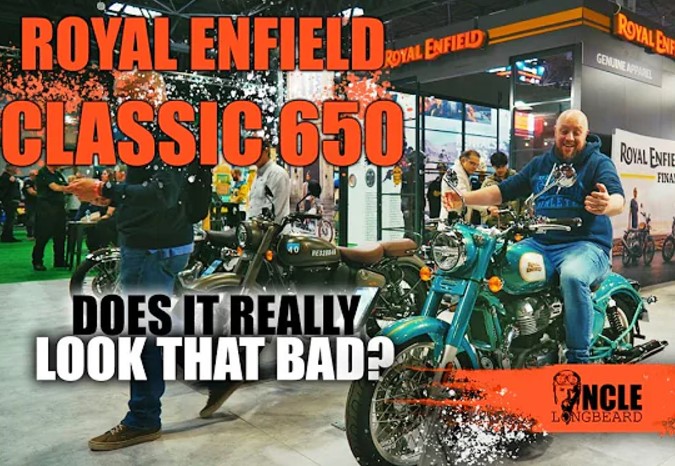
Is the Royal Enfield Classic 650 ugly?
Uncle Longbeard was worried about the looks of the Classic 650.

"When I saw the pictures of a new Classic 650 I thought: it's terrible, they ruined the bike with massive rear fender. Is it really that bad in reality? I went to the Motorcycle Live in Birmingham to check it out," longtime Royal Enfield owner Uncle Longbeard said on YouTube.

The rear fender looked bad to him, too massive. The front fender brackets looked too squarish, not pleasantly rounded.

But, seeing the Classic 650 in person, he ended up a convert. Sort of. The rear wheel moves backward slightly when the rider sits down, making it a better fit, he decided. A taller profile rear tire would further help; you could even fit panniers if you're really offended, he suggested. 

And you could paint those offending front fender brackets black to disappear them.

In fact, from the right perspective, the Classic 650 "looks just brilliant, and gorgeous and sexy," he concluded.

The Classic 650 is not the single-cylinder Classic 350 with the big-twin motor stuffed into it. It's based on the twin-cylinder Super Meteor 650, but it has a shorter wheelbase.

It delivers the Royal Enfield Classic 350 look you love in general appearance, but it looks bulked up to handle the bigger powerplant. Call it brawny; call it muscular.

Or, unfortunately, call it chubby looking. Over-stuffed. Bloated.

Tijo Tenson of TopSpeed refers, in a complimentary way, to the Classic 650's "chunky curved fenders."

Royal Enfield Classic 650.
Do these fenders make the Classic 650 look fat?

Slender it is not.

"It weighs 55.7 pounds above the latest Interceptor 650 and 4.4 pounds above the Super Meteor. This will surely add some challenges in tight maneuvers," Tenson pointed out.

In fact, "Royal Enfield Classic 650 is the heaviest motorcycle in the brand’s portfolio," wrote GaadiWaadi.

Chris Cope, of NewAtlas, thought he knew why:

"How has Royal Enfield managed to deliver a bike this attractive at such a reasonable price? Surely it's all plastic, right? But then you go around flicking everything ─ even the side covers ─ and hear the distinct 'tink-tink' of steel."

Weight is the price you pay for all that metal, Cope concluded.

"The bike is far more manageable than its 536 pound wet weight would lead you to believe. I only learned of the bike's weight after riding it and was genuinely surprised to see that it is so heavy. It really does not feel that way," he wrote.

The journalists also largely understood and appreciated that the word "classic" refers to reverence for what went before.

"The Classic 650 is still a 47-horsepower bike with tubed tires and non-adjustable suspension, but in terms of quality and enjoyability, this thing is so much better than it has any right to be...

"You see rich paint sparkling in the sun – including hand-painted pinstriping. You see gleaming chrome touches, and attention paid to seemingly every detail. You see a bike that is beautiful and well thought-out, but not pretentious, and it kind of blows your mind," Cope wrote in Motorcycle.com

But reverence for retro goes only so far.

Evan Allen, of Cycle World, delivered the bad news:

"Spirited riding will quickly find the Classic 650′s limited cornering clearance at an apex. The steel chassis provides plenty of stability, but the suspension components are oversprung—even for riders who significantly outweigh my 120 pounds frame. The fork is supportive, bordering on too stiff, but the dual shocks generate discomfort as you are kicked out of the seat on road imperfections and potholes.

"The brake system includes a single 320mm rotor matched to a dual-piston caliper upfront and a 300mm rotor with a dual-piston caliper at the rear. Both units provide adequate stopping power in the city and at a leisurely pace, but braking hard into a corner quickly triggers the dual-channel ABS system well before the tires run out of traction.

"Ergonomics are neutral and comfortable for my 5-foot-7 stature, but the solo seat limits the rider’s ability to expand the rider triangle and stretch out on longer rides. Wind protection is limited as would be expected from a classically styled retro. Riders looking for additional touring comfort should consider the Super Meteor 650."

More than one moto-journalist noted that the Classic 650s's press introduction ride was led by an experienced racer.

So, while most in the press pack complimented the Classic 650's mild manners at city speeds, they ended up showing it a hard time on the road, which showcased the bike's vibration, stiff suspension, over-anxious ABS and rev limiter, low-hanging rub points, and complete wind exposure.

Royal Enfield Classic 650 tips into corner.
Cycle World caption pointed out you can see the center stand.

One Royal Enfield photo shows a rider tipping the Classic 650 so far over into a turn that the caption points out that the bike comes with a (completely visible) center stand.

Alan Dowds, of MCN, experienced the Classic 650 at its worst:

"It’s obviously much less comfortable on faster British roads: you’re able to keep ahead of most traffic with a bit of effort, but there’s little performance in reserve. It’s a similar story with the handling, which is capable enough, but limited by the restricted ground clearance and the indifferent front brake. The pegs deck out quickly, and you need a strong grip to stop the 243kg Enfield in a hurry (though the back brake is powerful enough)."

Yes, but look, you wouldn't buy the Classic 650 to go canyon carving, would you? Obviously, the appeal of the Classic 650 is first about how it looks. How long it takes to get from Point A to B doesn't matter so much if you are having fun getting there.

Clearly, the Royal Enfield Classic 650 is meant to be beautiful and there's one last down side to that:

"The drawback of having a bike this pretty is that you will feel compelled to clean it far more often and more meticulously than you would, say, a Suzuki V-Strom 650. So, the Classic 650 loses just a little of its price tag charm when you factor in the additional cost of cleaning products," Cope summarized, in NewAtlas.

Indeed. Here is what reviewer Manaal Mahatme wrote in Motoring World about life with the similarly lovely Classic 350:

"Slowing down at the sight of the smallest puddle, and avoiding any dusty and under-construction roads became normal. I was becoming a clean freak around the Classic, and the not-so-shiny finish of the engine was bothering me every day. The engine polish is now on its way and the next time you see this Classic will be with more bling!"